click on the home button to go to the home page
|
The Industrial Era 1958 - 1960 The Third Generation of computers starts approximately in this era. These computers are characterized by mainly electronic models but now fully programmable. The invention of the IC technology starts the third generation of computers. |
pre history | antiquity | pre industrial era | industrial era
| 1947 | 1949 | 1950 | 1952 | 1955 | 1958 | 1961 | 1963 | 1965 | 1969 | 1970 | 1972 | 1974 |
| 1976 | 1978 | 1980 | 1981 | 1982 | 1984 | 1986 | 1989 | 1991 | 1993 | 1994 | 1996 | 2000 |
| 2002 | 2005 |
| Related Articles |
| Related Resources |
|
pre history |


 The
first 'flat transistor' is designed by Jean
Hoerni et al.
The
first 'flat transistor' is designed by Jean
Hoerni et al.
Flat because this form of the transistor consists of layers of thin semi conductor material.
Read on
transistors.
on
transistors.
Jean
Hoerni, Kurt Lehovec,
and
Robert N. Noyce at Fairchild
laboratories take part in the development of the Integrated
Circuit - a circuit on a single slice of silicon.
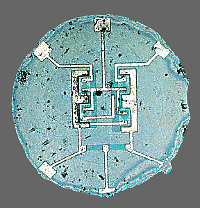
Noyce´s practical integrated circuit, invented at Fairchild Camera and Instrument Corp., allowed printing of conducting channels directly on the silicon surface.(11)
The illustration above shows a technical drawing from the patent Hoerni, Lehovec, and Noyce submitted. In this case it is a so called NPN type of transistor - negative - positive - negative layered. In 1959 they will complete the project successfully. In 1961 the first commercial Integrated Circuit will be put on the market.
Though which team invented the IC is controversial it is generally accepted that both teams at Fairchild and Texas Instruments developed the IC independently.
The first virtual
memory machine, Atlas, is installed in England by Ferranti.
Developed at the University of Manchester under management of R.M. Kilburn.
ALGOL:
ALGOrithmic Language - first called: International Algebraic Language
- is designed.
It took until 1960 before there is a formal syntax, because of that the language will be called ALGOL 60. ALGOL was a generic name for an entire family of higher level computer languages. This language introduced the concept of "block instructions", something we will learn to know as procedures. This concept was picked up by Niclaus Wirth and that lead to PASCAL. Wirth is also member of the ALGOL committee.
ALGOL broke away from the formula processing languages like Fortran. ALGOL however was more popular in the USA than in Europe.
FORTRAN II was
able to handle subroutines and links to assembly languages.
In Japan
a computer based on the principle of the parametron
was produced: HIPAC.
The parametron principle was technological a completely unknown phenomena. (see also 1954 and Masusino and Principle of Parametron). The machine has a magnetic drum as memory.
In Japan the parametron computer
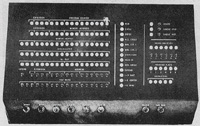
PC-1 is constructed, shown is the machine in the spring of 1958 when it was
operating but not yet completed.
Eiichi Goto is on the right; Hidetosi Takahasi on the left.(19)
The IBM
7090 machine was the the first fully transistorized mainframes built
in series.
This generation is five times faster than their brethren of the same class of computers with vacuum tubes. The original development that started with the Whirlwind project became a reality in 1958 with the installation of the SAGE system for Air Defense at McGuire AFB in NJ. The first effective air traffic control system was operational for the northeastern US.
The recently
founded Control Data Corporation under management of William Norris, created
their contribution to the supercomputer market with the fully transistorized
-- CDC 1604 -- Seymour Cray was the chief architect.
LISP
is developed on the IBM 704 at MIT under John McCarthy(19)
It is one of the languages used in the quest for Artificial Intelligence. The programming language LISP was well suited for manipulating strings or symbols and is called a non-numeric processing language. LISP is an interpreted language mostly used in Artificial Intelligence applications (AI). A feature of LISP is the use of brackets as delimiters. Over the years many versions of LISP will be offered: MacLisp, ZetaLisp, ICI-Lisp, InterLisp. Later students, changed the meaning of LISP, standing for LISt Processing, into "Lots of Idiotic, Silly Parentheses". (20)
Frank Rosenblatt
builds the Perceptron Mark I using a CRT as an output device. (19)
At Bell Labs
the first modulator-demodulator device is developed that became known as "modem".
This modem had a speed of 300 baud(23, 6)
The first database
networking system is on RCA's BIZMAC computer.
The machine could deal with one subject and handle all stored data on that subject. To be able to do that without changing tapes it had had maximum of 200 tapes to store data on.
By this year
over 200 programming languages have been created.(23)

At Poughkeepsie
(USA) engineers of IBM completed the first fully automated
production line to produce transistors.
One year later 1800 transistors per hour will come off the production line and tested at the same time as well.(2)
While there was
a movement towards supercomputers in many companies, IBM announced the availability
of two smaller sized machines for the small user -- the IBM 1401 for the business
user and the IBM 1620 for the scientist.

1401
The 1401 becomes the most popular business data processing machine, and for small universities and colleges. In six years time 10.000 1401 computers will be sold. The minimum memory on a 1401 is 1400 characters. The standard memory is 4000 characters, the maximum memory is 16000 characters. The 1401 does its arithmetic in hardware.
1620
The 1620 is the first computer experience for a many students, as witnessed at the above link. The minimum memory on a 1620 is 20000 digits. The maximum memory is 60000 digits. The 1620 takes two digits to store one alphanumeric character. The 1620 machine is supported by an arithmetic unit that uses a decimal table-look-up instead of binary adders. Initially IBM intends to name the 1620 as the CADET, but when this becomes translated into "Can't Add, Doesn't Even Try" and the name is dropped soon after.(20)
Both machines introduced a character oriented core memory in which "word" boundaries can be defined by the programmer to provide "unlimited precision". Both machines are decimal.
IBM developed
a small nice program for their own employees: SPEAK UP
! It should improve the communication between employees.
The DAC-1 (Design
Augmented by Computers) was created by Don Hart and Ed Jacks at General Motors
Research Laboratory and IBM.
(Not unveiled until the Fall Joint Computer Conference in Detroit in 1964.)(22) It was the first computer aided drawing system.
After
several years of work General Electric Corporation delivers 32 ERMA (Electronic
Recording Machine -- Accounting) computing systems to the Bank of America
in California to rescue the banking industry from being swamped by the rapidly
increasing numbers of checks being used by an ever increasing clientele.
ERMA is based on a basic design by SRI, the ERMA system employs Magnetic Ink Character Recognition (MICR). A special font is developed that made this possible.


This system made capture data from the checks possible and a check handling system was introduced that was not daunted by documents that were not in pristine condition.
The banking industry rapidly became automated, introducing new ways of banking including the ATM and electronic personal banking. On the other hand it was a highlight in the history of computer manufacturing at GE that, with the exception of developing a profitable line of machines for NCR (the NCR 304), never really achieved the status that might be expected of such a financial giant. (20)
The Xerox 914
is the first office copier for sale.
First packaged
software program is sold by Computer Science Corporation.(19)
IBM delivers
the first four models of the first all-transistor computers to United States
Air Force. These are called 7090 series.(23)
Both Texas
Instruments (February) and Fairchild Semiconductor corporation (July) file
for a patent for the process to produce transistors on a flat layer.
This is the process that will take the IC to mass production in about two years time.(3). Both firms engaged in a legal battle that will last through the decade of the 60's until both companies decided to cross-license their technologies.(5)
Fairchild
Camera and Instrument Corp. invented the resistor-transistor logic (RTL) product
on a chip.
Fairchild Camera and Instrument Corp. invented the resistor-transistor logic (RTL) product, a set/reset flip-flop and the first integrated circuit available as a monolithic chip.(11)
Minsky and McCarthy
establish MIT AI Lab
Samuel's checkers
program wins games against best human players
Physicist
Richard Feynman gives a lecture, at the American
Physical Society on 29 December 1959, exploring the idea
of building things at the atomic and molecular scale.
Richard Feynman amazed physicists with his vision of the future. 'Consider the final question as to whether, ultimately - in the great future - we can arrange atoms the way we want; the very atoms, all the way down! What would happen if we could arrange atoms one by one the way we want them?' Feynman was speaking at a meeting of the American Physical Society. The idea of nanotechnology was born. He imagined the entire Encyclopaedia Britannica written on the head of a pin. It will take untill 1990 before engineers of IBM will be able to move single atoms around. (9)
The IBM
700 series was the first to have a build in BIOS, called
IOCS (Input, Output
Control System). This IOCS made it possible to have multiple processes at
the same time. With this setup it became possible to operate a computer at a
distance and exchange data by ordinary telephone line. The first step on the
road to networks
is given!
LINC is the first
"minicomputer" with integral CRT (Lincoln Labs)
The Livermore
Advance Research Computer (LARC) by Remington Rand is designed for scientific
work and uses 60,000 transistors.
William Fetter
of Boeing coined the term "computer graphics" for his human factors
cockpit drawings.(22)
IBM developed
software for the ECHO project, communication via space or satellite transmission.
In the early
60's the flight trajectory of NASA's Saturn was calculated an astonishing few
thousand times by an IBM 7090. That machine could do 22900 calculations per
second. This set the standard in the industry: the number of (floating point)
calculations per second: FLOPS
|
IC classification To bring some order in the micro chips being made in hundreds of different kinds a classification was given to them according to how many transistors were integrated on one single chip: |
Digital Equipment
Corp (DEC) released its first mini computer: PDP-1 priced
at 125,000 to 250,000 US$ depending on the configuration. The first in a family
of computers that became famous. The chief designer was Benjamin Curley
 Since
1952 Grace Murray Hopper (the little lady in uniform) had been developing a
series of programming languages that increasingly used natural language-like
phrases to express the operations of business data processing. FLOW MATIC was
the last of these. Others also had taken on the challenge, including IBM that
produced a language named COMMERCIAL TRANSLATOR. With these languages as a basis,
an industry-wide team -- Conference on Data System Languages (CODASYL) -- led
by Joe Wegstein of NBS (now NIST) developed a new language in a very short time
and created the first standardized business computer programming language, COBOL
(Common Business Oriented Language). For the next 20 years there will be more
programs written in COBOL than any other single language.(20)
Since
1952 Grace Murray Hopper (the little lady in uniform) had been developing a
series of programming languages that increasingly used natural language-like
phrases to express the operations of business data processing. FLOW MATIC was
the last of these. Others also had taken on the challenge, including IBM that
produced a language named COMMERCIAL TRANSLATOR. With these languages as a basis,
an industry-wide team -- Conference on Data System Languages (CODASYL) -- led
by Joe Wegstein of NBS (now NIST) developed a new language in a very short time
and created the first standardized business computer programming language, COBOL
(Common Business Oriented Language). For the next 20 years there will be more
programs written in COBOL than any other single language.(20)
The second of
the mathematical languages, ALGOL 60 was developed, also by a committee. Although
not widely implemented ALGOL became the conceptual basis of many programming
languages thereafter
Mark Rosenblatt
published his results on the Perceptron.
This first working model on neural networks was demonstrated on a MARK I machine. The Perceptron program was capable of recognizing patterns. The demonstration showed that the Perceptron program could recognize letters from the alphabet.
But what Rosenblatt forgot to do was to massage the scientific community into having an open mind to his far reaching ideas. As a result the scientific community reacted not so scientifically and rejected his somewhat controversial ideas. This was a real set back for the budding cognitive sciences(21).
Removable disks
first appear (19)
IBM defines
PL/1 being a combination of ALGOL,
FORTRAN, and COBOL.
The new language is intended to be used to write large application programs
on large systems (meaning: Mainframes).
(23)
Heathkit brought
out the EC1 meant for educational purposes. It was the first Analogue computer
available to the public at an affordable price(25) app. 400
US$. The machine became very popular with engineers and at schools.

The first commercial
modem is marketed: Bell Dataphone 103 with the speed of 300 Bps (bits per second
= apr 30 characters per second ) (8)
PLATO is the
first computer system designed especially for general educational use, in other
words a learning computer. Creating an universal learning computer system will
be the "holy grail" for many scientists to follow.
PLATO I, accommodates only one student, and runs on the University of Minnesota’s ILLIAC computer. It connects a TV display, a specially designed key-set, a storage device and a slide selector to the computer. Later versions will be a multi-user environment.
The following is an abstract from the CBI's Iterations (9)
| In 1959 Chalmers Sherwin, a physicist and Associate Director of the Control Systems Laboratory at the University of Illinois, suggested to William Everett, Dean of the College of Engineering, the possibility of using computers for teaching. Daniel Alpert, put together a group of engineers, educators, mathematicians, and psychologists to discuss the matter. But they could not find an approach that would satisfy all members of the group. Dan Alpert was about to inform Everett of the failure when he mentioned the problem to Donald L. Bitzer, a young assistant in the lab. When Alpert approached him, Bitzer claimed he had already been “thinking about ways to use old radar equipment as part of an interface for teaching with a computer.” |
| It was Bitzer who completed the first version of PLATO, the first computer system designed especially for general educational use. In designing its teaching logic, Bitzer had cooperated closely with his colleague, mathematician Peter Braunfeld. They decided to go against the popular teaching methods: dividing information up into elementary bits for easy storage. Bitzer and Braunfeld adopted a system explored by Norman A. Crowder of the Air Force Personnel Training and Research Center. Crowder adapted a branch programming method over “drill and practice.” This meant that PLATO incorporated course material into larger related conceptual packages. If a student found the material easy or familiar, he or she could “leapfrog” through a course in a minimum of lessons. Students who needed more time and explanations found themselves directed back and forth through the total sequence of lessons until the concept was mastered. |
To get an impression of a version of PLATO running on a PC or Mac http://www.cyber1.org/ (Cyber1.org is a group of people dedicated to the preservation of the world's first computer-based community, PLATO)
At Cornell
University, Frank Rosenblatt builds a computer--the Perceptron--that can learn
by trial and error through a neural network.

|
Last Updated on June 17, 2006 | For suggestions please mail the editors |
Footnotes & References