click on the home button to go to the home page
|
The Industrial Era 1974 - 1975
The Third Generation of computers starts approximately
in this era. These computers are characterized by mainly electronic
models but fully programmable.
Intel's 8080 processor takes the marked by storm, floppy disk is invented, |
pre history | antiquity | pre industrial era | industrial era
| 1947 | 1949 | 1950 | 1952 | 1955 | 1958 | 1961 | 1963 | 1965 | 1969 | 1970 | 1972 | 1974 |
| 1976 | 1978 | 1980 | 1981 | 1982 | 1984 | 1986 | 1989 | 1991 | 1993 | 1994 | 1996 | 2000 |
| 2002 | 2005 |
| Related Articles |
|
| Related Resources |
history of videogames |

 4 January 1974,
INTEL introduces the 8080 microprocessor, an improved 8 bit version.
4 January 1974,
INTEL introduces the 8080 microprocessor, an improved 8 bit version.
This chip has a price tag of "just" 360 U$. The processor contains a Kernel of 75 instructions, the so called micro code. It is ten times as fast as the 8008 with 2Mhz. It addresses a memory of 64.000 bytes. There are 6.000 transistors (3micron) mounted on this chip. (23)
The designers and marketing people are thinking they have given the final solution to the still rising demand for computing power (64Kb address). This monumental mistake will have catastrophic results towards further development of better(faster) chips and software development for the next few decades.
October: Xerox
introduces a new text-editing product: BRAVO.(4)
Digital's first
Large Scale Integration processor, the MPS, is introduced. Digital also announces
LA36 DECwriter II which will become the market standard.(24)
The CP/M(23) (Control Program/Monitor also: Control
Program for Microcomputers) will be designed by Digital Research /John Torode
and Gary Kildall(24)
for the 8080 chip.
In fact it will be the first operating system for that particular micro processor. Many manufacturers of micro computers adopt this system. it has all characteristics of a well designed program in it: it is small and compact, relatively fast and above all stable. The first operating system to run (almost) independent of a platform.
|
The Floppy disk 1974 Just like on a hard disk data are written to a floppy disk in concentric tracks with direct addressable data sectors. That was not possible on other magnetic data carriers like drums. The access time is about 60 milliseconds. The professionals were flabbergasted. Now data could be transported from one mainframe to the other in a simple way. The problem to generate data over and over again for one single task is over. When transferred to a floppy disk this data could be read over and over again without having to run the program again. This means a giant leap in data acquisition and distribution it. The physical volume of data storage drastically went down. On one single floppy disk the equivalent of over 3000 punch cards can be stored. With this invention the user friendliness of mainframes is enhanced. Changes in programs is now a question of changing the data file on the diskette with the help of a word processor and save it again. Then the diskette can be given to the data processing department to have it run or processed. The end of the punch card is in sight It will take more than 20 years before something else will take the place of the floppy disk: CD Rom |
The Z-80, 8 bit processor
is designed by Zilog Corp.
Zilog is founded by former Intel employees that did not get the play room to follow up on their own ideas. The Z-80 is a good alternative for the Intel 8080 and offers various new advantages.
 The March 1974, "QST" magazine, contained the first formally
advertised personal computer: the Scelbi 8H computer based on a microprocessor:
Intel's 8008.
The March 1974, "QST" magazine, contained the first formally
advertised personal computer: the Scelbi 8H computer based on a microprocessor:
Intel's 8008.
Scelbi Computer Consulting - Nat Wardsworth and Robert Findley at Milford Connecticut (USA) - start to sell the first micro computer that is based entirely on a CPU:, de Scelbi 8-H, it uses the Intel 8008 chip. Scelbi aimed the 8H, available both in kit form and fully assembled, at scientific, electronic, and biological applications. Sales price US$ 565 with 1 Kb of internal memory and a cassette tape, with both teletype and oscilloscope interfaces. An additional 15 Kb is available for US$ 2760.
But the customer base is small and due to health problems of the designer the Scelbi never will be a success. But the Scelbi has at least the honor to have been one of the first PC's(25). The company sold about 200 machines, losing $500 per unit until it was taken out of production in 1975.
At almost the same time, Jonathan
Titus produced a widely marketed personal computer kit, named the Mark-8.
The world of personal computing was growing. Intel introduced the 8080 for the purposes of controlling traffic lights, but it was to find fame later as the processor for the Altair. (31)
Motorola introduces the 6800
CPU, an early 8 bits microprocessor that will be embedded in a lot of industrial
devices. The chip is designed by Chuck Peddle ad Charlie Melear.(27)
|
Pioneers now called hackers For the very first computer hobbyists suddenly a vacuum
is filled. The "legion" of amateur programmers just jump
"en masse" on the micro. With the first micro computer coming
to the market it seemed that everything just, as a kind of puzzle,
clicked together. Lack of knowledge was suppleted in a hurricane kind
of speed by computer clubs that grew like mushrooms. These clubs published
newsletters that spread the word. |
The first magazine dedicated
to a specific computer was the Micro-8 newsletter.
John Cocke designs first RISC
machine for IBM Research called the ROMP 801.
In the Netherlands Philips in
cooperation with the state phone company (PTT) are experimenting with video
telephony, an early form of video conferencing(ed).
The devices are developed by Philips at Waalre laboratories and in Leiden at the Dr. Neher labs. The experimental net has 67 users. On the picture is missing the Codal. A big cabinet with electronics to manage the video / telephone connection.

In December
this year Zilog Inc. is founded by Federico Faggin, he was a top employee of
Intel.
Zilog is going to compete with Intel in the production of microprocessors on a chip. (Z80)
First Use of
term "Internet"
appears in a conference paper by Vinton Cerf and Bob Kahn.
|
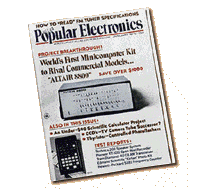
From the Apple II history In this year something important happens in the computing history. At least when you look at the years between 1971 and 1974 as a time of budding computer companies and pregnant of ideas and different hardware designs. In January 1975 the birth of a special case takes place. The announcement on a front-page of a hackers magazine: Popular Electronics.
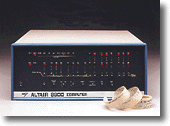
The parent of this baby is MITS inc. and we call her Altair 8800. She is 18" x 17" 7 high and weighs the tremendous amount of 256 bytes ( that is a quarter K).It is said that she is the worlds first mini computer to rival commercial models. The Altair 8800 has a Intel 8080 CPU and is sold for 395 U$ or when you want it assembled 498 U$. |
Ed Roberts (USA) starts
to ship the ALTAIR 8800.
The company is called MITS (Micro Instrumentation and Telemetry, Albuquerque, New Mexico USA). In this year 2000 pieces will be sold, more than any other model.
The Altair is build around the Intel 8080 chip and contains a memory of 256 bytes, a row switches in stead of a keyboard and led that serves as a read out in stead of a monitor. Over 2000 are sold by end of the year. It cost $395 but up to $2000 worth of peripherals were needed to make it go.
The first video terminal VT52l
from Digital Equipment.
Digital introduces DIGITAL's
Network Architecture (DECnet)
Sphere 1 microcomputer used
a Motorola 6800, with 4 Kb RAM, a keyboard, video interface and ROM based monitoring,
all for 650 $
The digital watch boom begins.
Texas Instruments introduces
their scientific calculator.
 Micro-Soft
(6) is founded by Bill
Gates and Paul Allen.
Micro-Soft
(6) is founded by Bill
Gates and Paul Allen. 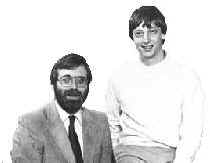 (35) on September 15.
Their first product is a version of BASIC that they sell to MITS who used it in their Altair microcomputers. It is a ROM based interpreted BASIC which will become known as Microsoft BASIC.(24)
In just about twenty years Microsoft will be the software company that will have installed their operating system on 90% of all Personal Computers
The first fractal
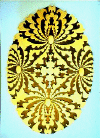
is published by professor Mandelbrot. Below you will find an example of a fractal.
Typically is that a fractal is only a mathematical formulae that can be used
in a program to generate a picture. (more info)
When you enlarge a fractal the pattern will always be the same. At least with the first types of fractals as you see below.
Besides they are also nice to look at. The typical thing of a fractal is that with a simple formula(14) of maybe 100 characters you can display a graphical picture with astonishing depth and width that would normally take more than four megabytes. Most of the effect is done because of alternate mirroring and repeating patterns that seems to grow from one single point into a big rich picture. But see for yourself, admire the mathematical simplicity.
Later on scientists will discover that an entire landscape can be translated in to a series of fractals, mathematical formulas and thus it is possible to shrink the memory requirements in computers and to store images. Apart from compressing techniques that can be used in combination with fractals. Also fractals can be and are used in digital TV sets, or other display devices to optimize and speed up transmissions and display refresh rates.
The
first Flight Simulator - "FS-0" - is
designed
as part of an engineering thesis by Bruce Artwick: "3D-graphics
demo of the simulation of flight on the Apple-II". In 1980 the design
will look like the picture below.
picture courtesy: simflight.comThis will spark an entire new family of software on various levels, gaming and high end professional training for pilots.
Read
on the history of video games
Frederick Brooks
writes The Mythical Man-Month, which describes software development as "the
mortal struggle of great beasts in the tar pits" and advises that adding
more people to a late project only makes it later.
In this year Ian Barron get the
idea that is should be possible to build a new processor that contained all
the properties of a big computer.
This processor should also have the ability to assemble parallel computers. The transputer is born.
But there must also be a new programming language suitable to support both machine language and the user friendliness of a higher level language . The development of a working model will take nine years! To get it in production another two years.
A laser printer
is marketed by IBM.
IMSAI announces
the IMSAI 8080 microcomputer 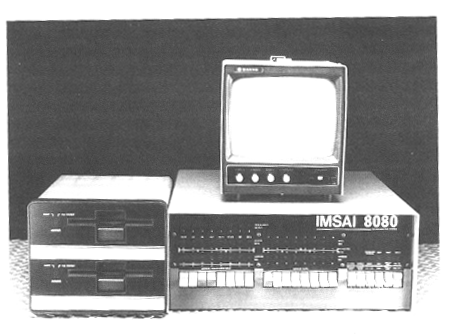
SWTPC
(for Southwest Technical Products Corporation) a designer and manufacturer
of electronic products, many the CPU 6800 computer available in kit form.
pictures courtesy: Michael Holley (c 2005)

As soon as CPU chips became available SWTPC is one of the first suppliers of a computer kit containing the 6800 CPU.
 |
|
|
|
|
Michael Jackson
describes a method to treat a program's structure as a reflection of a problem's
structure, a precursor to the Jackson System Development method.
To bring an
end to the chaos in (software) development a methodology PROMPTII is developed
by a company called Simpact Systems Ltd.
PROMPTII is short for Project, Resource, Organization, Management and Planning Technique. This method will become the basic method of delivering a project within time and budget in Europe. . Prompt eventually evolves to PRINCE, a UK government owned method put in the public domain. Prince and other methods are gaining influence with the years. However even decades beyond this point chaos will prevail in development processes.(5)

|
Last Updated on October 29, 2006 | For suggestions please mail the editors |
Footnotes & References
| 1 | http://iml.jou.ufl.edu/carlson/1970s.shtml |
| 2 | www.vintage-computer.com/1975.shtml; last access 14102004 |
| 3 | ref: Robert S. Jones found on http://www.vintage-computer.com/byte.shtml (last access 16 Oct 2004) |
| 4 | http://zeus.fh-brandenburg.de/history/ last accessed 25 december 2004 |
| 5 | http://www.ogc.gov.uk/prince2/ |
| 6 | Micro-Soft's name will be changed into Microsoft when they register the company on november 1976 |
| 23 | www.intel.com/intel/museum |
| 24 | Marian Bozdoc, Auckland NZ, |
| 25 | BYTE September 1995 p 54 |
| 26 | 8080 CPU Weynrich 1991 |
| 27 | Ken Olsson 1995 |
| 30 | Jack B. Rochester and John Gantz; The Naked PC; PCWorld p67-75, January 1988. Authors of The Naked Computer 1983 |
| 31 | www.computer.org; ACM = American Computer Organization |
| 32 | ATM automatic teller machine, you can now get money outside the bank office building and business hours |
| 33 | PIN = personal identification number |
| 34 | Joe Rigdon, rigdonj@intellistar.net |
| 35 | picture timeline 25th ann. Microsoft |