click on the home button to go to the home page
|
The Industrial Era 1972 - 1973 The Third Generation computers started approximately in this era. These computers were mainly characterized by electronic models and were fully programmable. The first consumer game is published, diagramming techniques for software development were defined, the Hewlett Packard handheld scientific calculator HP35 is now available. |
pre history | antiquity | pre industrial era | industrial era
| 1947 | 1949 | 1950 | 1952 | 1955 | 1958 | 1961 | 1963 | 1965 | 1969 | 1970 | 1972 | 1974 |
| 1976 | 1978 | 1980 | 1981 | 1982 | 1984 | 1986 | 1989 | 1991 | 1993 | 1994 | 1996 | 2000 |
| 2002 | 2005 |
| Related Articles |
| Related Resources |
|
pre history |
 In January Magnavox (USA),
member of the North American Philips group, started selling a game computer
running "Odyssey".
In January Magnavox (USA),
member of the North American Philips group, started selling a game computer
running "Odyssey".
This game was already written in 1968(1) for a mainframe computer by the American Ralph Baer. But as with most advanced ideas it was too early for consumers, not ready at that time to adapt something like a video game. Commercially it meant a disaster and the 100 U$ game console gathered dust.
 On
24 August 1972 INTEL released the 200 kHz 8008, an 8 bit version of the 4004.
On
24 August 1972 INTEL released the 200 kHz 8008, an 8 bit version of the 4004.
The speed was 300.000 instructions per second, could address 16Kb memory. It contained 3500 transistors based on 10 micron technology. It was the first processor able to recognize all characters of the alphabet (letters and numbers).
The processor was originally built for Computer Terminal Corporation,- later called Datapoint. This processor will instantaneously be popular with manufacturers of small computers.

A so called "die" photo of the 8008 processor.
As a result of the speed in development
of minituralization several pocket calculators appeared on the market.
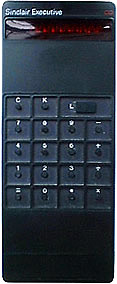
Sinclair's Executive, picture courtesy nvg.org
Clive Sinclair is the first (August 1972) to bring a pocket calculator - the size of a package of sigarets - based on intel's new CPU on the market, only the basic calculations were possible though. Pricing: expensive but lower than others: 79 UK pounds.(9) Power consumption is compared to other calculators extremly low due to a smart power switching technique. The reason why this calculator has a small footprint.
(Texas Instruments brought out the types TI2500, 3000, 3500) but they were still very expensive. All basic functions ( + - / : *) and a percentage key were present. Numbers were displayed by a special kind of LED's, at the same time the reason for high battery consumption. Rechargeable batteries only existed in laboratories yet.
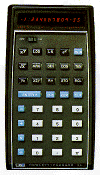
Hewlett Packard released the
first scientific calculator: the HP 35. This machine would wipe out the use
of what is left of slide rulers.
The use of these ancient "calculators" became extinct over night. This calculator had inherited many of the functionalities of the HP 9100A model and it influenced the way mathematicians and engineers would calculate. The HP35 contained 8 IC's and was sold at 395 U$. A lot of money for that time.
Hewlett Packard also wanted to make a move on the business market and brought out the HP 3000 minicomputer.
In
November 29 1972, Nolan Bushnell(17)
and Al Alcorn wheeled a strange apparatus into Andy Capp’s Tavern in Sunnyvale,
Calif.
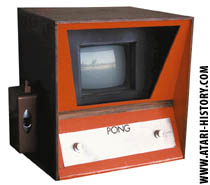
Bushnell, the founder of a new company called Atari, and Alcorn, Atari’s first engineer, set up the cube-like device on a barrel and switched it on.
Two dials were set below glowing rectangles on a screen. The instructions read: “1. Insert quarter. 2. Ball will serve automatically. 3. Avoid missing ball for high score.” Curious patrons began to follow step one.
Not before long, the machine stopped working. Alcorn returned to the bar to check it out. Opening it up, he saw that the side-mounted coin mechanism (from a Laundromat) was jammed—brimming with quarters. Pong was already on its way to being the first commercially successful video game.
The game was called "Pong". A very simple contraption build from 2 knobs, logic modules and connectors for a TV. Pong was the first to combine the critical elements: a simple interface, amusing play and technology that was cheap and easy to manufacture. A decade after that first coin slot jammed, arcades full of Pong progeny were bringing in $5 billion a year. The video-game industry crash of the mid-1980s shook Atari and the rest of the gaming arena. But by that time arcade games had introduced an entire generation to playful computing.

The game looked like playing Ping Pong or "squash". A cursor type of "ball" moved from left to right over the screen and should be hit back by an electronic bat. This bat was controlled by turning the knobs on the game console so the bat goes up or down to "hit" the "ball" (cursor)
Look at the little point at the right hand side: the ball. The two little verticals are the bats. The center line is the net and at the top "row" are shown the points.
To market their machine Bushnell and Alcom founded Atari.
Read
on the history of video games
 One
of the first digital microcomputers available for personal use in the USA was
the MITS (Micro Instrumentation and Telemetry Systems) 816.
One
of the first digital microcomputers available for personal use in the USA was
the MITS (Micro Instrumentation and Telemetry Systems) 816.
Though not equipped with a display or keyboard, the 816 was of considerable interest to the amateur enthusiast who wanted a personal computer. (31) It is also the first computer to use the Intel 8008 CPU.

ARPAnet
is demonstrated at CS-ACM ICCC in Washington (31)

Xerox decides to
build a personal computer to be used for research. The project "Alto",
as it is called, starts in November at the Palo Alto Research Center (PARC).
The result will be the Alto personal computer that uses a mouse, Ethernet, and a graphical user interface. But the machine will not sell many copies because of its extreme high price. Nonetheless it serves its research purposes very well.

Also
at PARC Gary Starkweather presents after 9 months of research the worlds first
working laser printer.
In 1973 there were several models of the laser printers at the center. And in 1977 Xerox will put the first commercial laser printer on the market, the Xerox 9700.(3) Ten years later HP will put the first personal laser printer on the market.
A
Canadian firm Automatic Electronic Systems introduced the world's first programmable
word processor with a video screen" the AES 90. The system used magnetic
disks for storage and a custom built processor.(20)
Wang,
VYDEC, and Lexitron also introduce word processing systems.
MAA (predecessor of Digital
Research) defined together with Intel a new system-programming language called
PL/M (Programming Language for Microcomputers)
to replace assembly-language programming for Intel's 8-bit processors .(16)
The first implementation of
PROLOG (Programming in Logic)
was developed at University by Alain Colmerauer of Aix-Marselle.
It will be the preferred language for the 5th generation of machines. It's a descriptive and declarative language.(16) Prolog will popularize key logic programming concepts.
Dennis Ritchie from Bells Labs
in New Jersey, created C, a programming
language derived from BCLP. To become the most popular language for professionals,
not recommended for beginners.(16)
FORTH
was developed, a medium-level language which used a small number of very brief
instruction words. Forth was originally designed for telescope control and it
would become the standard language used in astronomy.
The first e-mail
program for Arpanet is created by Ray Tomlinson of BBN.(2)
Smalltalk
is developed by Xerox PARC's Learning Research Group, based largely on the ideas
of Alan Kay.
Analytic complexity
theory develops the idea of NP-completeness, showing that a large class of computing
problems, such as the "traveling salesman problem," may be computationally
intractable.
In Wimbledon,
England, an experimental computerized axial tomography imager finds a brain
tumor in a patient.
DEC's PDP 11/45
is introduced, its circuitry encased in chips.
Steve Wozniak
builds a "blue box" tone generator to make free phone calls and sells
them in the dorm at UC Berkeley.
|
In Mr. Jurans own words:
|
 |
At
Xerox PARC, Alan Kay proposes they build a portable personal computer:
the Dynabook
Dynabook will have the size of an ordinary notebook and other features considered standard at the end of the 20th century. But PARC management does not support the idea and the project is put off.
Michael
J. Flynn publishes Flynn's taxonomy.
This is a classification of computer architectures. The four classifications defined by Flynn are based upon the number of concurrent instruction (or control) and data streams available in the architecture:
Later there will be extensions to this taxonomy or classification.(10)
Cullinane,
led by John J. Cullinane, ships IDMS, a network-model database for IBM mainframes.
Jonathan
Titus from Blackburg, Virginia (USA) develops the MARK-8 that was built
on the basis of an Intel 8008(26) micro
processor.
However it is a kit, something you had to build yourself. It had no power supply, monitor, keyboard or housing to be bought separately. The publication in Radio Electronics Magazine described however exactly how to built one.
The machine was programmed by setting eight (flip) switches, one for each bit. One could imagine that programming the Mark 8 is still a time consuming business. However since this computer was geared to the private market and only "computer freaks" or hackers as they were often called did want to buy this computer. The tedious way of programming did not matter. All what counted was that they could do the programming in any way they liked. And the kick of having your own computer was something you could not even start to explain.
Throughout the USA user groups were established and the computer newsletter was a result thereof

Gary Killdahl wrote a simple
operating system in his PL/M and he calls it CP/M (Control Program/Monitor
UNIX is rewritten in 'C' and
becomes available for a large range of different machines.
UNIX will be, because of its translation into "C", a very important factor in the Operating System arena. Almost all computer networks are running on Unix or a variant of it, or something that has the feel and working like UNIX. Two of them are XENIX and Linux. Even micro computers ( ATARI, Commodore Amiga) adapted a form of Unix for these systems.
Paul Fiedl a chemical engineer
at IBM develops SCAMP : the Special Computer APL Machine
Portable(18).
When this machine had interested John Opel (president of IBM) enough IBM would have had un contended supremacy in Personal Computing. The SCAMP had a build in cassette tape drive, a selectric type keyboard (standard keyboard for electric typing machines), 64k memory, and a very small screen. Fiedl even wrote a spreadsheet program for financial modeling, a full three years before VisiCalc came out for the Apple. But Opel thought it to be too complicated and too much ado about!
Again engineers of IBM came with
a new first and equips the newly released IBM
3740 with floppy drives that can read single sided 8" diskettes. The
floppies had twice the capacity of the previous one's of 1971: 250.000 characters.
Sharp (Japan)
develops the LCD (Liquid Crystal Display) technology which
is intended for calculators.
Many years Sharp will stay market leader in this field. The technology is going to evolve to large flat screens for portable computers, but before that will happen another 20 years will pass.
|
The LCD technology This technology is build on the principle that crystals will re-orient in a particular direction when there is electrical current influencing them. It is like when a magnet it set close to a compass needle, the needle takes a different direction. Because of the different orientation of the crystal in a particular LCD cell the screen in that part is no longer transparent. That is how pictures (and characters by the way) are represented or composed. LCD technology will be primarely used in small
screens for gauging equipment, cars, and small appliances.
|
Twenty-seven years after the
unveiling of the ENIAC, and many years after the US Patent Office had issued
the patent for the computer to Eckert and Mauchly, the Judge Earl Larson of
the US District Court in Minneapolis invalidated it.
In a suit between Honeywell Information Systems and Sperry-Rand Corp. regarding the payment of royalties for the use of the concept of the computer, Larson found that Mauchly had derived his ideas for the computer from "one, John Vincent Atanasoff". Neither Eckert nor Mauchly ever gave up their opposition to this finding, believing that their invention was true. For many this was the first time they had heard of the work of Atanasoff, or of the ABC.
John Vincent Atanasoff is recognized as the creator of the modern computer when federal judge invalidates Eckert and Mauchly's ENIAC patent.
Nassi and Schneider develop a
diagramming technique that produces "program structure diagrams" (PSD).
It enhances the analysis methodology for information systems enormously. A NSD diagram is a graphical representation of a small part of the program by means of a limited set of symbolic graphics. The picture below represents a simple NSD diagram.
|
Nassi Scheider diagrams how you use them
|
While the concept of a wide area
network has been effectively developed as a part of the ARPAnet project, the
basis for a "local area net" is Ethernet, created at Xerox PARC by
Robert Metcalfe.
In some ways Metcalfe invents Ethernet three times, the first time as part of his dissertation at MIT (as part of Project MAC), at Xerox PARC, and then again later again at 3COM, a company he founds to exploit his invention.
This protocol manages a Local Area Networks called LAN. And is a design that allows computers to communicate to each other over a local area network.
Internet consists of 25 computers.
Digital developed DEC Data Communication
Message Protocol (DDCMP) as a standard for its future computer-to-computer communications.

example of UPC barcode
The Universal
Product Code (UPC) is developed. This unique code consists of black stripes
of two different thicknesses that can be read by special bar scanners.
The first company to produce bar code equipment for retail trade use (using UGPIC) was the American company Monarch Marking in 1970, and for industrial use, the British company Plessey Telecommunications was also first in 1970. UGPIC evolved into the U.P.C. symbol set or Universal Product Code, which is still used. George J. Laurer is considered the inventor of U.P.C. or Uniform Product Code.(8)
Almost all products in the world will have such a code, even magazines will have a code in the next few years. In shops cashiers and other point of sales ( POS19) units will be equipped with barcode scanners in various forms, portable or built in. Through this the price is always correct ( when the database in the computer is correct at least). As a bonus the client will find much more information on a sales slip than before.
In
France the first complete, not as a do it yourself kit, micro computer is introduced:
the Micral. The machine is designed by François Gernelle

Early model

The design is based on the Intel 8008 running at 500 kHz. But it will not be a commercial success. Micrals most important contribution to the scene is that during a meeting about the computer the term Micro Computer is coined.(20) Gernelle is awarded two worldwide patents on the machine in 1973 but the name "micro-ordinateur" or micro computer is not mentioned in the patents because of its novelty, as the story goes. Micral means "petit" in French slang.
Works begins
on the Transmission Control Protocol (TCP) at a Standford University laboratory
headed by Vinton Cerf.
Alan Kay develops a forerunner
of the PC. His "office computer," based on Smalltalk, employs icons,
graphics, and a mouse.
Trough a technique called large-scale
integration, 10,000 components are placed on a 1-sq-cm chip.
The SCAMP is redesigned
into the IBM 5100 but the price label, the 5100 sold for
between $8,975 and $19,975, and the heavy reliance on APL and BASIC will
not give it a long commercial life30
One of the earliest IBM attempts to move computing into the hands of single users was the "SCAMP" project in 1973. This six-month development effort by the company's General Systems Division (GSD) produced a prototype device dubbed "Special Computer, APL Machine Portable" (SCAMP) that PC Magazine in 1983 called a "revolutionary concept" and "the world's first personal computer." To build the prototype in the short half-year allowed, its creators acquired off-the-shelf materials for major components. SCAMP could be used as a desktop calculator, an interactive APL programming device and as a "dispenser" of canned applications. The successful demonstration of the prototype in 1973 led to the launch of the IBM 5100 Portable Computer two years later. (34)
Robert Metcalfe writes a memo
on "Ether Acquisition," which describes the Ethernet as a modified
Alohanet.
At the University of California, Berkeley, Michael Stonebraker and Eugene Wong use published information on System/R to begin work on their own relational database.
Their Ingres project will eventually be commercialized by Oracle Corp., Ingres Corp. and other Silicon Valley vendors. And in 1976, Honeywell Inc. will ship Multics Relational Data Store, the first commercial relational database. (7)
At
the Waseda university in Japan the Wabot-1
is built.
It is the first full-scale anthropomorphic robot built in the world. It consists of a limb control system, a vision system, and a conversation system. The Wabot-1 is able to communicate with a person in Japanese and to measure distances and directions to the objects using external receptors, artificial ears and eyes, and an artificial mouth. The Wabot-1 walkes with his lower limbs and is able to grip and transport objects with hands that used tactile sensors.(11)
read

|
Last Updated on November 12, 2006 | For suggestions please mail the editors |
Footnotes & References
| 1 | ref: correction by Ted Stahl |
| 2 | http://iml.jou.ufl.edu/carlson/1970s.shtml |
| 3 | http://www.crn.com/sections/special/hof/hof02.asp?ArticleID=38521 |
| 4 | ref http://www.yourdon.com/books/msa2e/CH15/CH15.html
last accessed 20 okt 2004 Nassi-Shneiderman diagrams (sometimes referred to as Chapin charts) were introduced in the 1970s (see [Nassi and Shneiderman, 1973] and [Chapin, 1974]) as a way of enforcing a strict structured programming approach. A typical Nassi-Shneiderman diagram is shown in Figure 15.3. As you can see, the diagram is easy to read. However, one could argue that Nassi-Shneiderman diagrams are just structured English statements with boxes drawn around them. |
| 5 | www.computerhistorymuseum.org for more information; details |
| 6 | pictures and text courtesey of Mr. Warren Juran; http://www.jurancompany.com/firstsearch.html; accessed 24 May 2005 |
| 7 | source: http://www.computerworld.com/databasetopics/data/story/0,10801,70102,00.html; last accessed 26 september 2005 |
| 8 | The first patent for a bar code type product
(US Patent #2,612,994) was issued to inventors Joseph Woodland and Bernard
Silver on October 7, 1952. The Woodland and Silver bar code can be described
as a "bull's eye" symbol, made up of a series of concentric circles.
ref: http://inventors.about.com/library/inventors/blbar_code.htm On October 20, 1949, Woodland and Silver filed their patent application for the "Classifying Apparatus and Method", describing their invention as "article classification...through the medium of identifying patterns". |
| 9 | http://www.nvg.org/sinclair/calculators/executive.htm |
| 10 | www.wikipedia.org; http://en.wikipedia.org/wiki/Flynn's_Taxonomy accessed 20060620 |
| 11 | http://www.androidworld.com/prod06.htm last accessed 20061111 |
| 16 | Marian Bozdoc, Auckland NZ, www.bozdoc.f2s.com (dead link) |
| 17 | Nolan Bushnell (Weyhrich 1991) |
| 18 | APL = A Programming Language |
| 19 | POS = Point of Sale; cashier or counter in a shop |
| 20 | Ken Olsson 1995, 2000 |
| 21 | MIPS = million instructions per second, long this standard will be used to indicate the speed of a processor. Until the speed of the processor produces unrealistic numbers; this plays begin 1990's. |
| 22 | Where to find what in the computer's memory; in other words on what location (read address) can a particular data or computer instruction be found |
| 23 | 1976 C.P.A./M TechKnowlogy 1992 |
| 24 | Automatiserings Gids 12/08/94 |
| 25 | BYTE September 1995 p 54 |
| 26 | 8080 CPU Weyhrich 1991 |
| 27 | Ken Olsson 1995 |
| 28 | H. Edward Roberts and William Yates, "Altair 8800 Minicomputer, Part 1", POPULAR ELECTRONICS, January 1975, pp. 33, 38. The article is interesting also in some of the terminology that is used. The Altair is described as having "256 eight-bit words" of RAM. Apparently, the term "byte" was not in common use yet. |
| 29 | Steven Levy, HACKERS: HEROES OF THE COMPUTER REVOLUTION, pp. 187-192. |
| 30 | Jack B. Rochester and John Gantz; The Naked PC; PCWorld p67-75, January 1988. Authors of The Naked Computer 1983 |
| 31 | www.computer.org; ACM = American Computer Organization |
| 32 | ATM automatic teller machine, you can now get money outside the bank office building and business hours |
| 33 | PIN = personal identification number |
| 34 | http://www-03.ibm.com/ibm/history/exhibits/pc/pc_1.html |