|
The History of Computing Project Is a collaborative effort to record and publish the history of the computer and its roots in the broadest sense of the word. Its founding principle is to work together in as open and
cooperative a manner as possible in producing a definitive history and
historical archive of computing. Explicit goals are to provide an accurate and balanced history with input from as many sources as possible and maximum access to the results worldwide. The contents of this site is provided under the The Project is incorporated as a nonprofit organization: History of Computing Foundation |
See also our page on how to cite us.
The project's origin lays in 1986 when somebody asked the
original author (Cornelis
Robat) during a course he gave:
a kind of "101
introduction to computing".
At that time he did not have a solid answer. Because who thought
about that in those days. Computer people were all very, very busy to keep
up with things changing around them at the speed of light.
The computer revolution hadn't really started yet! Let alone that someone
was interested in the history of it, there was no history.
At a first attempt to reconstruct the History of Computers a rough concept of four pages were created. It was in the form of a hand out distributed during "introduction to computers" sessions.
Though as a 101 in computer history it might have served its purpose it did
not satisfy one's curiosity and of course there where many blank spots. This
needed a more serious approach and with each 101 session the handout grew.
Then the handout grew into a full fledged (private) project that completely
ran out of hand. At first the information was gathered from all possible sources.
Even from children’s magazines and movies. Later on books were bought
or borrowed, museums were visited and in the mid 1990’s the Internet
proved to be an invaluable and inexhaustible resource.
Until 1993 the material served as a basis for lectures and other presentations,
those who wanted a copy of the material got one because it was just about
50 pages.
But the next two years the amount of information quickly became too much to
print (+500 pages). Also people started to ask for pictures and other illustrations.
Thus from 1995 pictures and graphs were added.
Next issue: publication.
Publication of the story was done by zipping the file and copy it on a 720Kb
floppy. It was sold for a nominal price on the HCC fair in the Netherlands.
That proved to be a success, also because a diskette is small and very portable.
It was taken for granted that everyone had a word processor and was able to
print their own copy of "the history of computing". At that time
the project was called "the chronology of computers" and the language
used was Dutch.
From 1996 other people started to cooperate with this project and to not let
them down the "history" had to be published in some form other then
a diskette. The question however was not when but how. Some attempts were
made to spread it via BBS systems, and the story was gladly accepted by the
BBS sysop's, but that did not reach enough people in one time.
In 1997 the first attempt was made to publish the information via the internet on a web site and a few chapters were placed on the web (www.computermuseum.nl) Somehow the webmaster ran out of spare time and quit her job uploading the material. Now there was a problem and people started to ask questions. Also the scope of the project was widened quite a bit. Mainly because of the web's possibilities where there is virtually unlimited space. The chronology became a part of the whole and other sections like biographies, hardware and reference pages were added. Followed by a reference section containing: "sciences", "technology" and more sections that were needed to support and explain the history of computing. Then the project was renamed into:
the History of Computing project
Soon it was no longer possible for one single person to keep this project going. The project became too large and something drastic had to be done. The maximum what could be done was done and a backlog of updates was the result. At the end of 1999 after talking to some friends it was decided to set up a foundation that could take care of the job and ensure the projects continuity.
In 2002 the information fitted in no way on a floppy anymore, even in compressed form. And we started to distribute our material on a CD ROM. Ever since, this product became more sophisticated by the year: packaged with a professional full color cover and print on the CD. It now is an independent product and sold via the internet or on fairs. See our e-shop to obtain a copy.
The History of Computing Foundation officially was founded in April, 2000 by Cornelis Robat, Fannie de Boer and JanWillem Jekel
Since 2004 there are about 14 persons involved with the project; the continuity of the project is secured. But as in any organization some leave with our gratitude and some are joining our little organization, thus we keep looking for more colleagues.
If you want to join us, in any capacity please 
To finance the foundation the History Project primarily relies on seed funding from Robat in't Veld Formatie, an independent software developer and systems architect. We have assembled a Board of Directors and incorporated as a non-profit corporation, and are seeking various kinds of support, from funding, to equipment, to volunteer time.
A number of organizations and people have provided crucial cooperation to the Project, however, editorial control is independent to separate the output of the Project from any institutional interests.
Since 2002 we started to distribute a CD ROM packaged with a professional full color cover and print on the CD. It is sold via the internet or on fairs. See our e-shop. The revenues cover part of our expenses.
CD via PayPal
Since 2004 we allow paid advertisements on our site in the form of unobtrusive expressions, indicating the add. This we keep on a low level, again just to cover our expenses. Mail our treasurer for more info.
In 2005 we published a "Friend of the foundation" page
and for the time being (for no special reasons) we keep that on a low profile.
Please contact
us for details or go to the Friends of the Foundation page  if you want to support the Project.
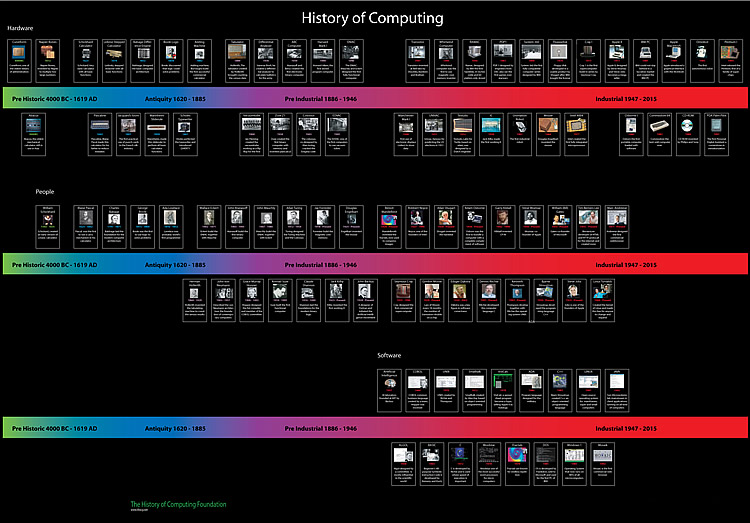
In 2006 we developed a large poster (100 x 70 cm) to display the main historic events of the history of computing. This poster has been published in November 2006. See our e-shop.
Some people ask us how do and did we get all this information. Well the answer
is simple: from any available source.
And luckily the subject of computer history is growing immensely in popularity.
Even books are printed on specific parts of the computer history. Or are trying
to give an overview on a particular time section.
Most are dealing with periods from 1940 and up, which is a pity. But still it
is nice reference material for our editors of course. (See
the bibliographical section of this project)
And there are thousands of sites all over the planet created by people and companies
that describe their private collections or histories. That too is a very valuable
source for us; not only for information and specs but also for the needed pictures.
(See list of interesting sites).
Since 1994 the Internet is a popular source. And all relevant information from
history, museum, or collection's sites found is downloaded into our digital
reference library. The information is reformatted into our standard format and
when relevant put onto our project's site, of course with the proper references
and after asking permission when the information is copyrighted (indicated or
not).
Why downloading all, you would ask?
Because many sites just vanish after 3 to 6 months. Some sites are moved without
notice, as is their good right. And some sites stay on for a longer time, and
then vanish just as well. There are not many sites that stay on for more than
3 years. This is the reason why we download everything of interest or historic
value, in order to guarantee the preservation of the information. In that way
we created a large database which, someday, will come online as well.
To read all the available information in one single session is not something
you do over night without missing a lot.
But to make it suitable for on line reading we divided the whole story into
small easy to digest portions with hyperlinks connecting the various subjects,
so come back often.
There is also a site map for an easy overview
on the site. See also our "how to use this site "
page.
Please be aware that some sections, chapters or pages are not quite finished,
due to limited resources, a backlog in updates or information that is not
yet processed.
See also "how to cite us" for bibliographical info.
The history of computing foundation is collaborating with other organizations in the production of a history CD which is available via this site for 10 EUR. This CD contains much more than available via the site. When interested please go to our on line shop
If you want to use the information for non commercial purposes it is granted beforehand under the Open Content License
In all cases were we cite copy righted material the individual owners are referenced.
In case of doubt we use the ODL rules as suggested by that organization. Mostly
the footnotes at the bottom of each page will point you towards the authors.
Material that was found and used on our site and found on several other sites
as well without reference to who owns it, the information is used with reference
to the URL where we found it. In our view this does not mean that the owner
of that site can claim the copyright to that information neither can we. By
inserting the reference we just want to indicate where the material came from.
And in the same time point you towards a site that might be of interest too.
In all other cases the foundation assumes copyrights on all material found on
this site.
For a more elaborate explanation on copyrights go to our Copyrights
statement. For copyright on pictures read this page.
By all means NO! Mainly because data on a certain period is still missing,
or contributors omitted some info not known at the time they have sent us their
material.
Another lacuna in our story is for example computer history from Russia, China
and Japan. There is little known about these areas. Though in the last few years
information is slowly coming on line. And what happened in Africa and South
America in this field. No, the story will never be complete.
The above is the main reason that this material is published in electronic form
and not as a hardcopy; that would be a book of some 2000 pages thick. ;=) So
it is relatively easy to make corrections and publish it, just costing a few
bytes on the internet.
Gladly! Time is our biggest enemy; a lot of material is just thrown away by
people not realizing the value of what they are throwing away. That is why your
help is needed to make this story more complete and document the computer history
in a proper way.
How?
But remember when you send text, corrections, pictures or anything, we must have the name of the originator: you or a web site's url, or book, paper, magazine you got it from. We love to give credits and honors.
Don't hesitate to contact us. You'll be receiving an answer within a few days.

|
Last Updated on 18-Apr-2007 | For suggestions please mail the editors |
Footnotes and references
| 1 | ODL - Open Document License / Open Content License http://opencontent.org/opl.shtml |