


|
The Industrial Era 1965 - 1968 In this part the emerging telecommunication is one of
the more important events. |
pre history | antiquity | pre industrial era | industrial era
| 1947 | 1949 | 1950 | 1952 | 1955 | 1958 | 1961 | 1963 | 1965 | 1969 | 1970 | 1972 | 1974 |
| 1976 | 1978 | 1980 | 1981 | 1982 | 1984 | 1986 | 1989 | 1991 | 1993 | 1994 | 1996 | 2000 |
| 2002 | 2005 |
| Related Articles |
|
| Related Resources |
history of video games |
 The first glass
fiber cables are being used in a punch card reader from IBM.
The first glass
fiber cables are being used in a punch card reader from IBM.
 While some companies
were developing bigger and faster machines, Digital Equipment Corporation introduced
the PDP-8 in 1965, the first TRUE minicomputer.
While some companies
were developing bigger and faster machines, Digital Equipment Corporation introduced
the PDP-8 in 1965, the first TRUE minicomputer.
The PDP-8 had a minuscule instruction set and a primitive micro-language, and excellent interface capability. Thus the PDP-8 became used extensively as a process control system, including interfacing to telephone lines for time-sharing systems.(19)
...by 'hypertext' I mean nonsequential writing - text that branches and allows choice to the reader, best read at an interactive screen. Do you want to know |
 |
 |
At the University
of Belgrade, Rajko Tomovic makes one of the earliest attempts to develop
an artificial limb with a sense of touch. |
|
 |
 Compatible Time-Sharing
System (CTSS) allows several users simultaneously to use, or share, a single
computer.
Compatible Time-Sharing
System (CTSS) allows several users simultaneously to use, or share, a single
computer.
At MIT this is noted by J.C.R. Licklider, director of information processing research at ARPA, who believed that the technology had useful applications in the agency. He arranged to sponsor Project MAC (variously interpreted as "Machine Aided Cognition", "Minsky Against Corbató" and other names) that would take the next logical stage in the development of time-sharing to produce a system known as "Multics". Choosing a GE 600 series machine as the basis for the development, MIT was joined by GE and AT&T Bell Laboratories to produce a general-purpose, shared-memory multiprocessing timesharing system.(19)
Maurice Wilkes develops
the first cache memory chip used in mainframe and minicomputers.
IBM starts shipping
the 360 computer family.
The series name 360 is derived from the compass of 360 degrees. This indicated that this family of computers were all compatible within the 360 series. In this period of time (plug)compatibility was a revolutionary insight of the developers to cope with the industrial malaise of trying to get computers to talk to each other. Without using a translation table or rewriting software that was nearly impossible, at this time.
The CTSS (computer
time sharing system) operating system is introduced.
Fuzzy Logic designed
by Lofti Zadeh (University of Berkeley, California), it is used to process approximate
data such as 'about 100'.
Moore is widely known
for "Moore's Law,"
in which in 1965 he predicted that the number of transistors the industry would
be able to place on a computer chip would double every year. In 1975, he updated
his prediction to once every two years. (14)
 |
Texas Instruments
is Founded
The acoustic modem
is strongly improved by John Green at Stanford
university. His modem improves the quality of computer networks because it now
can detect separate bits that have been sent from long distances. So far only
short distances were possible, within a building for example
Steven Gray founds
the Amateur Computer Society and starts publishing the Amateur Computer Society
ACS Newsletter issue 1 appeared in August 1966.
This example will be followed by many computer hobby clubs all over the world and will be the most important medium to share information for time to come. Some of these newsletters will become regular magazines other will disappear in a few years. Some say that by founding the ACS to be the birth date of personal computing. (3)
First WAN experiment
(ARPAnet) (13)

The hand-held pocket
calculator is invented at Texas Instruments, Incorporated (TI) in 1966 by a
development team which included Jerry D. Merryman, James H. Van Tassel and Jack
St. Clair Kilby.
In 1974 a basic patent for miniature electronic calculators has been issued to Texas Instruments Incorporated. The patent is for personal-sized, battery-operated calculators which have their main electronic circuitry in a single integrated semiconductor circuit array, such as the popular "one-chip" calculators. (1)
|
 |

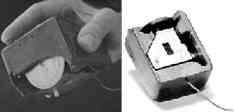

On June 21, 1967, Douglas Engelbart applies for
a patent on his X-Y Position Indicator for a Display System, now better known
as the mouse.
He started research for the mouse in 1963 to come up with a prototype in 1965 .(3) In 1968 he will perform a demonstration to show the mouse in its context: a human computer interface. In 1970 he will receive the patent.
The first Random Access
Memory - RAM - chip of 256 bits is developed by Fairchild Semiconductor
Inc. and will be announced in 1970. This chip contains over a thousand transistors.
A dynamic memory cell
is being built into a chip by IBM. This means that now a bit only needs one
transistor. And as a result the densities on a chip can be drastically expanded.
 A team headed by David
Noble from IBM starts the process of developing the first floppy disk.(3)
A team headed by David
Noble from IBM starts the process of developing the first floppy disk.(3)
Two years later it will be used in IBM's System/370 mainframe machines to replace the much slower paper tape. The read only floppy will contain a program called Initial Control Program Load (IPL) (13) such a program is needed to boot a mainframe or a section there off.
The first office calculator
is now marketed: ANITA MARK 8 and is designed by Norman
Kitz.
In 1967 the LOGO "turtle"
was born. Seymour Paper designed the LOGO computer language as a learning tool
for children.(3)
Grace Hopper becomes
project manager of a military work group that eventually will create the computer
language ADA. An homage to lady Ada
Lovelace.
Barclays Bank in the
UK claims to have installed the first cash dispenser in
the world in June 1967.
This machine operates very different from today’s devices (ATM). There are no magnetic cards; customers are issued with paper vouchers which are inserted into the machine which retains the voucher, and dispenses a single £10 note. Other banks use machines which accepts thin plastic cards; these are returned to the customer through the post after processing so that they can be used again. The dispenser machines are far from reliable.
Andreas van Dam completes
the Hypertext Editing System, a program that allows non-sequential access to
the various parts of a document.(13)
IBM releases the 360/91
machine and introducing the concept of pipeline processing.
This improves the performance of a computer by 33 %. The pipeline is the computer equivalent of the assembly line.(13)
Development of Arpanet,
forerunner of the Internet, begins with U.S. Defense Department funding.
The first ATM hits the streets at
Barclay's Bank in London.
The Garmisch Conference in Germany marks a turning
point in software development.
At the conference scientists, engineers and industry leaders, discuss the problem that software developers are unable to cope with the advances in computer hardware. Here the term "Software Crisis" is used for the first time.
A prime example of software getting over complicated:
IBM's operating system OS/360 is riddled with errors. To such a degree that it failed to operate properly and caused machines to crash for more than 4 hours.The conference results in rough guidelines that eventually will lead towards a structured design methodology. That in its turn will yield fewer errors in software.(20)
Douglas C. Engelbart
publicly demonstrates the mouse.
It is a device that he had been thinking about and working on for more than a decade.
(15)
He also demonstrated video conferencing and hypermedia. Those "inventions" weren't designed to make money or create a product. Rather, they were part of Engelbart's desire to "find much better ways for people to work together to make this world a better place."
During that landmark demonstration Douglas C. Engelbart, of the Stanford Research Institute, demonstrates his system of keyboard, keypad, mouse and windows at the Joint Computer Conference in San Francisco's Civic Center.
(15)
He demonstrates the use of a word processor, a hypertext system, and remote collaborative work (later coined as: "teleworking") with colleagues. (3)
But Engelbart did not realize that however useful his ideas were, his machines and software looked to the audience as coming from the far future. And when asked for a price later on, the company he was paid by, set it much too high. It meant the instant death for his project.Invited by Rank Xerox, Steve Jobs of Apple inc. studies the ideas and goes head on to develop the Lisa (also much too expensive) and MacIntosh (expensive but affordable) Both machines based on the ideas he saw at the Palo Alto Research Center (PARC).
The first machines
based on the IC technology are being sold to the general public.
IBM uses in their new
/360 systems CACHE memory, a super fast ram.
This memory showed to be 12 times as fast as the standard magnetic core memory, the average access time was 80 ns. Very fast for this period.
IBM offers the IMS
hierarchical database for System/360 mainframes

Gordon E. Moore,
Robert N. Noyce en William Shockley are leaving Fairchild and
establish Intel (18.07.1968).
The first working model
of VIRTUAL REALITY is ready.
CMOS
- Complementary Metal Oxide Silicon - is developed.
This technology uses less power than the standard transistor technology. Because of that these chips are very suitable for portable computer systems that run on batteries:
- because the batteries in portable systems will last longer;
- the limits of miniaturization are almost reached because of heat problems were partly solved by this new technology
But it will take another 25 years before this CMOS technology really takes off.
Commodore markets one
of the first electronic calculators. These machines were heavy, clumsy and could
only do the four basic calculations: ad, subtract, multiply, division.
 Hewlett-Packard announces
their HP 9100A series calculator with CRT displays selling for about
$5000 each (21)
Hewlett-Packard announces
their HP 9100A series calculator with CRT displays selling for about
$5000 each (21)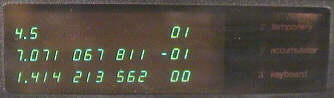
In 1955,
during the development of the programming language FORTRAN,
Harlan Herrick had introduced the high level language equivalent of a "jump"
instruction in the form of a "GO TO" statement.
In 1968 Edsger Dijkstra laid the foundation
in the march towards creating structure in the domain of programming.
He writes not a scientific paper on the subject, but instead a letter to the editor entitled "GO TO Statement Considered Harmful". (Comm. ACM, August 1968) The movement to develop reliable software was underway. (19)
Arthur C. Clark introduced
HAL, the computer of the future in the movie "2001: A Space Odyssey".
the design is based on the artificial intelligence proposals of I.J. Good (a member of Bletchley Park) and Marvin Minsky. Supposedly HAL was a monosyllabic cipher of IBM! (19) It is also Clark who published the idea of satellites in space (earth orbit) for communication.
Computer Science Corp.
becomes the first software company to be listed on the New York Stock Exchange.(13)


COBOL is now officially
defined by ANSI.(13)
First PhD in computer
science achieved by Wexelblat at University of Pennsylvania
One of these famous quotes "But what... is it good for ?" Indicating at the use of a Personal
Computer. |
|---|

|
Last Updated on November 10, 2006 | For suggestions please mail the editors |
Footnotes & References

