


click on the home button to go to the home page


|
The Industrial Era 1947 - 1948 The First Generation of computers start approximately in this era and computers were characterized by electromechanical mechanisms and partly programmable. In this chapter the transistor will be developed and the first stored program computers come on line |
pre history | antiquity | pre industrial era | industrial era
| 1947 | 1949 | 1950 | 1952 | 1955 | 1958 | 1961 | 1963 | 1965 | 1969 | 1970 | 1972 | 1974 |
| 1976 | 1978 | 1980 | 1981 | 1982 | 1984 | 1986 | 1989 | 1991 | 1993 | 1994 | 1996 | 2000 |
| 2002 | 2005 |
| Related Articles |
 buy our CD for easier off line browsing |
| Related Resources |
|
 ISO
is founded. The International Standards
Organization will play an important role in standardizing programming
languages and many other generic computing related subjects like operating
systems.
ISO
is founded. The International Standards
Organization will play an important role in standardizing programming
languages and many other generic computing related subjects like operating
systems.
The
first generation of modern programmed electronic computers was built in 1947.
This group included computers using Random Access Memory (RAM), a form of memory
designed to give almost instantaneous access to any information stored in memory.
Physically they were much smaller than the ENIAC, about the size of a large
piano and used only 2,500 electron tubes. Where the ENIAC
needed over 18,000. This group of computers included the Manchester
MARK-I, EDVAC and UNIVAC,
the first commercially available computers.(16)

Fred Williams an English
professor, developed in cooperation with Tom
Kilburn, the first Random Access Memory - RAM - the "Williams Tube".
which becomes a working model late in this year. Its first practical use will
be for the Manchester MARK-I
computer in 1948.
F.
C. Williams, Max Newman and others build the Manchester Mark I computer
known as the MADM. An electronics firm, Feranti, will build several Mark I machines.
Alan
Turing publishes an article on Intelligent Machinery which launched Artificial
Intelligence outside of the science fiction arena.
The Association
for Computing Machinery ACM
is formed.
The FBI estimates
the average computer fraud at $650,000 for a total of $3 billion to $5 billion
per year. The average value of fraud in financial institutions is $1.5 million.
(27)
Professor
Maurice Wilkes begins work
on the EDSAC Electronic Delay Storage Automatic Computer at Cambridge. The EDSAC
becomes operational in 1949 and will be the first computer to actively utilize
the stored-program concept. The EDSAC uses 3,000 vacuum tubes.
In January, Northrop
Company produces a Digital Differential Analyzer DDA.
July, Howard
Aiken and his team complete the Harvard Mark II, which is now operational. (25,
26)
August 18 Hewlett-Packard
partnership Bill Hewlett and Dave Packard becomes incorporated.
October 9, Northrop
Aircraft Company sings a contract with Eckert and Mauchly's company Electronic
Control Company to build the BINAC Binary Automatic Computer.
In October,
the directors of J. Lyons & Company, a British catering company famous for
its teashops but with strong interests in new office management techniques,
decide to take an active role in promoting the commercial development of computers.(23)
Four years later in 1951 this effort will result
in the LEO I the first computer to run commercial software.

December, The
Electronic Control Company is refounded as the Eckert-Mauchly Computer Corporation.
John Mauchly chooses the name "UNIVAC" Universal Automatic Computer
for his company's product. The UNIVAC was first sold in 1951.
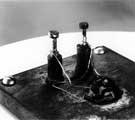
 December 16, the
Invention of the Transistor at Bell Telephone Laboratories, USA, by William
B. Shockley, John Bardeen and Walter Brattain. On December 23, Bell Labs management
is informed by Walter H. Brattain,
William Shockley and John
Bardeen that they have developed the first transistor. (27,
25) . On 16 December 1947 the three showed their invention
at the laboratories to a small public. Bell laboratories patents the transistor.
December 16, the
Invention of the Transistor at Bell Telephone Laboratories, USA, by William
B. Shockley, John Bardeen and Walter Brattain. On December 23, Bell Labs management
is informed by Walter H. Brattain,
William Shockley and John
Bardeen that they have developed the first transistor. (27,
25) . On 16 December 1947 the three showed their invention
at the laboratories to a small public. Bell laboratories patents the transistor.
This invention earned the three engineers the Nobel price(17) in 1956.
 |
 |
 (17) |
The transistor preludes the Second Generation and following generations of computers.
But much more research was needed to put the transistor into production what will take no less than six years to achieve that. (1) The small size, high yield, low heat production and the low price will guarantee the success of the transistor that will make computers another 1000 times faster than those on the market in this period.
How the name "transistor" came about
As each invention needs a name Bardeen and Brattain wanted a name that reflected the terms "varistor" and "thermistor". But they couldn't find a convenient name. They went to talk to J.R. Pierce. And the latter realizes that the device functions like a vacuumtube. After a short reflection he mentions the two primary properties of the vacuumtube: transconductance and, a moment later resistance. Then he murmured : "TRANSISTOR".
- This is it, the word we need cried Brattain.source: Robert Ligonnière in www.ordiworld.com
1948
The US military
is now informed about transistors, since they are paying for the bills. As they
do with many other research groups in the USA. That developments sometimes do
not always have peaceful effects is a natural by-effect to their kind of business.
It is undeniable that because of this lavishly high level of military funding
developments in (digital) computing are spurting ahead. Of course this does
not justify the war machines, or at least the use for that purpose.
Two German
scientists Herbert Matare and Heinrich
Welker invent parallel to Shockley and Brattain the junction transistor.
They work for the Compagnie des Freins et Signaux Westinghouse in France.
The patent is submitted 18th August 1948 and granted on 11 june 1952 under Brevet
d'Invention (patent) 1.010.427 of the French patent buro. (10)

(24)
Read on
transistors.
on
transistors.
|
Burning out Computers so far mentioned are known as the first generation of computers. They were huge and needed often more than one floor of an average large building. Several thousands of vacuum tubes were mounted inside the computers, generating a tremendous heat. The disadvantage of computers running in this period was that they only worked correctly for a few hours in a row. This was caused mainly because of the poor quality of the tubes and the heat that was generated inside the machines didn't do the tubes good too. Tubes therefore easily burned out because of the heat and had to be replaced quite often. All computers started to work following the binary principle. Each tube
stood for "true" (1) or "false" (0). The computer
had to work through a series of tubes to execute an instruction from the
program and one can imagine that when a few tubes burned out the machine
would not work properly. A simple example is the ASCII alphabet invented
by a group of engineers (amongst whom Bob
Bemer) at IBM in 1963 were each character is defined by a combination
of zero's and one's.
|
January,
the magnetic drum is introduced, invented in 19547 by Andrew Donald Booth, as
a low energy device that will replace the Williams Tube in another few years.
But the magnetic drum, which is two inches long and two inches wide and capable
of holding 10 bits per inch.(27), is still very unreliable
and prone to crashes.
 January
24, the SSEC (Selective Sequence Electronic Calculator), using both electronics
and relays, is dedicated by T. J. Watson, Sr. IBM at its World Headquarters
in New York. (26, 27)
January
24, the SSEC (Selective Sequence Electronic Calculator), using both electronics
and relays, is dedicated by T. J. Watson, Sr. IBM at its World Headquarters
in New York. (26, 27)
27 January; IBM shows the SSEC to the public in New York. Remarkable is that "C" does not mean 'Computer' but 'Calculator'. (SSEC = Selective Sequence Electronic Calculator) This indicates the difference between these two. The SSEC is the first calculator to execute commands sequential and is able to change the program depending on the results it produces during its processing. The SSEC is 250 times faster then the MARK I, but the machine still contains 12.500 tubes and 21.400 relays and is 36 meters long. Generating a lot of heat and noise. The development cost over one million US$ but IBM put the machine at the disposal to scientists for free(7) The SSEC was set up around the periphery of a 60 foot by 30 foot room.
 IBM
brings out the IBM 604 model that contains only 1400 tubes. This machine contained
over 1400 vacuum tubes and had 50 decimal units of storage. It is the first
computer able to modify a stored program. This is the first machine to feature
FRU (Field Replaceable Units), which cuts downtime as entire pluggable boards
can simply be replaced instead of troubleshot.
IBM
brings out the IBM 604 model that contains only 1400 tubes. This machine contained
over 1400 vacuum tubes and had 50 decimal units of storage. It is the first
computer able to modify a stored program. This is the first machine to feature
FRU (Field Replaceable Units), which cuts downtime as entire pluggable boards
can simply be replaced instead of troubleshot.
This one works relatively slow and is capable of just about 70 program steps.
The marketing analysts of IBM estimate the market at 75 pieces. But before years
end over 5.600 are installed. In 1974 more than 400 of these machines will be
still in operation!(7)
Robert Metcalfe
of Xerox PARC (Palo Alto Research Center) develops the ethernet protocol for
the first local area network (LAN). (t)
IBM is the
first manufacturer that translates machine maintenance into a modular system.
No longer vacuum tubes or other parts are replaced piece by piece but the machine
is assembled from modules. When a tube burns out a complete module is replaced
not the tube alone. This means repairing computers in minutes and not hours
as before. Back in the workshop maintenance engineers can look for the error
by using reference computers. They do that by replacing the components one by
one and look what goes wrong. The computer at the customers site is of course
already up and running again. This saved a lot of money and guaranteed a high
"up time"(11) as
system engineers like to say.

|
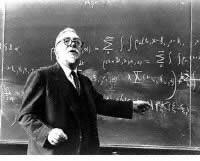 |
Norbert Wiener (USA) publishes his book "Cybernetics, or Control of Communication in Animal and Machine". This book is still one of the standard works in the field of Cybernetics.(3) |
|
 |
Alan Turing designs together with a few of his colleagues in the USA a theoretical computer called: ACE - Automatic Computing Machine. A universal calculator(12). But it will only exist on paper because it will never be build.
|
|
An Wang invents the computer memory core. It will take him about three years to come with a marketable product. |
 (8) (8) |
Richard Hamming
devises a way to find and correct errors in blocks of data. The Hamming code
is subsequently used in computer and telephone switching systems.
A contract
is drawn up between Eckert-Mauchly Computers and the U.S. Census Bureau for
the production of the UNIVAC. (27) This effectively saves
the company from bankruptcy since both, Eckert and Mauchly, are neither good
salesmen nor management types.

The first
Curta handheld mechanical calculator is sold. The Curta computed with 11 digits
of decimal precision on input operands up to 8 decimal digits. The Curta was
about the size of a handheld pepper grinder.
On 21 June
(UK) the first programmable computer at Manchester University, runs its first
program written in binary form by Prof.
Tom Kilburn.

At the Cambridge
university the EDSAC (Electronic Delay Storage
Automatic Calculator) is designed and built by Maurice
Wilkes and F.C. Williams, and the staff of the Mathematical Laboratory at
Cambridge University. The machine is inspired by the Univac
The machine has acoustic memory storage tubes, oscilloscope displays and contained a so called library of subroutines designed by Wilkes and Wheeler. This library consist of small programs that are labeled subroutines. Probably this was the first attempt to create a so called Kernel(2). The EDSAC is considered to be the first full-scale stored program computer.(18) Most importantly it is the first computer that can store not only data but any user program in electronic memory and process it at electronic speed.(22)
Program and data both modifiable in storage, as suggested in Zuse's 1936 patent application but Zuse himself did not implement this technology in his Z1 Z2 and Z3 models.(21)
It is the first machine that has all the components now classically regarded as characteristic of the basic computer.
July 21 SSEM,
Small-Scale Experimental Machine or 'Baby'


the Manchester Baby and its first computer program by Tom Kilburn
Based on ideas from John von Neumann about stored program computers, it was the first computer to store both its programs and data in RAM, as modern computers do. Interestingly, Konrad Zuse's 1936 patent application (Z23139/GMD Nr. 005/021) earlier already suggested a `von Neumann' architecture with program and data modifiable in storage (not implemented in his 1941 Z1 though). By 1949 the 'Baby' will grown into, and acquire a magnetic drum for more permanent storage, and will become the Manchester Mark I.
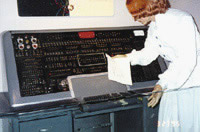 Based
on the idea of the 'Stored Program Computer' Eckert and Mauchly found the UNIVAC
company that develop the UNIVAC-1 (UNIVersal
Automatic Computer). It is the first company that manufactures computers for
businesses on a large scale and that not being used for war purposes in the
first place. Forty six units will be build and sold for over 1 million dollars.
Since this machine makes use of the stored program technology rewiring circuits
and setting switches to execute a program had become obsolete. This machine
received its instructions directly from the stored program itself. The short
code developed for the UNIVAC 1 was both the first interpreted language
and the first assembly language. (18)
Based
on the idea of the 'Stored Program Computer' Eckert and Mauchly found the UNIVAC
company that develop the UNIVAC-1 (UNIVersal
Automatic Computer). It is the first company that manufactures computers for
businesses on a large scale and that not being used for war purposes in the
first place. Forty six units will be build and sold for over 1 million dollars.
Since this machine makes use of the stored program technology rewiring circuits
and setting switches to execute a program had become obsolete. This machine
received its instructions directly from the stored program itself. The short
code developed for the UNIVAC 1 was both the first interpreted language
and the first assembly language. (18)
Univac will later be sold to the Remington Rand Corp.
April, The
selectron is abandoned as the IAS machine memory device in favor of Williams'
electrostatic memory tube. (27)

|
Updated on May 21, 2007 | For suggestions please mail the editors |
Footnotes & References

