


The Industrial Era 1984 - 1985 This period still belongs to the Third Generation
of computers. |
| 1947 | 1949 | 1950 | 1952 | 1955 | 1958 | 1961 | 1963 | 1965 | 1969 | 1970 | 1972 | 1974 |
| 1976 | 1978 | 1980 | 1981 | 1982 | 1984 | 1986 | 1989 | 1991 | 1993 | 1994 | 1996 | 2000 |
| 2002 | 2005 | 2007 |
1984

 |
|
Apple shows the famous Orwellian commercial, which is aired during the Superbowl(50) , and marks the introduction of the Macintosh.
But the superbowl advertisement nearly didn't make it
to the screens. 
The Apple Macintosh (named after the apple variety: Mac Intosh) is put on the market and based on the design of the Alto made by Rank Xerox. Steve Wozniak and Steve Jobs were specifically invited to study this design of Xerox. And based on what they saw there the Mac Intosh is designed with a full windows based interface. This user interface is completely graphical orientated and is controlled by a mouse. Many techniques of the predecessor Apple LISA are integrated in the design of the Macintosh (like the GUI, Graphical User Interface).
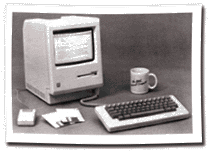
This computer differs compared to the IBM and IBM-clone computers.
The computer is designed around the Motorola 68000 which is more suitable
for a graphical environment than the 80X86 Intel family.
When the retail price drops to a more affordable (compared to the Lisa)
2495 US$ within six months the Apple company sells more than 100.000
Macintosh computers.
To see the full inset add in Newsweek follow this link: http://toastbucket.com/apple1984ad/
| Related Articles |
|
| Related Resources |
pre history |
history of videogames |

Hewlett Packard introduces the first inkjet printer available to consumers.
Though the inkjet printer dates from appr. 1970's (Teletype Inktronic)(16) it never became a commercial succes until this year. An inkjet printer injects small drops of ink on the paper in the shape of letters just like a matrix printer. Because of the special quality of the ink the small dots of ink flows together giving the letter a solid appearance.
Hewlett Packard also introduces the first laser printer (HP Laser Jet) intended for the personal computer user.

Rank Xerox the real inventor of this type of printer failed to recognize the potential of the personal computer market. And misses the world hegemony in printers here by denying that power.
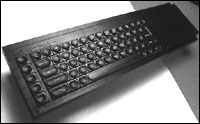
Sinclair Research released the QL computer (Quantum Leap)
The QL is based around the 8Mhz 68008 processor. The chip is a 32-bit processor but outside this processor the computer has still an 8-bit architecture. The machine contains 128 Kb memory and a multitasking operating system, which is very special in this period of time. But this machine becomes not very successful because of difficulties in the supply chain.
INMOS develops the first limited test version of a transputer.(17)
IBM introduces the AT (Advanced Technology) computer

It contains an Intel 6Mhz 80286 CPU. It supports 1 Mb of memory. It is possible to set the CPU in the so called "enhanced mode", which makes it technically possible to run programs which are larger than 640 Kb. However this mode is very difficult to use which the result that very few programs which are specially designed for the 286 CPU. Quarterdeck, a software company, designed an virtual memory extender so that even programs not designed for this enhanced mode could run in it.
MS-DOS 3.0 supports the new AT computer.
MS DOS 3 screenIt is now possible to read 1.2 Mb 5.25 inch diskettes and 20Mb hard disks.

In 1984 science-fiction author William Gibson coins the term "cyberspace" in his novel Neuromancer

FIDO bulletin Board System (BBS) becomes active.
This is a network where messages and software can be exchanged on world-wide scale. The network is divided in several zone-nodes and regional-nodes. Via these nodes it is possible to send messages and software to other nodes in other regions of the world. If you want to send a message you have to log into a local node via modem. By using and electronic address of a specific region a message jumps via several nodes to the place of destination. Within one year there will be approximately 100 nodes available 24 hours a day.
The system is more or less similar to the ARPA net launched in 1970. The big difference between ARPA and FIDO is that everyone is allowed to use FIDO. The use of the system is free of charge, only in some cases the system operator (SYSOP) asks a small membership fee. Most of the time the SYSOP is also the owner of the BBS equipment.
Stewart Brand and Larry Brilliant come up with the idea of "the Well" (Whole Earth 'Lectronic Link).
In La Jolla, Ca., Larry Brilliant, physician and head of Network Technologies Int'l. in Michigan, pitched the idea for a public computer conferencing system to Stewart Brand, publisher of the Whole Earth Catalog. Their meeting led to the 1985 founding of "The Well" online service that operated as a collection of conferences. It used the PicoSpan conferencing software. In 2001 Katie Hafner authored "The Well: A Story of Love, Death and Real Life in the Seminal Online Community."(1)

|
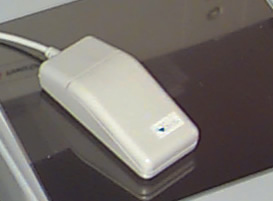
A mouse is an input/pointing device needed when you want to work with the so called WIMP (Windows) interface on your computer. Originally is was a little square box made of wood that contained two wheels and some kind of buttons to "click" on the various elements on your screen.
The invention was first used on Xerox
Alto and Star computers,
for the consumer the Lisa and
later the Apple Macintosh
computers were among the first to use a device like that.
Later in the 1990's the RSI(49) syndrome caused many computer workers pain while working with a mouse. Because of that computer hardware had to be redesigned to alleviate the RSI factors. Thus a clumsy squarish looking box became a highly ergonomic mouse that reduced the strain in using it. The mouse is still being approved upon and has taken many forms.
|




The Psion 1 is considered the first personal digital assistant (PDA).
(2)

The Psion can store addresses and phone numbers, keep a calendar and includes a clock and a calculator.
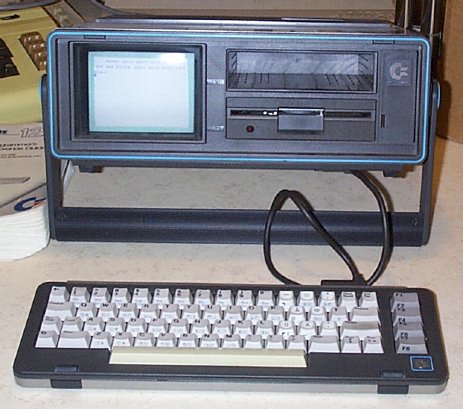
Commodore SX-64 The first color portable computer, the "Executive" has a 5-inch color TV build in. Commodore SX-64s are still prized collectibles.(7)
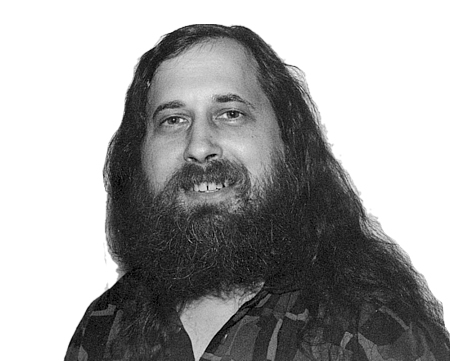
Richard Stallman thinks that users deserve the freedom that he believes they lost: freedom to copy and redistribute software as well as make changes to it.
As a consequence he leaves MIT's Artificial Intelligence Lab to found the GNU Project. The GNU project stands for free software one may copy and alter as they like. One of the prime examples is Linux (1991), free for all to use as one sees fit.
India born Narendra Karmarkar (1957), working at Bell Labs USA, stunned the world in 1984 with his new algorithm to solve linear programming problems.
This made the complex calculations much faster, and had immediate applications in airports, warehouses, communication networks etc.(3)

Fujio Masuoka and his team invent flash memory.
Flash is a low power, low-cost, storage technology that will find its way into mobile phones, mpeg players, camera's, solid state hard disks, cars and numerous other devices. In 2006 he will be awarded nearly 750.000 USD from Japanese electronics company Toshiba after a long legal battle to get his dues.
The name 'Flash' is suggested by Dr. Masuoka's colleague, Mr. Shoji Ariizumi, because the erasure process of the memory contents reminds him of a flash of a camera.
The term computer virus is coined by US computer scientist Fred Cohen.

While doing his PhD, Fred Cohen shows a program that changes other programs by embedding itself into these programs. Because of the analogy with biology he calls such a program a computervirus.
1985
GEM is Digital Research's GUI (or a WIMP in the original).
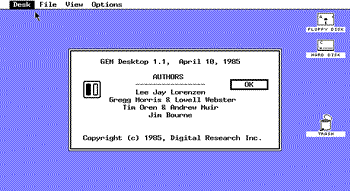
Gem 1.1 april 1985 (8)
It stands for Graphical Environment Manager, and is written by L.J. Lorenzen et al, who had just left Xerox PARC, where the concept of a GUI/WIMP was invented. GEM will become quite a popular interface at one time. Later this year Microsoft's DOS version of Windows will be published and this will kill this gem, also because DRI did not recognize its potential to offer an anti dote. (does this sounds familiar?)
The Compact Disk Read Only Memory, a.k.a. the CD-ROM, is developed with the audio Compact Disk as basis by engineers from Philips (.nl) and Sony (.jp).
picture courtesy: igloo.cl
The U.S.S.R. may have its own generation of computer kids.
Estimated by western experts on advances and current state of the art in computing in the Soviet Union the latter lags behind some 3 to 10 years, depending on the technological field or scientific area.
The Kremlin's Politburo takes action and has decreed that in September computer classes will begin "on a large scale" for the 8 million ninth- and tenth-grade students in the Soviet Union's 60,000 high schools. [...] "All- round and profound mastering by young people of computers must become an important factor in speeding up the scientific and technological progress in the country." While computers are widespread in American high schools, most Soviet students have no chance to learn about the machines until college.(11)
1 Mb of RAM becomes a standard in 286 computers.
The new 286 CPU is able to address 16 Mb of memory and has a clock speed that varies between 8 to 20 MHz. The processor supports 1024 colors but only 16 to 32 colors (depending on the amount of video memory) can be displayed at once.
The WELL launches on April 1st.
The Whole Earth 'Lectronic Link (WELL), a California-based online company owned by Whole Earth Catalog publisher Steward Brand, launches. The service provides bulletin boards for online discussions and attracts a hip, intellectual crowd. The discussion group later provides Internet services to its members. Salon.com, an online magazine, will buy the discussion group portion of the company in the mid-1990s. (6)
The WELL allows customers to register on-line to use the WELL for $8 per month plus $2 per hour. The initial staff is one full-time and one part-time employee. The WELL exists on a leased VAX 11/750 computer and hard disks, UNIX system software and a conferencing program called Picospan. The WELL has 12 phone lines and 800 MB storage. (13)
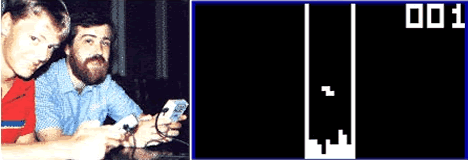
Tetris is written by a Russian named Alexey Pazhitnov.
Dmitry Pavlovsky, Alexey Pajitnov, and Tetris. (8)It will be released later for various western games machines, the jewel in the crown being its inclusion with Nintendo's Game Boy in 1989. Alexey made nothing from the game, since under the Communist Regime it was owned by the people - although after the collapse of Communism he was able to move to the USA where he now works for Microsoft.
Read |
INMOS introduces the first Transputer, the T414.
A micro processor which is especially designed for parallel processing of data. It is the fastest 32-bit CPU at this moment: 20 million instructions per second (MIPS) and 2 million floating point calculation per second (FLOPS).
The basic idea behind the Transputer is simple: put on a CPU some extra memory and four fast DMA / serial communication "links" on a chip. Put these chips in a network and let them all simultaneously (parallel) work on the same problem.
It was only until IBM developed a expansion card containing the program language OCCAM that made "parallel computing" more popular.
Windows 1.0 released
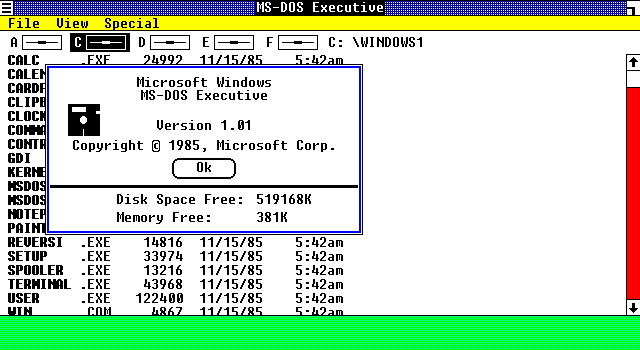
Microsoft ships Windows 1.0, nearly a year later than expected. The interface allows rudimentary pointing and clicking. Although several companies had raced to develop point-and-click interfaces, in the end, they cede the victory to Microsoft. However, Windows doesn't catch on widely until the introduction of Windows 3.1 in March 1992. (6)
Control Video changes name to Quantum Computer Services.
An online gaming company changes its name to Quantum Computer Services. Quantum creates online services for Apple, Commodore, and other computer manufacturers. In 1989, the company will change its name again, this time to America Online. (6)
Microsoft announces Excel

Microsoft unveils plans for a new spreadsheet program designed for the Apple Macintosh. The new product, called Excel, gives the Apple a badly needed business application. (6)
The first domain names are registered
Symbolics.com becomes the first registered domain (15-mar-1985) and is quickly followed by cmu.edu, purdue.edu, ucl.edu, and others. (6)
Quantum launches Q-Link
Quantum Computer Services launches Q-Link, an online service for users of Commodore's Amiga computers. The company also develops AppleLink, a network for Apple users. Quantum will later change its name to America Online. (6)
The Motorola 68000 cpu is quickly succeeded by 68010/ 68020 and 68030 processors.
These kind of chips are mainly used in computers which are more graphical orientated. Such as: Apple Macintosh IIe and Atari ST series.
Lotus Development (producer of Lotus 1-2-3) looked at VisiCalc as one of their strongest competitors.
In the vision of "If you can’t beat them join them" Lotus bought the VisiCalc company a few years ago. And as everyone expected, Lotus removes VisiCalc from the market.
The prototype of the Amiga is developed by an independent company (Hi Toro est. 1982 and later renamed to Amiga inc.)
Because of the long design process of more then three years, the company has a shortage of funds to continue the project. Commodore takes over the company and launches in July of this year the Commodore Amiga 1000.

The Amiga 1000 is created in part by Jay Miner, who previously designed the Atari 400 and Atari 800. The Amiga originally is designed to be a killer game machine, but it has so much potential that it has grown into a real computer. (4)
The Amiga causes an enormous shock among the users. The computer is so advanced for its time that even the marketing department of Commodore does not know what they are up to. The computer integrates almost everything: Video, graphic and sound chips. Also external sound and video sources can be connected to this machine. The operating system of the Amiga is designed by Carl Sassenrath and also advanced for its time: multi tasking environment, graphical user interface. Equipped with 256Kb RAM the Amiga is sold at a retail price of 1300 US$. All this classifies the Amiga 1000 as the first Multi Media computer.
And as usual in this epoch a magazine about the machine becomes available within a few months of the Amiga 1000 launching. An unusual well designed periodical for this period.
first cover of Amiga World (14)

Hewlett Packard introduces the HP LaserJet on the market.
This will become one of their most successful products. Thanks to HP, laser printer technology becomes within reach of smaller companies. Also the use of desktop publishing is given a big impulse.
MS-DOS 3.1 supports a network environment.
Aldus company introduces the first Desktop Publishing program called Page Maker.(48)
Pagemaker drives the success of the Macintosh. The page layout software launches the desktop publishing industry virtually overnight. The software is designed for the Apple Macintosh and was the first program that enabled a single individual to write, make a layout and print a book or newspaper, including illustrations on a personal computer and a printer. In 1989 the program will be published for IBM compatible PC’s.
Intel announces the 32-bit 80386 processor which is also downward compatible with the 80286.
Details of the CPU are: Registers, Address and Data bus are 32bit, addressable memory of 4Gbyte, Virtual Mode which allowed Real Mode simulation in Protected Mode. The chip contained 275.000 transistors and reached a speed up to 8 MIPS. With this kind of speed the PC came in range of low end Main Frame computers.
Amongst the first machines that used the 80368 technology were the Compaq Deskpro 386 and the IBM’s System 2. Compaq was way ahead on the development of 386 computers compared to IBM. It is therefore that the Compaq company was responsible for the explosion in sales of 80386 computers. Compaq wanted to produce best quality computers and ascertain a leading role in computer development the price of a Compaq computer is 30% higher than one of the competitor.
MS-DOS 3.2 is made compatible for 3.5 inch micro floppies with a capacity of 720Kb.
Microsoft's Quick BASIC revolutionized BASIC and legitimized it as a serious development language for the DOS environment.
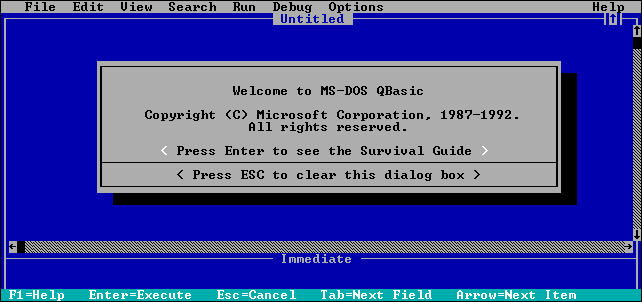
Quick BASIC is a compiled language. Microsoft started to ship an interpreted version of this with each version of DOS called GW-BASIC.
The first business intelligence system is designed and implemented for Procter & Gamble. (9)
In 1989 Howard Dresner of the Gartner Group will introduce "BI" as a umbrella term to describe a set of concepts and methods to improve business decision-making by using fact-based support systems. (source: wikipedia 10)

|
Last Updated on May 5, 2007 | For suggestions please mail the editors |