


click on the home button to go to the home page
|
The Industrial Era 1955 - 1957 The first commercial machines constructed entirely from transistors are put on the market. Fortran is developed. The first operating system comes on line. And Kilby invents the Integrated circuit. |
pre history | antiquity
| pre industrial era | industrial
era
| 1947 | 1949 | 1950 | 1952 | 1955 | 1958 | 1961 | 1963 | 1965 | 1969 | 1970 | 1972 | 1974 |
| 1976 | 1978 | 1980 | 1981 | 1982 | 1984 | 1986 | 1989 | 1991 | 1993 | 1994 | 1996 | 2000 |
| 2002 | 2005 |
| Related Articles |
| Related Resources |
|
pre history |
 The term artificial
intelligence (AI) is coined by Dartmouth mathematician John McCarthy.
The term artificial
intelligence (AI) is coined by Dartmouth mathematician John McCarthy.
Foundations are laid for AI research during a two-month conference, "Dartmouth Summer Research Project on Artificial Intelligence."
Bell Labs introduces
its first transistor computer.
Transistors are faster, smaller and create less heat than traditional vacuum tubs, making these computers more reliable and efficient.
On 2 October
1955 at 23.45 the power finally shut off, the ENIAC retired.
It’s estimated to have done more arithmetic than the entire human race has done prior to 1945. Parts of the machine are exibited at the Smithsonian (Washington USA) and a few other locations in the USA (computerhistory.org).

(7) IBM 702
The first commercial
machine completely constructed from transistors is put on the market by IBM:
series 702
The high price of the transistors causes that the sales are a flop. Still the trend is set by this machine.(1) As you will have noticed there are several "first" fully transistorized computers, but this is the first commercial one.
Allen Newell,
J.C. Shaw and Herbert Simon develop IPL-II, the first artificial intelligence
language.(2)
During
the development of the programming language FORTRAN, Harlan
Herrick introduces the high level language equivalent of a "jump"
instruction in the form of a "GO TO" statement.
In 1968 in an article Edsger Dijkstra will state "GO TO Statement Considered Harmful" thus setting the stage for more advanced (read: structured) programming.
William Shockley's
Semiconductor Laboratory is the first company established in Silicon Valley,
San Francisco Bay(2)
In March Computer
Usage Company is the first software company to open for business.
CUC is founded by Elmer C Kubie and John W. Sheldon(7)
IBM
brings out the "Magnetic Disk Memory" : RAMAC350 - Random Access
Method of Accounting and Control.
Look close at the picture at the right hand side you will see the cabinet of the RAMAC "harddisk"

The era of magnetic disk storage dawned with IBM's shipment of a 350 RAMAC to Zellerbach Paper in San Francisco. The IBM 350 disk served as the storage component for the RAMAC. This "machine" is man's height, contains 50 steel platters coated with a magnetic layer. The platters are mounted on a vertical shaft that drives them around. The read and write heads do not move. The total capacity of the system is 5 million bytes ("characters").(4)(3)

detail of Ramac steel platters
The first Operating System is
designed by Bob Patrick en Owen Mock.
The system gets the cryptic name of: GM/NAA-I/O and is installed on the IBM 704.
Researchers at MIT first begin
experimenting with direct keyboard data input.
The
first transistorized computer is completed, three TX-O (Transistorized Experimental
Computer) at the MIT laboratories.(19)
Another first is the TRIDAC to use transistors. Computers based on transistors mark the beginning of the 2-nd Generation of Computers
APT
(automatic Programmed Tool) is developed by D.T. Ross.
With this piece of software one can create shortcuts in software development. The tool writes the programmers text or "macro's" out in assembly.
The case against
IBM of monopolistic practices is settled by forcing IBM to lease and sell its
machines.
But IBM ships still 55% of all the data processing equipment.
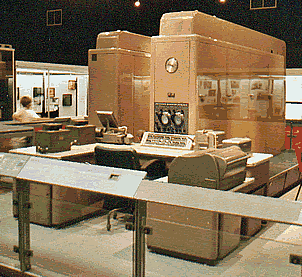
The first Pegasus, produced by the UK company Ferranti Ltd., went into service
in March 1956, at a time when all of the computers installed in the UK were
designed and built in Britain.
Pegasus was noted for its reliability and ease of use. It was the first computer to have a general register set architecture – a feature now seen in most modern computers. 40 Pegasus machines were built by Ferranti Ltd. between 1956 and 1962. Number 25, the only one still working, was installed in a special gallery in the Science Museum, London(12)
A.
Newell, D. Shaw and F. Simon invent IPL (Information Processing language)
|
|
The
acronym AI - artificial
intelligence - is coined by John McCarty; first meeting of McCarthy,
Minsky, Newell, and Simon |
John McCarthy |
Newell,
Shaw, and Simon create "The Logic Theorist", this program solves math
problems.
CIA
funds GAT machine-translation project.
In the first five years after the 1954 Georgetown-IBM demonstration, Machine Translation (MT) research was pursued with great enthusiasm and optimism. Numerous groups were formed in many countries. In the United States, the five early centres of Washington, Georgetown, MIT, Harvard and Los Angeles (RAND), were joined during the next five years by groups at Michigan, IBM, Ramo-Wooldridge, NBS, Texas, Berkeley (University of California), Wayne State, and numerous shorter lived projects. In the Soviet Union large scale projects were begun at three Moscow centres and in Leningrad. Major projects were set up in a number of centres in Japan, and research was beginning
in Czechoslovakia and France. (9)
First
commercial banking system (ERMA) at Bank of America.
Ulam
develops "MANIAC I", first chess program to beat a human being.
In
December Jack St. Clair Kilby at Texas
Instruments completed building the first IC (integrated circuit), containing
five components on a piece of germanium measuring half an inch long and thinner
than a toothpick(3)
 IC by Jack Kilby(3) |
 |
|---|
Kilby created the circuit to prove that resistors and capacitors could exist on the same piece of semiconductor material. His circuit consisted of a sliver of germanium with five components linked by wires. It is generally accepted that both teams at Fairchild and Texas Instruments developed the IC independently.
George
Devol and Joseph Engelberger found the first robot company: Unimation Inc.
Devol predicts that the industrial robot will "help the factory operator in a way that can be compared to business machines as an aid to the office worker".
read
on the history of robotics in our robotics timeline.

Siemens (Germany) starts to produce
the 2002 computer in series. It is one of the fully transistorized computers
in Europe.
 Digital
Equipment Corporation (DEC) is founded by Ken Olsen and Harlan Anderson.
Digital
Equipment Corporation (DEC) is founded by Ken Olsen and Harlan Anderson.
Starting out with laboratory and scientific modules. Their first computer the PDP 1 (Programmed Data Processor) will be released in 1960 and will get many successful descendants. DEC will be one of the most important computer producers of the world.
G.W.A. Dummer, exhibits during
the Royal Radar Exhibition in England a model of an Integrated circuit.
Jack
Kilby and Robert Noyce invent
the SILICON WAFER. With this they lay the foundation of the: Third Generation
of Computers.
John
Bardeen, John Schrieffer and Leon Cooper (USA) develop a theoretical model
for Super Conductivity.
We shall see later that super conductivity becomes more important when the critical limits of chip design comes near. Critical means how many transistors or other elements can be integrated on one single chip without creating interference. In Dr. John Bardeen wins a Nobel Prize for work in Superconductivity
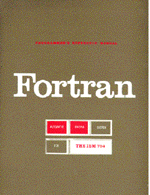
FORTRAN-1
is formally published.
FORTRAN uses notation that have a strong resemblance with those used in algebraic notation. For that Fortran will become very popular with scientists and technicians.
In late 1953, John W. Backus submitted a proposal to his superiors at IBM to develop a more efficient alternative to assembly language for programming their IBM 704 mainframe computer. A draft specification for The IBM Mathematical Formula Translating System was completed by mid-1954. The first manual for FORTRAN appeared in October 1956, with the first FORTRAN compiler delivered in April 1957. This was an optimizing compiler, because customers were reluctant to use a high-level programming language unless its compiler could generate code whose performance was comparable to that of hand-coded assembly language.
Control
Data Corporation is founded by William C. Morris and a group of engineers (amongst
whom Seymour Cray) from Sperry
Rand
The
first issue of Datamation is released.
A periodical dedicated to Information Techniology and developments therein.
Nippon Telegraph
and Telephone Corp (Japan). develops the Musasino-1, the
first parametron computer.
It uses 519 vacuum tubes and 5,400 parametrons—logic elements based on the principle of parametric excitation and invented by Eiji Goto in 1954.
A first attempt
to immitatie human intelligence in a simulacron is attempted by Herbert.
A. Simon, Allen Newell & J.C. Shaw. They devise a logic theory machine (first proof by machine) the General Problem Solver (GPS). The method for testing the theory involves developing a computer simulation and then comparing the results of the simulation with human behavior in a given task.
on
aritficial Intelligence
and man-machine simulations
 Noam Chomsky |
|
Another one of these: "could't be wrong more"... "I have traveled the length and breadth of this country and talked with the best people, and I can assure you that data processing is a fad that won't last out the year."
|
|---|

|
Last Updated on May 1, 2007 | For suggestions please mail the editors |
Footnotes & References
