click on the home button to go to the home page
|
The Industrial Era 1982 - 1983 This was the period that Commodore
starts its success story with the Commodore Vic20 and C64. Computer architecture in this period still belongs to the Third Generation of computers. |
pre history | antiquity | pre industrial era | industrial era
| 1947 | 1949 | 1950 | 1952 | 1955 | 1958 | 1961 | 1963 | 1965 | 1969 | 1970 | 1972 | 1974 |
| 1976 | 1978 | 1980 | 1981 | 1982 | 1984 | 1986 | 1989 | 1991 | 1993 | 1994 | 1996 | 2000 |
| 2002 | 2005 |
| Related Articles |
 to support our work buy our CD |
| Related Resources |
history of video games |
 Time Magazine eschewed
its Man of the Year Award in favor of Machine of the Year:
Time Magazine eschewed
its Man of the Year Award in favor of Machine of the Year:
The Computer.

Ironically enough most of the article is written on a mechanical typewriter!
This
is the year in which one of the most successful computers ever is
introduced, the Commodore 64.

This machine is build around the 6502 chip and is sold at a retail price of 595 US$. The total estimation of sales un tillCommodore went out of business on April 29, 1994, varies between 17 and 22 million C64 computers. The Commodore 64 is also the first computer with a sound synthesizer chip (named: SID, Sound Interface Device), designed by Bob Yannes.
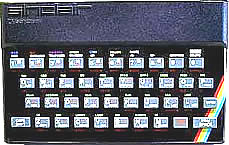
Sinclair research developed the
ZX spectrum, the successor to the ZX81.
Compared with the ZX81 the spectrum has 16 or 48 Kb of memory, displayed colors on the screen but still used cassettes as a way of data storage.
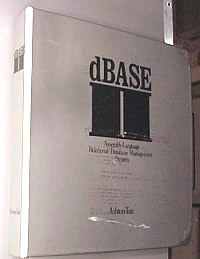
Ashton
Tate releases the database program dBase II. This program will be extremely
popular for the next 15 or so years.
dBaseII derives from the Vulcan database created by Wayne Ratliff in 1978. But the marketing did not bring the results expected and after a some years Ratliff sells the package to Tate. It is renamed into dBase II. (2) There was no dBase I but both think it better to skip a nomination for marketing reasons. The Ashton-Tate company will blow new life into the marketing effort and the program will be a huge success. Mainly because the interfacing is so easy to understand and open ended. In its final version dBase II allows up to 65,000 records, and up to 32 fields of 1Kb each.
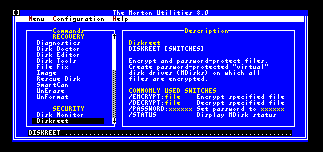
Peter Norton Computing
introduced Norton Utilities.
This program will be used by the computer savvy people and served as a prime hacker tool. You could when you knew how, even repair your hard disk's FAT (file allocation table) with it.

The Sun Microcomputer
corporation is founded and releases the SunOS operating system based on the
Unix dialect 4.2 BSD and 4.3 BSD. This will work on the Sun 1 - first successful
workstation using UNIX & C.
Sun Sparc workstation 1
John Warnock
and Chuck Geschke engineers from Rank Xerox found Adobe company.

Epson America
constructs the HX-20 it is the first laptop computer commercially available.
It uses a CMOS version of the 6801, has 16 Kb RAM and a small display.
Compaq Computers
is founded by Rod Canion, Jim Harris and Bill Murto.
They design the company's product at a local "House of Pies" and start by bringing out the first IBM -PC clone. (7)
Van Suwannukul
invents the Hercules Graphics adapter card.
Jim Clark
founds Silicon Graphics Inc. He will resign in 1994 to start Netscape Inc.
As a result
of mass production techniques in the field of microchip manufacturing, the first
affordable machines with 128 Kb of memory appear on the market.
Japan enters
the supercomputer arena.
Under the supervision of the Japanese Ministry of Trade and Industry (MITI) a project called "The fifth generation computer project" is launched. The initial budget for this project is 7 million US$ and should be leading to the Japanese to supremacy in the field of supercomputers. Though many products derives from this program the time seemed not ripe for artificial intelligence and hyper computers. The project will be canceled in 1993 but some parts or spin off products are transferred to other projects. Not until 2002 Japan will gain the indisputable advance in supercomputing
Sony introduces the 3.5inch (88.9mm)
micro floppy.
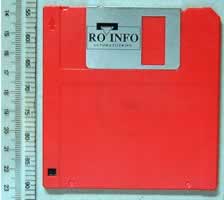
The single sided version is able to contain 360 Kbytes. The double sided, as shown above, is able to store 720 Kbytes .
Many manufacturers try to make
their microcomputers compatible with IBM's"open architecture", in
which they succeeded very well.
As a direct result of this development the computer market leads into fierce competition. Here the "big players" however seem to loose on the smaller companies which are able to adapt much quicker to a changing market as the big bureaucratic corporations.
Hewlett Packard introduces the
first "desktop mainframe", the HP 9000.
This machine contains the 32-bit "superchip"'(43) technology that is just as powerful as the room size computers from the 1960’s. This is the first mini computer specially designed for a multi-user environment.(44)
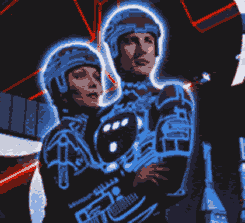
Disney is the first to use computer-generated
graphics. Their first product is Tron a hybrid form between
actors and overplayed graphics
With the introduction of the
80286 CPU Intel continue their development of the 8086 chip.
New features: REAL MODE (for compatibility with the 8086), PROTECTED MODE (enables extended memory up to 16 Mbytes), Multi Tasking and Multi User Operation. The processor contains 134.000 transistors and has a speed of 1.5 MIPS(9) see also Moore's Law
Mitchell Kapor found Lotus Development
Corp. Lotus 1-2-3 is designed by one man: Jonathan Sachs, and launches in October
1982.
The program is specifically designed for the IBM PC. It runs 10 times faster than any other computer program on the market at the time.

The name 1-2-3 refers to the fact that this program combines three functions in one computer program: A spreadsheet, a small file management utility and a graphic module that makes it possible to visualize data. This program will determine the way of doing calculations at the office for the next decade.
Introduction of MS-DOS 1.1.
This version also supports double sided diskettes.
In 1982, Ray
Noorda establishes Novell in Provo, Utah to design and market PC "networking"
software called Novell NetWare.
With the NetWare Network Operating System (NOS), PCs could be used to share files, printers, and other system peripherals among a group of users. DOS at this time, provides no support for network connectivity. (26) Novell is the first to realize that PCs can be inter-connected via interfaces (boards) and a special operating system enabling one or more PCs to act as a SERVER serving client PCs.
The physicist
Richard Feynman conceives the idea of a quantum
computer, a computer that uses the effects of quantum mechanics.
Future Computing Inc. quote: "CP/M 2.2 is extremely important, and the Z80 chip will live forever because of it."(13) |
Microsofts'
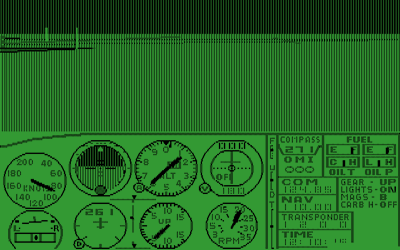
first version of flightsimulator is released in November, and
featured variable weather and time of day, and
a coordinate system.
courtesy Microsoft, digitaly enhanced by thocp
This Microsoft Flight Simulator 1.0 program was used as a benchmark program. If one's computer could run MSFS 1.0, it is 100% MS-DOS-compatible, and if it couldn't, it wasn't. (from personal experience of the editor)
Read
on the history of video games
IBM introduces
DB2 (Database 2), originating from System R which never really left the prototype
stage.
DB2 is primarily designed for mainframes and will be one of the most successful database systems for large businesses.
DB2 has its roots back to the beginning of the seventies where Dr. E.F. Codd, working for IBM, described the theory of relational databases and in June of 1970 published the model for data manipulation. To apply the model Codd needed a relational database language which he named Structured English QUEry Language or SEQUEL. SEQUEL was already a trademarked name, so IBM renamed the acronym to SQL, short for Structured Query Language. The acronym SQL still stands to this day.
Some years
ago (1978) engineers from Technical Design Labs came out with a processor also
known as the "General".
Neil Colvin (Phoenix) and Roger Amidon are the architects.(51)
Epson tries its hand at manufacturing
PCs with the Epson QX-10 and the CP/M based operating
system.
A promising machine, but sorry for Epson, 8 bit CP/M machines are already outdated. The first prototypes reach the USA in mid 1982's. It bears a close resemblance to an American computer, the General, which is designed in 1978 by Technical Design Labs. But TDL couldn't raise the funds needed for production and eventually they went out of business. Two of TDL's founders, Chris Rutkowski and Roger Amidon, joined Shinshu Seiki (for father of Epson) and worked on the preliminary QX-10 design. (52) Software for the QX-10 is developed by Rising Star Industries. This company is founded at the end of 1982 (by Epson?), its name is derived from the Rising Sun of Japan and the Stars and Stripes of USA(52) However where all other integrated DOS packages fail, the VALDOCS package that is sold in combination with the Epson QX-10 proves to be a huge success. VALDOCS include a word processor (with keyboard macro’s and multiple screen formats), a spreadsheet, a database and communication modules. And to top all of that: a desktop manager with an address book, mailing list manager, notepad, calculator and more is included. You can switch from one program to another with just pressing a button.
|
BUT "I spent two hours trying out the Epson QX-10 with VALDOCS. VALDOCS is a great idea. However, it is poorly implemented; the machine is slow, slow, slow. Unfortunately the VALDOCS program is written in a FORTH dialect instead of assembly language.. as it is now, I found it to be a disappointment."~ John K, Lewiston, ID Users were just not up to it to learn a complete environment and so the concept of a fully integrated environment was just too much for most of them. Also software designers and programmers did not have the methodology and technology to make this project more or less bug free That killed appetite as well. |
Marketing experts at the IBM
company make an error in judgment.
The estimated computers sales for the next decade is already realized.

IBM puts the IBM PC XT on the
market.
This machine sets the trend of PC architecture in the 1980’s. The machine has an improved BIOS and is equipped with a 10 Megabyte hard disk. Donald Estridge has been the team's (dirty dozen) manager.
The introduction of the IBM PC
Jr. becomes a huge flop.
The machine is intended for the consumer market but nobody wanted to have this one at home. The machine is just too expensive for what it offered, compared to the competition at least.
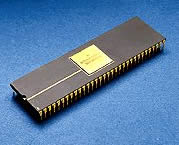
Motorola's
68000 chip proves to be very suitable to build advanced computers and also forms
the heart of laser printers.
This family of CPU's will also be very well suited for graphical oriented environments.
Philips, a
Netherlands based electronic manufacturer, brings out a PC for the home market.
Based on a Z80 CPU, it contains 16K RAM and slots for 2 modules and 1 micro tape an advanced design for this period in time. The system cost US$ 365 (Fl. 1495 ) monitor not included(2). But as many of Philips' fine ideas the marketing gets again in the way of promoting this machine on the local market.
Commodore has a new premiere:
a portable color computer: the Commodore SX64, based on the C64.

Commodore SX64
 |
Compaq offers the first
portable IBM-PC clone which is IBM software compatible. The exterior design
looks like a sewing machine case. The surface is made out of synthetic material
but has a steel frame inside. The biggest disadvantage of this machine is
the fact that it did not fit under airplane-seats and its full height disk
drives are often prone to failures. |
 |
Microsoft
announces Windows and Multi-Tool Word - later known as Microsoft Word.
It takes over two years before the product is on the shelves. Sounds like the usual ghost ware, but this time the product will be just "delayed". Microsoft distributed 450,000 disks with a demo version of the Word program in PC World magazine.
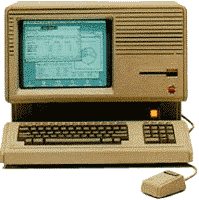
During a shareholders
meeting Apple introduces the Apple LISA (Largely Integrated Systems Architecture).
LISA is intended to be the successor to the Apple II and is the first PC (micro computer) based on a WIMP environment (Window, Icons, Mouse and Pull-down menus). This machine is geared towards the professional market but the high retail price (4500 US$) prevent the computer from becoming a success. Everything on the machine is expensive: memory expansion of 512kb costs 400 US$.
Introduction
of MS-DOS 2.0.
This version also supported hard disks and subdirectories. MS-DOS became more easier to use.
MS-DOS 2.10
is released this version contains an international character set.
Several manufacturers will offer this version as a package deal along with the computer which is released under the name MS-DOS 2.11 indicating that the operating system is modified for machine specific hardware components, similar versions are called OEM versions.
Richard Stallman
publishes his GNU Manifesto and stated his goal to create a free operating system,
a unix alike as it will turn out to be.
But since Unix is a proprietory system(10) the new system had to be created from scratch. That is why it is important that GNU’s *Not* Unix.’ The name “GNU” -- pronounce the “g” -- is in fact a recursive acronym for “GNU's Not Unix”)(11)
Some of these famous citations
|
1983-85 C with
Classes is redesigned and reimplemented as C++.

|
Last Updated on February 24, 2007 | For suggestions please mail the editors |
Footnotes & References