Introduction
this page will be continuously updated
last update:
16-nov-06
Introduction
We all know a PC, probably heard of supercomputers. But mainframes
are not so known.
When you watch television and see a movie with a big machine,
or hear people talking to each other (at college) about a mainframe do you
sometimes wonder what that is? What they are talking about? Then this page
is intended for you.
This page is the first in a future series to explain what
a mainframe is and how it evolved in history. Who were the pioneers and
what companies were, and still are, involved.
How did and how do they look like? On this page are a few
pictures of the earliest mainframes.
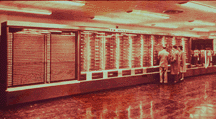
When you think of a mainframe do you think of a large computer?
Right!
But how large is it and what does it do, and what is its
place in the family of computers we know.
The ranking of a mainframe is as you can see almost at the
top. (quantum computers are hardly out of the laboratories)
A mainframe is simply a very large computer. And totally different
from what you have on your desk. Don't say: what seems to be a mainframe
today is on your desktop tomorrow. Apart from the CPU's (processors) that
is far from true.

Mainframe is an industry term for a large computer. The name
comes from the way the machine is build up: all units (processing, communication
etc.) were hung into a frame. Thus the maincomputer is build into a frame,
therefore: Mainframe
And because of the sheer development costs, mainframes are typically manufactured
by large companies such as IBM, Amdahl, Hitachi.
Their main purpose is to run commercial applications of Fortune 1000 businesses
and other large-scale computing purposes.
Think here of banking and insurance businesses where enormous amounts of data
are processed, typically (at least) millions of records, each day.

But what classifies a computer as a mainframe?
- A mainframe has 1 to 16 CPU's (modern machines more)
- Memory ranges from 128 Mb over 8 Gigabyte on line RAM
- Its processing power ranges from 80 over 550 Mips
- It has often different cabinets for
- Separate processes (program) for
- task management
- program management
- job management
- serialization
- catalogs
- inter address space
- communication
Historically, a mainframe is associated with centralized computing opposite
from distributed computing. Meaning all computing takes (physically) place on
the mainframe itself: the processor section.
 (3)
(3)
Refer to mainframe.in for lots of links to other mainframe related sites.
Chronology
Building mainframes started with the MarkI soon to be followed by tens of other
types and manufacturers. But as said earlier, because of the development costs
only governments and large firms could pay for the development of such behemoths.
Have a look at some early mainframes:
1939
 Atanasoff-Berry
Computer created at Iowa State.
Atanasoff-Berry
Computer created at Iowa State.
1940
Konrad
Zuse's -Z2 uses telephone relays instead of mechanical logical circuits
1942

1943
Colossus
- British vacuum tube computer
1944
Eniac (electronic numerical integrator and calculator ) in operation
at the Moore School. Te NIAC has thirty separate units, plus power supply and
forced-air cooling, weighed over thirty tons. Its 19,000 vacuum tubes, 1,500
relays, and hundreds of thousands of resistors, capacitors, and inductors consumed
almost 200 kilowatts of electrical power.

Manchester Mark1
1945
John von Neumann writes "First Draft of a Report on the EDVAC" in
which he outlines the architecture of a stored-program computer. This report
changed the direction of computer development away from punched paper tape.
1946
J. Presper
Eckert & John Mauchly, ACM, AEEI
1947
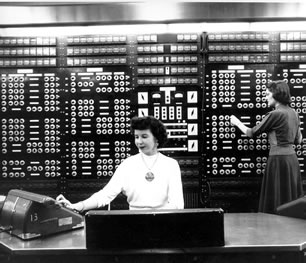
Harvard Mark
II (Magnetic Drum Storage)
1948
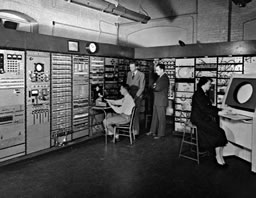
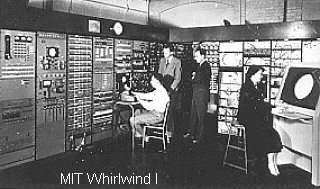
whirlwind
Whirlwind at
MIT
Manchester
Mark I (1st stored-program digital computer.
Remington
engineers complete the Model 3, a one of a kind concept computer.
GE Electronics
Laboratory in Syracuse wins an order for a USAF tube computer, named OARAC.
1950
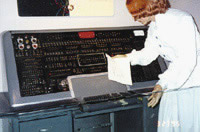
Univac I
Univac I first
deliverey to the US Census Bureau
1951
The first UNIVAC I mainframe computer was delivered to the Census Bureau. Unlike
the ENIAC, the UNIVAC processed each digit serially. But its much higher design
speed permitted it to add two ten-digit numbers at a rate of almost 100,000
additions per second. Internally. It was the first mass-produced computer. The
central complex of the UNIVAC was about the size of a one-car garage: 14 feet
by 8 feet by 8.5 feet high. It was a walk-in computer. The vacuum tubes generated
an enormous amount of heat, so a high capacity chilled water and blower air
conditioning system was required to cool the unit. The complete system had 5200
vacuum tubes, weighed 29,000 pounds, and consumed 125 kilowatts of electrical
power.
1955
IBM 704 announced. It was the first large-scale commercially available computer
system to employ fully automatic floating point arithmetic commands. It was
a large-scale, electronic digital computer used for solving complex scientific,
engineering and business problems and was the first IBM machine to use FORTRAN.
The 704 and the 705 were the first commercial machines with core memories.
IBM 705 announced. Developed primarily to handle business data, it could multiply
numbers as large as one billion at a rate of over 400 per second. In a 1954
IBM publication, the 705 was credited with "Forty thousand or twenty thousand
characters of high-speed magnetic core storage; Any one of the characters in
magnetic core storage can be located or transferred in 17 millionths of a second;
Any one of these characters is individually addressable."
Honeywell computer business was originated from the Datamatic Corporation, founded
in Newton MA, as a joint-venture by Raytheon and Honeywell, to produce large-scale
computer systems. Raytheon sells its 40% interest to Honeywell in 1957
1952
Illiac I, Univac
I at Livermore predicts 1952 election,
AVIDAC built
at Argonne
The Remington
(later SperryRand) Model 409 is delivered to the Internal Revenue Service facility
in Baltimore.
MANIAC (mathematical
analyzer, numerical integrator and computer) built at Los Alamos by Metropolis.
It is responsible for the calculations of Mike, the first hydrogen bomb. This
machine is followed by MANIAC II,
IBM-builds
the STRETCH supercomputer and a series of commercial super computers that have
made the Laboratory the world's largest scientific computing center.

IBM 701
The IBM 701
Electronic Data Processing Machine announced by IBM President Thomas J. Watson,
Jr. was IBM's first commercially available scientific computer and the first
IBM machine in which programs were stored in an internal, addressable electronic
memory. It was the first of the pioneering line of IBM 700 series mainframe
computers, including the 702, 704, 705 and 709. The computer consisted of two
tape units (each with two tape drives), a magnetic drum memory unit, a cathode-ray
tube storage unit, an L-shaped arithmetic and control unit with an operator's
panel, a card reader, a printer, a card punch and three power units. The 701
could perform more than 16,000 addition or subtraction operations a second,
read 12,500 digits a second from tape, print 180 letters or numbers a second,
and output 400 digits a second from punched-cards.
1953
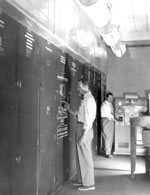
Edvac
IBM's drum memory 650 computer, announced. It sells for $200,000 to $400,000
and is a great success: more than 1800 will be sold or leased. The basic IBM
650 has 2000 words of memory and 60 words of core memory. It will be the first
computer on which IBM makes a meaningful profit.
First IBM 701 delivered.
IBM 701
1954

IBM 650 (first
mass-produced computer) o the market.
FORTRAN developed
by John Backus.
ORACLE-Oak
Ridge Automated Computer And Logical Engine.
Texas Instruments
introduces the silicon transistor.
Univac II introduced.
1956
 IBM 704
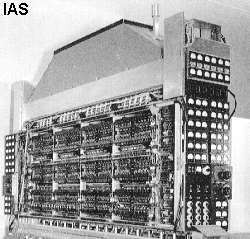
1956
MANIAC 2,
DEUCE (fixed head drum memory), clone of IAS
The Air Force accepts the first UNIVAC Solid State Computer. The machine was
one of the first to use solid state components in its central processing unit.
Remington Rand was not able to market a commercial version for three years.
The UNIVAC Solid State Computer came in two versions: the Solid State 80 handled
IBM-style 80 column cards, while the Solid State 90 was adapted for Remington
Rand's 90 column cards. A Solid State system consisted of the CPU and drum memory,
card reader, card punch, and printer. There was the option of adding a tape
controller and up to ten UNISERVO II tape drives. The drives could read both
mylar tape and the old UNIVAC metallic tape: the mode was selected by a switch
on the front of the drive. Actually a hybrid, the CPU had twenty vacuum tubes,
700 transistors, and 3000 FERRACTOR amplifiers.
1957
Installation of the first Honeywell Datamatic D-1000 to Blue Cross/Blue Shield
of Michigan.
1958
Nippon Telegraph
& Telephone Musasino-1: 1st parametron computer, Jack Kilby-First integrated
circuit prototype; Robert Noyce works separately on IC's, NEC 1101 & 1102
Introduction of Honeywell H-800 first shipped in 1960.
Delivery of first GE ERMA system. Two years later it is renamed GE-210. It
was also sold by NCR as NCR-204.
1959
The fully transistorized IBM 7090 computer system delivered. The system had
computing speeds up to five times faster than those of its predecessor, the
IBM 709. It was both a scientific and business machine. It was finally withdrawn
from production in 1969
The IBM 1401 is called the Model T of the computer business, because it is the
first mass-produced digital, all-transistorized, business computer that can
be afforded by many businesses worldwide. The basic 1401 is about 5 feet high
and 3 feet across. It comes with 4,096 characters of memory. The memory is 6-bit
(plus 1 parity bit) CORE memory, made out of little metal donuts strung on a
wire mesh at IBM factories. The 1401 has an optional Storage Expansion Unit
which expanded the core storage to an amazing 16K. The 1401 processing unit
can perform 193,300 additions of eight-digit numbers in one minute. The monthly
rental for a 1401 is $2,500 and up, depending on the configuration. By the end
of 1961, the number of 1401s installed in the United States alone will reach
2,000 -- representing about one out every four electronic stored-program computers
installed by all manufacturers at this time. The number of installed 1401s will
peak at more than 10,000 in the mid-1960s, the system will be withdrawn from
marketing in February 1971.(5)
1960
Paul Baran
at Rand develops packet-switching, NEAC 2201,
Whirlwind-air
traffic control,
Livermore Advanced
Research Computer (LARC),
Control Data
Corporation CDC 1604,
First major
international computer conference

Stretch
UNIVAC announces
the 1107 (completed in 1962) with the EXEC I operating system which occupied
about 8K of the 1107's 32K of memory. The machine is intended to support true
multiprogramming: sharing CPU time among several batch runs.
Introduction
of Honeywell 400
Decision to launch the GE Mosaic line, a family of four 24-bits computers. The
lower models will be announced as GE-415, GE-425 and GE-435. They will be known
as Compatible GE-400 series.
1961
IBM Stretch-Multiprogramming
IBM 7040 and
7044 computer systems announced.
1962
First use of
virtual memory in a mainframe computer.(4)
Control Data
Corporation opens lab in Chippewa Falls headed by Seymour Cray,
Telestar launched,
Atlas-virtual
memory and pipelined operations.

Timesharing-IBM
709 and 7090
Introduction
of Honeywell 1800 (first shipps in 1964).
IBM's 1440
Data Processing System is a low-cost compact electronic computer designed specifically
for small and medium-size business firms.
IBM 7094 computer
announced. With a memory reference speed of two microseconds (millionth of a
second), the 7094 could in one second perform 500,000 logical decisions, 250,000
additions or subtractions, 100,000 multiplications or 62,500 divisions. The
7094 internally performed mathematical computations 1.4 to 2.4 times faster
than the IBM 7090, A typical 7094 sold for $3,134,500. IBM provided customers
with a complete package of 7090/7094 programs, including FORTRAN and COBOL programming
languages, input-output control system and sorting, without charge. The 7094
was withdrawn from marketing in 1969.(5)
1963
Introduction
of Honeywell H-200, a machine targeting the IBM 1401, with a similar architecture
and a "Liberator" program translator.
1964
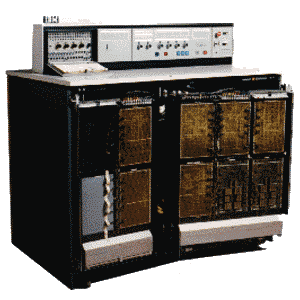
IBM 360
IBM 360-third
generation computer family.
Burroughs B5000
mainframe introduced. The system can be considered the first of the "third
generation" of computer systems. The most remarked-upon aspects are its
use of a hardware-managed stack for calculation, and the extensive use of descriptors
for data access. It includes virtual memory -- perhaps the first commercial
computer to do so -- as well as support for multiprogramming and multiprocessing.(5)
CDC (Computer
Data Corp.) 6600 shipped; 100 nsec cycle time.
First GE Time-sharing
operation at Dartmouth College of the DTSS Dartmouth time-sharing system on
a GE-265 (GE-225 + Datanet-30)
The Burroughs
B5500 has multiprogramming and virtual memory capabilities, and is three times
faster than the B5000.
1965
The Sage System,
IBM ships the
midrange 360 model 40 computer which had COBOL and FORTRAN programming languages
available as well as the stock Basic Assembly Language (BAL) assembler.
Introduction
of GECOS-II, a multi-programming operating system for the GE-600
1966
The Burroughs
B6500, an improved version of the B5500.
1967
First IBM 360/Model
91 shipped to NASA GSFC.
1969
First shipment
of the CDC 7600 computer system.
First shipment
of IBM 360 Model 85. The 360 family was intended to have 3 operating systems:
* DOS/360 operating system for the small machines. It could run two "real-time"
sessions and one batch session.
* OS/360 operating system for the midrange and high end.
* TSS/360 operating system for Time-sharing Multi-user system
Introduction
of Honeywell model 115 in the H-200 product line. The line is renamed H-2000
after models 115/2, 1015 and 2015 introduced in January 1971, and model 2020
and 2030 in December 1972 after the GE merger. The line is eventually merged
into Series6 0 NPL through a H-200 mode (emulator) on level 64. Introduction
of GE-655 that is better known as H-6000 after 1970.
1970
Burroughs
announces the 700 series. The first B6700 computer systems were installed during
1971. It was the first Burroughs machine with dynamic linking of programs at
runtime. The B6700 line started out with one CPU and one i/o processor and could
be expanded up to a maximum of three CPUs and two i/o processors.
Formal acquisition
of Bull-General Electric by Honeywell. BGE takes the name of Honeywell-Bull.
IBM announces
a family of machines with an enhanced instruction set, called System/370. The
370s proved so popular that there was a two-year waiting list of customers who
had ordered a systems.
A giant dies:
Announcement of the cession of the world-wide GE computer business, except time-sharing
to Honeywell.
1971
US Air Force
orders several Honeywell H-6000 WWMCCS (World Wide Military Command and Control
System), a $3.5M contract.
First shipments of IBM S/370 Models 155 and 165 as well as the S/360 Model 195.
1973
Introduction
of virtual memory on IBM S/370 Models 158 and 168.
1975
Amdahl 470
V/6 computer system delivered to NASA.
1977
The Burroughs
Scientific Processor was developed, and announced.
IBM 3033 computer
system announced
1979
The Burroughs
900-level systems are introduced.
1985
The most powerful
IBM computer system of its time, the 3090 high-end processor of the IBM 308X
computer series incorporated one-million-bit memory chips, Thermal Conduction
Modules to provide the shortest average chip-to-chip communication time of any
large general purpose computer. The Model 200 (entry-level with two central
processors) and Model 400 (with four central processors) IBM 3090 had 64 and
128 megabytes of central storage, respectively. At the time of announcement,
the purchase price of a Model 200 was $5 million. A later six-processor IBM
3090 Model 600E, using vector processors, could perform computations up to 14
times faster than the earlier four-processor IBM 3084.(5)
1990
The ES/9000
models came out with fiber-optical I/O channels (ESCON), and IBM began using
the name System/390. The ES/9000s exploited new technologies, such as high-speed
fiber optic channels with IBM's new ESCON architecture, ultra-dense circuits
and circuit packaging that provided higher performance, extended supercomputing
capabilities and twice the processor memory previously available. The line spanned
a 100-fold performance range increase from the smallest (model 120) to the most
powerful (model 900 six-way multiprocessor). Basic purchase prices for the air-cooled
processors of ES/9000 ranged from approximately $70,500 to $3.12 million. Basic
purchase prices for the water-cooled models ranged from $2.45 million to $22.8
million.(5)
1999
IBM releases
a new generation of S/390.
From the late 1990's mainframe manufacturers start to leave the
mainframe market, thinking mainframe business to be less profitable.
And then there is virtually only one manufacturer of major importance
left: IBM. And as the single (most important) manufacturer IBM can
dictate its own prices and sales goes up as well as profits. Not surprisingly
IBM's innovations in new mainframe architecture leaves the rest far
behind.
In due time this is observed by other computer manufacturers and since
2001 competition gets stronger again. |
2002
The IBM S/390
G5/G6 enterprise server family has up to 256 channels, from 2 to 8 Cryptographic
Coprocessors, from 8 to 32 Gigabytes of memory, and can run under OS/390, MVS,
VM, VSE, or TPF operating systems. It can also host an unbelievable amount of
hard drive storage.
2004
The 3/4 ton
IBM eServer zSeries 890, dubbed the "Baby Shark" can host up to 32
GBytes of memory.
The four PCIX Crypto Coprocessor (and optional PCI Crypto Accelerators)
on the z890 have seven engine levels, giving a total of 28 capacity settings
overall.
With it's advanced virtualization technology the 64-bit z890 can run several
operating systems at the same time including z/OS, OS/390®, z/VM®,
VM/ESA®, VSE/ESA, TPF and Linux for zSeries and Linux for S/390®.
The z890 is upgradeable within z890 family and can also upgrade to z990
from select z890 configurations.
Configured with the new Enterprise Storage Server Model 750 which handles
from 1.1TB up to 4.6TB of data, the x890 makes an awesome server.
Construction
In the early days output came via a paper tape.
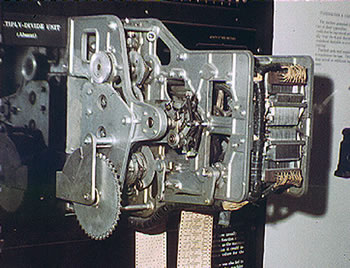
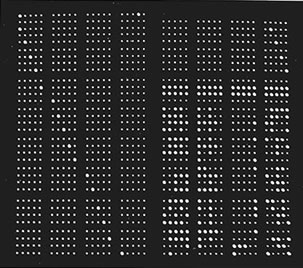
Later by an array of burning lamps and when the vacuumtube technology became
sophisticated enough to build a CRT output came by means of spots on the screen
(see williams tube).
Operating systems
At first there was no operating system. Most machines were hard wired. Programming
it meant rewiring panels and setting hundreds of switches to have the machine
calculate a table.
The next years when programming languages became available and memory was no
longer a problem programmers created operating systems. You no longer had to
be an electrical engineer to program a machine like that.
That made it possible for scientists and other users to quickly make a program
and get the results.
To take care of all this a mainframe needs a sophisticated Operating System.
And as you look at it closely also quite different from what you find on your
desktops machine. Almost always text based terminals (no graphics) are connected
to it. Also PC's can be connected to a mainframe with a special interface program
- often called 3270 emulation.
But a mainframe does have some particular properties:
- It manages a large number of users
- Distributes the sheer workload that can be handled by the machine over different
processors and in/output devices.
- All processes are running on the host and not on your terminal.
- Output is sent to your terminal through a program running (in background)
on the host(mainframe). Nothing else goes over the line. It is like you are
connected to a large computer by long wires. That is also the reason why it
seems that your keyboard typing sometimes appears slower on your monitor then
you actually type
Operating systems for mainframes are few in number: UNIX, Linux, VMS, Z/OS,
Z/VM, VSE/ESA. The latter three are of IBM origin and all three: VMS, Linux
and Unix also run on IBM mainframes(2)
However there are some dialects of VMS, Linux, and Unix running on different
machines.
Programming mainframes
When the first programming languages like Cobol, Fortran and Algol were created
every large company and institution could hire people to do the programming
of administration or complicated scientific calculations. The atomic bomb project
in Los Alamos was a prime example of doing calculations using computers, without
it the project never had succeeded in time.
Pioneers
Many scientists have contributed to the mainframe computer as it is now. Things
did not go as smooth and fast as it goes nowadays. Sometimes many items, mechanisms,
or materials still had to be invented before things really got on their way.
On line memory was a crucial phase in developing large computers. Also when
timesharing was invented in the late 60's mainframe use exploded.
Companies
To create a mainframe one needed at least a few hundred thousand dollars to
build the first types.
Later types of the 60' and 70's required a few million dollars and now depending
on what capacities you need mainframes range between two three hundred to several
tens of millions
It is reasonable to say that small companies can not afford to spent that kind
of money to develop one machine or prototype.
Firms like:
Ahmdal (Hitachi)
Bull
Comparex (Hitachi)
DEC (Compaq)
Fujitsu
Hitatchi
IBM
ICL (Hitachi)
NEC
Siemens
Unisys
Sun
and the like were the only ones financially capable of developing mainframe
machines.
As mainframe markets shrunk some companies were assimilated by their peers
and other congregated into even larger firms.
Conclusion
A (modern) mainframe is still a very large machine, sometimes tens of square
meters. Has usually more than one processor and loads of memory: often running
between a few mega- to several hundreds Gb of RAM.
It has tons of disk space and other storage facilities in large size and quantities
that are not normally found with mini or micro computers. And although it looks
like hundreds of users are using the machine simultaneously it is all governed
by a sophisticated time sharing system, hence: serialization. (per processor)
IBM
701 (1952)
Introduction | Chronology
| Construction | Operatingsystems
| Programming | Pioneers
| Companies

   |
Last
Updated on
November 16, 2006
|
For
suggestions please mail the editors
|
Footnotes & References


