click on the home button to go to the home page
|
The Industrial Era 1989-1990 The Fourth generation of computers starts approximately
in this era. These computers are characterized by fully electronic
and programmable models. ICs are built which contain more than 500.000
components. With this step the FOURTH GENERATION of computers started |
pre history | antiquity | pre industrial era | industrial era
| 1947 | 1949 | 1950 | 1952 | 1955 | 1958 | 1961 | 1963 | 1965 | 1969 | 1970 | 1972 | 1974 |
| 1976 | 1978 | 1980 | 1981 | 1982 | 1984 | 1986 | 1989 | 1991 | 1993 | 1994 | 1996 | 2000 |
| 2002 | 2005 |
| Related Articles |
| Apple company |
| Related Resources |

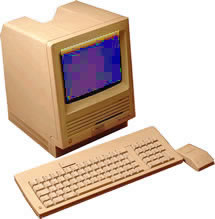
Apple MacIntosh SE/30 (7)
 Apple
introduces one of its best Mac Intosh products ever: MacIntosh SE /30.
Apple
introduces one of its best Mac Intosh products ever: MacIntosh SE /30.
A built-in hard drive with 128Kb RAM a 1.4Mb floppy that can read PC disks and is powered with a Motorola 60030 CPU. The machine keeps a good price on the second hand market because it is much in demand with business people


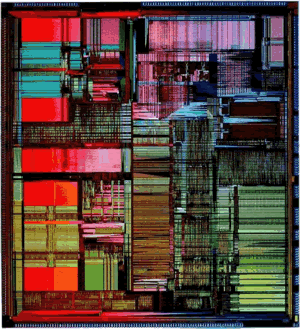
housing and die Intel 486
in
April this year INTEL continues its development of the 80386 with the 80486.
In fact it is a 386 but with a cache of 32 Kb and a coprocessor integrated in a single chip. In the coming two or three years the chip will not completely be bug free, a common trait of the industry. The processor contains 1.2 million transistors and operates at 20 MIPS.
ARPANET
turned off (August).
With the successful introduction of TCP/IP, which allows different computer networks to communicate with each other, ARPANET is becoming obsolete, and ARPA decides to decommission the network. By the summer of 1989, all of ARPANET's sites are transferred to the faster NSFNET, and ARPANET is turned off for good. (6)
Quantum Computer
Services in Vienna, Virginia USA, names online service America Online (October).
The company has developed a network with Apple, called AppleLink, but when the two companies part ways, Quantum changes the name of the service to America Online. Later, the entire company becomes America Online. (6)
 |
|
|
|
 |
Maxell
is marketing the first 5.25" 10 Mb floppy discs developed by IBM.
The disk has a slow (80 ms) access time but still quicker than a regular 8" disk with 150 milliseconds.
All modern
computers are now standard equipped with VGA monitors and cards, initially with
256 Kb but soon 512 Kb becomes the norm.
Through this improvement in graphics the development and acceptance of drawing programs are greatly stimulated. ACAD and ORCAD are some of the programs which have a full development environment (Computer Aided Design) which can now be used on a PC. Before only highly specialized and very expensive (> 150,000 U$) machines were capable of doing that.
Commodore
is the first to bring the CD-I (compact disc interactive) to the market.
The principle was introduced a couple years ago by Rank Xerox, but Commodore succeeded to be the first to bring this product commercially on the market.
The system is based on the interaction between the hard- and soft ware. The hardware consists of a CD on which both the program and data are. By means of a mouse/controller one can react interactively on a game. Hence the end of a game is not always the same. For educational purposes one can by pointing to a picture or an item on the screen obtain more information. E.g. by clicking on a painting one can get more information of the painter. The idea of interactive media is based on the HyperCard principle: "links" from a subject to other information.
Tim
Berners Lee didn't invent hypertext,
but he invents software for the World Wide Web. HyperText Markup Language,
also known as HTML.
 |
The mild-mannered Berners-Lee is working at CERN, a high-energy physics lab in Switzerland. He has already written a few database programs to store information via random links, but this was only for his personal use. Then the idea came to him -Click!- to create a hypertext structure that would span the globe via the Internet, accessible to anyone with a mouse.... (4)
|
Microsoft Corporation
introduces Windows for IBM computers.
The American
National Standards Institute (ANSI) publishes the first standard for the C
programming language: ANSI-C.
Prince, a development
methodology, is created from PROMPTII and replaces it as the default method
by the OGC (1)
This method with the backing of UK gets more support from users in countries on the continent of Europe.
One of these famous citations Quote from a Lotus Development official, while demonstrating a new DOS version of Lotus 1-2-3: "We don't see Windows as a long-term graphical interface for the masses."(3) |
In 1990 the World
Wide Web is officially born when Tim Berners-Lee of the physics laboratory in
Geneva developed the HTML and WWW software for it.
 |
|
First Internet
service provider: The World. It becomes the first commercial provider of dial-up
Internet access. (6)
Zenith, Compaq,
Olivetti and ALR launch, before IBM, computers of the Intel
486 series on the market. Compaq is the most expensive (US$ 27,000)
The 20 Mb 5.25"
floppy disc is for sale on a limited scale.
|
|
 |
Window 3.0 has
become a GUI (Graphical User Interface) which adapts automatically to
the built-in CPU and memory (RAM).
Special versions for e.g. the 80286 and 80386 are not necessary anymore.

window 3.01 screenshot
Microsoft and IBM have a problem because of the marketing of Windows 3.0 by Microsoft. In the opinion of IBM, Windows 3.0 is competing with the development and acceptance of the OS/2 system. MS maintains that this is not the case. However, Windows 3.0 is a serious competitor for OS/2. Window 3.0 is far closer to the demands of the user than OS/2 ever will be in the coming years. For this reason the Management of IBM thinks to loose their market share through in their eyes unfair competition by MS who was involved with IBM in the development of OS/2.
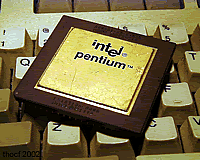
Intel announces
officially the '80586' CPU , called the Pentium, which will get in production
in 1992.
 |
|
In the same month
IBM introduces the model 90 (80486 CPU), a powerful machine which is developed
to support office automatization within a network surrounding.
Special for the model 90 is that it has the so-called open CPU architecture. This means cards can be replaced/added which makes it possible to equip the machine with e.g. a parallel processor. Also exchanging the CPU card with another (e.g. a 586) is now possible.
Other manufacturers will follow with other 'high-end' (read more expensive) models.
Hewlett
Packard introduces the HP LaserJet III printer.
 |
During the next few years the price will rapidly decrease and small companies can afford this printer. This is the first printer where font cartridges can be used so that several fonts can be selected. In the mean time the HP printer technology has become the world standard. There is almost no printer available which can not emulate the HP II printer. |
IBM
scientist Don Eigler uses a Scanning Tunneling Microscope
(STM) to move single xenon atoms around on a nickel surface.
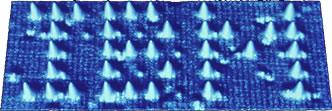
This is an experiment with far reaching effects. The engineers moved 35 atoms to spell out "IBM" in a 10 micrometers sized logo , a feat many engineers will repeat to make their mark.(2)

|
|
Last Updated on March 20, 2006 | For suggestions please mail the editor in chief |
Footnotes & References