


The Industrial Era 1952 - 1954 The Second Generation of computers started approximately in this era. They were characterized by electromechanical mechanisms and (partly) programmable in the sense of von Neumann's stored program architecture.
|
pre history | antiquity | pre industrial era | industrial era

1952

IBM (International Business Machines) decides to add computers to their line of business equipment products.
This will lead IBM to become a dominant force in this field. The first production-line electronic digital computer from IBM is Model 701, designed by Nathaniel Rochester and marketed for scientific use. It includes 1 Kb RAM. The 701 is the first machine to use a Tape Drive.


| Related Articles |
 |
| Related Resources |
pre history |
A juicy detail: a complaint against IBM is filed alleging monopolistic practices in its computer business, in violation of the Sherman act.(2) (see also 1953 - Philips)
Grace Murray Hopper an employee of Remington-Rand works on the UNIVAC.
She takes up the concept of reusable software in her 1952 paper entitled "The Education of a Computer",(20) and develops the first software that can translate symbols of higher computer languages into machine language. (A/O compiler)
Jay Forrester develops magnetic core memory at M.I.T.(2) However An Wang did so in 1948, another fine example of parallel invention.
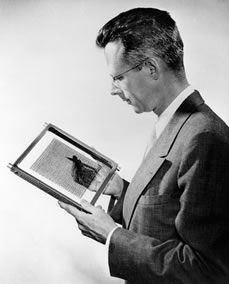
The EDVAC ( Electronic Discrete Variable Automatic Computer) is completed at Moore School by Mauchly, Eckert and Von Neumann.

A UNIVAC I computer made by Remington-Rand accurately predicts the outcome of the US presidential election, this brings the computer to the attention of the general public.(2)
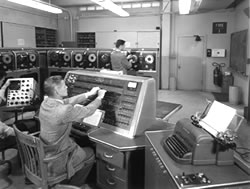
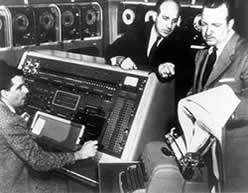
But Mr. Cronkite the anchor of the news show and his editor team can not believe the results that the machine calculated and had the predictions changed. So it appears, at least to the public, that the computer is wrong, but in fact it are the editors themselves. They felt it not to be "politically correct" to make the predictions of the Univac public in such an early stage. Or as others said later: they could not believe the statistical analysis.

The first computer manual ever was written by Fred Gruenberger
for the University of Wisconsin Press (15) (16) Prefaced
by d'Uzjian (he) describes (a) future where computer technology will
be seamlessly merged into an appliance that looks and feels remarkably
like today's modern microwave oven.
RCA develops the Bizmac with iron core memory and a magnetic drum supporting the first Database.
Alick Glennie develops Auto code, the first compiler. But this one is restricted for military use only .(11)
A first concept of Integrated Circuits is published by Geoffrey Dummer in Washington.(11)
The very first computer in the Netherlands is constructed by W.L. van der Poel: Testudo(5).

Construction started in 1947 and completed at TU Delft by students after van der Poels' design.(3) The relay based machine measures 5 by 0.6 meters. Adding takes 30 seconds and multiplication 45 seconds(6)
1953
IBM introduces the first "mass" produced computer: type 650 also known as the Magnetic Drum Computer.

This is a machine between mainframe and micro. Later this breed of machines will be called mini computers. The first year of production approximately 450 will be sold. In the following 15 years about 1500 (1800(11)) will be sold. And that is for this period an unsurpassed sales result. Like the 701, the 650 can both read from and write to magnetic tape and punched cards.
Bell Telephone Laboratories build the first completely transistorized computer, the TRADIC.
The machine contains 800 transistors.
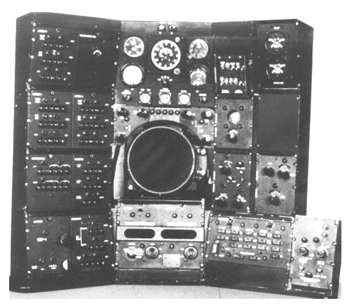
The first high speed printer is developed by Remington Rand for use on the UNIVAC
Magnetic-core memory replaced electrostatic tubes on Whirlwind, doubling the speed, quadrupling the input data rate and reducing memory bank maintenance time from 4 hours/day to 2 hours/day (11)
 |
 |
First product to use transistors is on the market: hearing aids.
In the Netherlands Philips built the PETER (Philips Experimentele Tweetallig Electronische Rekenmachine). But by an agreement with IBM Philips promises not to enter the computer market and developed computers only for internal use. ( 22)
ILLIAC - the world most powerful computer ran at University of Illinois.
We can only see a short distance ahead, but we can see plenty there that needs to be done.
Alan Turing, on computers in 1953
A first attempt in automatic translation was done in January when an IBM 701 was used in a research project to translate Russian into English. The result is enhanced by using electronic dictionaries and a number of programs that contained the syntax rules of different languages. A satisfactory translation was achieved. Much of the knowledge gained in this project was used in the Echelon project
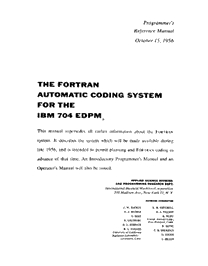
John W. Backus an employee of IBM designes the programming language FORTRAN(7)

FORTRAN: FORmula TRANslator.
Engineers and scientist definitively chose this path of programming with a higher computer language. Rewiring of machines to reprogram them belonged to the past. Another gigantic step forward! (1952: Grace Hopper)
Scientist could work independently from programmers and offer their programs directly to computers to run them. It took until 1956 before a manual appeared. Documentation would always be the last thing programmers do obviously.
In this year IBM's first commercial computer: IBM 704, is introduced.
With build in indexing and a Floating Point Unit it could reach 40.000 additions per second and capable of approximately 5 kFLOPS. Principal architect is Gene Amdahl who also designed the first Operating System ever for a computer, in this case it was the IBM 704.
Gordon Teal of Texas Instruments found a way to make transistors from large mono crystals of cheap silicon oxide. The dimensions were still relatively small: some millimeters to a few centimeters.
The first company to start with mass production of silicon transistors is Texas Instruments
Read on
transistors.
on
transistors.
The NORC (Naval Ordinance Research Computer) is a special made computer constructed by IBM for the American navy.
This machine will be used for logistic services and contains over 9000 vacuum tubes.

In Japan the Parametron computer is invented by Eiichi Goto
The principle of the Parametron is invented by professor Eiichi Goto. The machine called Musasino I is built in the laboratory of the Japanese PTT (NTT) at Musasino - Japan. The architecture has a strong resemblance to the ILLIAC 1, the one being built on the University of Illinois (USA). The reason was that scientists consciously chose to reuse the program code of the ILLIAC.(10) It will take a few years before this type can be commercialized.

Jack Tramiel starts Commodore.
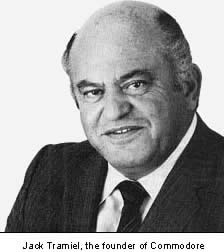

This firm will be the one that took the front runner position in the field of Personal Computers, a term not even coined yet. It would give the greatest push ever in the hobby computer industry. Commodore marketed famous machines like the Commodore C64, VIC20 and the Amiga machines. The latter was very advanced for its time, but hampered by bad quality of parts. However in the first few years of its existence Commodore would just repair typing machines and related equipment.


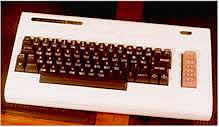
Fujitsu Ltd. puts the first Japanese computer on the marked: the Facom-100.
facom 100
Above is shown an office situation

Devol patents the first programmable robot and coins the term Universal Automation.
At the suggestion of his wife, Evelyn, he later shortens this to Unimation. When he filed a U.S. patent for a programmable method for transferring articles between different parts of a factory, he wrote: "The present invention makes available for the first time a more or less general purpose machine that has universal application to a vast diversity of applications where cyclic control is desired."(24)
read

|
Last Updated on May 17, 2007 | For suggestions please mail the editors |
Footnotes & References