| |
pre history | antiquity | pre
industrial era | industrial era
|
 |
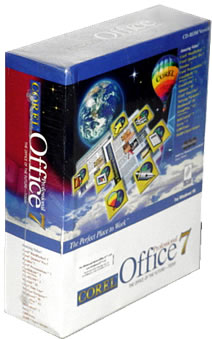
Corel (founded 1985) buys WordPerfect, Quattro Pro, and the PerfectOffice
application suite from Novell.
 |


|
| pictures courtesy Corel 2000/2006 |
Corel pays
US$180 million in cash, stock, and future licensing royalties for the
office suite. A high price in hindsight.
|
|
Intel introduces the 200 MHz Pentium processor, shipping it initially
in small quantities.
It incorporated 3.3 million transistors, and performed at 284 MIPS.
Price was US$599 in quantities of 1000.
|
|
Microsoft unveils Windows
CE operating system for hand-held PCs.

Code-name of the project is Pegasus. "CE" stands for
Consumer Electronics.
|
|
The first successful and affordable Personal Digital Assistants (PDA)
the Palm Pilot becomes available to consumers.
The installed memory is large enough to hold thousands of contacts,
appointments and notes. PDA's can do calculations, play games and music
and potentially download information from the Internet. Since the interface
was very easy to use it becomes an in mediate hit with consumers. It
is small and light enough to fit in a shirt pocket and runs for weeks
on a few AAA batteries.(4)
|
|
IBM launches OS/2 Warp 4, in San Francisco, California. Priced at US$249. |
|
CD-ReWritable (CD-RW) is announced. The technology is developed by
a five-company consortium. |
|
Apple Computer buys the NeXT Software company for about US$425 million
in cash and Apple stock. |
|
One of the first web shops is opened by IBM: World Avenue. IBM calls
it a "Web shopping mall" that allows online vendors to rent
virtual storefronts.
This is one of the earliest examples of commercial site hosting. However,
the online mall concept fails to catch on, and IBM will close World
Avenue a year later. (10)
|
|
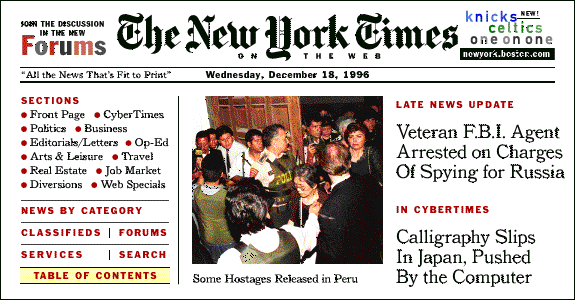
The New York Times , which previously offered its content through
America Online, announces that it has launched its own web site.
picture courtesy: web.archive.org (17)
It is the first paper to do so. As consumers move from proprietary
services like AOL to the Web throughout late 1995 and 1996, proprietary
services begin to lose customers, and many publishers start to migrate
their content to the Web. (10)
|
|
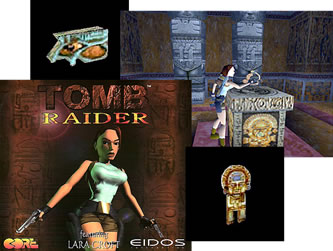
Tomb Raider
Tomb Raider is developed by Toby Gard & Phil Campbelland from
Core Design, published by Eidos Interactive. Tomb Raider follows the
exploits of Lara Croft, a British female archaeologist in search of
ancient treasures à la Indiana Jones. (19)
pictures courtesy Eidos, collage by thocp
Lara Croft, a modern time virtual heroine quickly becomes a new (cult)
figure. In a few years publicity agencies will succeed to change Lara
Croft into a real person from the idea of serving as a role model for
modern young adventurous women. About exploiting a game to its fullest...
But this sets a trend. Games become movies, as books become movies
become games.
|
|
January. General Electric (GE) sells its Genie online service.
GE was one of many corporations that tried to enter the online service
game in the early 1990s. However, the rise of the web draws customers
away from online services, and many ventures, like Genie, are sold
and turned into Internet Service Providers (ISP). (10)
|
|
February. Pointcast, a little-known company in Cupertino, California,
announces a beta version of its Pointcast software.
The service, which grabs information from the Web to display it on
the user's screen, kicks off a year of industry hype about "push" technologies.
The hype fades after a year or so when consumers fail to embrace push-technology
over active web browsing. (10) Push technology will
evolve into the annoying pop-up windows a few years later. On its turn
triggering a tug of war between the advertisers and the commercial
defenders. Anti pop-up utilities will be a standard feature of most
browsers in about 6 years.
|
|
In March and April, Lycos, Excite, and Yahoo, al search engines went
public. All will perform strongly. (10) |
|
June,
eBay is founded by Jeff Skoll and Pierre Omidyar.

The site is started as a collector's exchange
site that will grow into the world's largest "personal trading community". |
|
Microsoft releases its Internet Explorer browser on August 11, 1996,
to compete with Netscape's Navigator software.

The two companies engaged in a rapid series of upgrades and promotional
offers to win market share. (10)
The way Microsoft pushes this browser, e.g. by integrating this into
the MS Window software, will in about 8 years result to that some 96%
of all web users use Internet Explorer. Some courts will rule that
this practice is crossing the line of legal competitive commercial
behavior and deems that Microsoft must separate Internet Explorer from
their Windows operating system. It will take years of legal battle
and counter attacks before Microsoft will comply. However practice
will neutralize the court's decision, by enabling to disable IE as
a standard browser. And it seems that the US legal system is forgetting
what it started with.
|
|
October. Prodigy, once one of the top three online service providers,
re launched itself as an Internet access provider.
Sears and IBM have launched the joint venture in the late 1980s but
sold it in 1996 as online service customers migrated to the web. Although
Prodigy continues to provide a proprietary online service, the company's
management says that Internet access will become the company's main
focus. Prodigy will go public in 1998. (10)
|
|
A new version of the development methodology Prince2 is published, having
been contributed to by a consortium of some 150 European organizations.(13) |
|
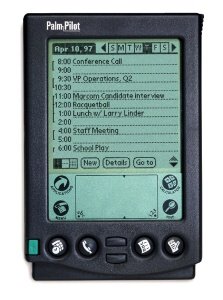
March,
the Palm Pilot is available for consumers.
 (14) (14)
This one is successful contrary to earlier types from Tandy (Zoom),
Apple (Newton) or Psion (Psion organizer) The so called Personal Digital
Assistant or PDA can do numeric calculations, play games and music
and download information from the Internet. (15)
The PalmPilot is manufactured by Palm Computing, a division of U.S.
Robotics. Pilot Pen Corporation brings a trademark infringement suit
against the company. Beginning in 1998, the devices are known officially
as Palm Connected Organizers.(19)
|
|
Bluetooth technology is invented by Dutchman J. Haaften
employed by Ericsson (Sweden).
In about 2 years time this technology will be adapted
as an industry standard because Ericsson has put the technology in
the public domain as an open architecture. The latter is also one of
the main reasons why the PC technology is flying high since the mid
eighties. Bluetooth is suitable to be built into many appliances, but
was developed for the mobile telephony.
|
|
Cell phone's until now could only "bleep" a
melody.
When Nokia, a Finnish cell-phone company, introduces“smart
messaging,” a protocol that allows people to send text messages
to one another over their phones Vesa-Matti Paananen, a Finnish computer
programmer, figures that it can work as well for sending bits of songs.
Paananen develops software and calls it Harmonium. The software is
able to program cell phones to produce harmonic melodies. That melody
can be send to friends by using smart messaging.(12)
|
|
In
this year IBM releases Deep Blue
A super computer tailored to beat a world champion chess
player: Garry Kasparov. The machine performs at a trillion Flops. But
many critics are saying that it has only beaten Kasparov by brute force
and had little to do with AI. Fact is that it is the most powerful
computer for this year.
At a forum discussion held at Computer History Museum
in Mountain View, on 8 September 2005, Murray Campbell stated:
Deep Blue's strategic and imaginative qualities were
illusory, however. "Deep Blue did not have an effective ability
to learn,"
Campbell said at the forum. "The entire machine was honed and
tuned by hand." Creating a program that learned chess as humans
do, from teachers, books and their own playing experience, would be "well
beyond the current state of the art," he added.(18)
|
|
Apple co-founder Steve Jobs, who left the company in 1985 to found Next
Software and later become president of Pixar, returns to Apple as interim
CEO. Two years later, he will still be in the "interim" position. |
|
Sun files a lawsuit against Microsoft, accusing the software
giant of undermining Sun's Java programming language.
Sun alleges that Microsoft is trying to disrupt Java
development by distributing a version of Java not compatible with that
used by the rest of the industry. (10)
|
|
Amazon.com, an online bookseller, goes public in May.
The day before the IPO, Barnes and Noble sues Amazon for allegedly
falsely advertising itself as "the world's largest bookstore." Nevertheless,
the online bookseller closes 30 percent above its opening price. The
lawsuit will be settled later this year.
|
|
America Online buys its onetime rival, CompuServe.
Rather than merging it into its own online offerings, AOL leaves CompuServe
as a separate service. (10)
|
|
April. Microsoft buys Web TV Networks.
The company's technology allows users to read e-mail and surf the
Web on their television sets. The $425 million purchase is Microsoft's
largest Internet-related acquisition to date. (10)
|
|
June. The USA Supreme Court rejects the Communications
Decency Act.
Part of the Telecommunications Act of 1996, the act makes it a felony
to distribute "indecent material" on the Internet. The court
unanimously rules that the law violates the First Amendment: freedom
of information. (10)
|
|
The Frauenhofer Institute (Germany) releases the MP3 format, even when
the Institute patents the format there will be no royalties asked for its
use, an influential stimulant to make it the PC's core, and many more appliances,
music system. |
|
A web site with a very long name goes on line:
http://www.llanfairpwllgwyngyllgogerychwyrndrobwllllantysiliogogogoch.co.uk |
The internet allows a maximum of 64 characters for a domain name (including
the .co.uk ending) and this name has exactly 64! According to the Guinness
Book of Records (2002) this is the longest site name registered so
far. (16)

picture courtesy: Keith Wood
|
|
The
first affordable digital cameras come on the market.
The number of brands and models are increasing by the
day 
They are at first very simple camera's with mainly USB ports and special
cables or equipped with memory cards or modules. The quality (480 x
640) and saturation is very poor. But the next year better cameras
will see the light. But for simple web publishing this kind of digital
cameras are all right. An attempt to construct a digital replacement
for the normal 35mm picture cartridge is tampered by low resolution,
high energy consumption and price (over 1000 US$). Another development
of digital photography is an inlay that can be placed inside the mirror
reflex cameras. It means a second life for those reflex cameras gathering
dust But it still is an expensive gadget not for the normal photo
amateur. The next few years will show dramatic improvements both in
quality and price. |
|
August.
Apple Inc. releases the iMac. A machine intended for
starters and according to Apple it is optimized for the Internet.
 
left iMac from August 1998(11)
right Apple eMac from April 2002
It's not a machine more advanced then other brands but
it starts a totally new trend in computer styling and marketing. The
machine has a semi transparent colored casing and looks like a modernized
terminal from the 80's, everything is build into one single box.
It is the first PC, in this decade, devoid of "legacy
I/O technology". The lack of a floppy drive, and total reliance
on USB connectors, instead of serial/parallel/ADB(6).
This is considered very risky by industry pundits. Yet it fuels USB
(universal serial bus)
device development, and pushes the adoption of USB by PC manufacturers.
PC manufacturers start struggling to develop a truly "legacy-free" PC
in the vein of Apple's original iMac.(5)
In terms of corporate survival however this new marketing strategy
is also saving Apple Inc. from going under. The next few years Apple
will go through a complete revival.
|
|
 
Two Dutch scientists, dr.
Willem Vos and dr. Judith Wijnhoven, published a report in Science
on how to make so-called photonic crystals that could trap light.
Their paper was inspired by that of Eli
Yablonovitch back in 1987. This new publication sets off a gold
rush into this specific field of physics."(1).
(read
more over here)
Speculations points towards the creation of unlimited memory with this
technology, consuming virtually no power.(8)
|
|
Byte Magazine, one of the first personal
computer magazines and at one time (end 1980's), the most important,
ceased its existence as a printed publication at the end of 1998. CMP
is the new owner.
The once over 200 pages thick magazine had grown into an electronic
magazine owned by CMP.com (www.byte.com). One could say that the web
is the best place for a magazine like this where printed media for
high tech information got outdated   fast. fast.
Shown at left is Jerry Pournelle one of the editors from the very first
beginning since 1975 and still is!
|
|
Auction site eBay, started as a place where founder Pierre Omidyar's
girlfriend could swap Pez dispensers with other collectors, launched
a spectacular IPO.
The company's stock price soared 163 percent on its first
day of trading. (10)
|
|
The U.S. government decided to privatize the registration
of Internet addresses called: URL's (Uniform Resource Locators).
Government contractor Network Solutions has enjoyed an
exclusive government contract during the last six years, registering
some two million names at seventy dollars apiece. The government created
the Internet Corporation for Assigned Numbers and Names (ICANN) to
help privatize the business. (10)
|
|
Kevin Warwick has a transponder chip implanted in his
arm. |
| |
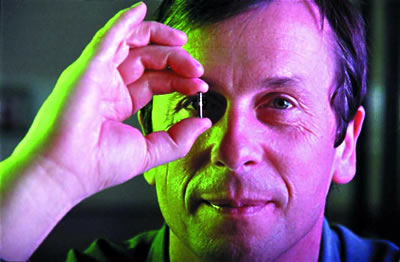 He
claims to be the first person to do so. Media call him the first cyborg
- silicon merged with organism. Receivers or detectors mounted on the university's
campus and buildings detect his signal and react by opening doors and telling
him "you have mail". The
transponder is about as large as a 2 pence coin's diameter (UK). He
claims to be the first person to do so. Media call him the first cyborg
- silicon merged with organism. Receivers or detectors mounted on the university's
campus and buildings detect his signal and react by opening doors and telling
him "you have mail". The
transponder is about as large as a 2 pence coin's diameter (UK). |
| |
 Not
to have his body accepting this transponder, removing it will become
more complicated, Warwick ends the experiment after 10
days. Later Warwick will implement this "Cyborg" technology with other
processors implanted in his body to direct other devices outside his
body (2002)
and later by transmitting sensory pulses from one's body to his (2007). (21) related
story: robotics Not
to have his body accepting this transponder, removing it will become
more complicated, Warwick ends the experiment after 10
days. Later Warwick will implement this "Cyborg" technology with other
processors implanted in his body to direct other devices outside his
body (2002)
and later by transmitting sensory pulses from one's body to his (2007). (21) related
story: robotics 
|
| |
Pictures published with kind permission of professor Kevin
Warwick , university of Reading; 30 march 2007 |
|
October. The Justice Department's long-awaited antitrust
suit against Microsoft Inc. is launched.
The government alleged that Microsoft engaged in predatory and anti-competitive
business practices regarding its operating system. The case dragged
on until 2004. (10)
|
|
October. President Bill Clinton (USA) signed the Digital
Millennium Copyright Act.
A law that imposed new safeguards for copyrighted materials on the
Internet. The legislation also barred technologies that can crack copyright
protection devices. (10)
|
|
November. America Online (AOL) buying Netscape rocks the
online world.
  
Some industry analysts say the move will make AOL powerful enough
to challenge Microsoft's dominance in the technology industry. (10)
|
|
 (3) is
founded by Larry Page and Sergey Brin. (3) is
founded by Larry Page and Sergey Brin.

Larry Page and Sergey Brin - picture courtesy Google
Two Stanford Ph.D. candidates, who developed a technologically
advanced method for finding information on the Internet. Google is a
play on the word googol meaning "an
unspeakable large number". Google's use of the term reflects the
company's mission to organize the immense amount of information available
on the web.(2) |
|
On February 10, ICL (Electrolux) brings out
their version of the Kitchen Computer.

A Web/Java based application integrated in a refrigerator.
Honeywell that tried to introduce a similar device in 1969 had to abandon
the project. ICL was one of the first to try it again 30 years later.
Time will prove whether this machine is too early again. (see also Honeywell
1969)
L |
|
Palmtop computers with color displays com
within reach of the average consumers.

Prices will go down to less than 200 US$ for palmtops
with about the same features. In the next five or six years palmtops
(later called PDA's) will become more and more complex and the price
will rise to about 500 USD including features like bluetooth, gps,
mpeg player, movies and telephony
|
|
The Millennium bug is
taken seriously now by almost al industrialized countries.
Those who are willing to spent the money fix most of
the errors found in programs that were related to calculations with
dates and codes that could relate to leap years and the so called signal
codes (99 meant often end of record or file).
The main advantage however of these actions are that the firms and
governmental organizations that take action on the millennium issue
now have an big advantage on their competitors. They clean out all
old programs, some times modernize them and throw out the stuff where
functionality can be taken over by more modern programs or hardware.
They can now make a fresh start.
|
|
The plummeting price of PCs leads some companies to offer
free or very cheap PCs if users sign up for online services.
One company, Free-PC.com, distributes free computers to people who
agree to share personal information and download Internet advertising.
|
|
Disney and Infoseek launch the Go Network (January)
Disney and Infoseek create the Go Network and launch an aggressive
advertising campaign to drive traffic to the site. In July, Disney
buys a majority stake in Infoseek. (10)
|
|
Prodigy Classic online service folds (January)
Citing Y2K computer problems, Prodigy announces it will shut down
its Prodigy Classic online service. The company had focused on its
Internet service provider business for several years, but maintained
the online service, which still had about 208,000 customers.(10)
|
|
Gates increases philanthropic efforts (August).
Bill Gates merges his two
charitable foundations, the William H. Gates Foundation and the Gates Learning
Foundation, into one organization, the Bill and Melinda Gates Foundation.
The merger created the country's richest charitable foundation, worth $17.1
billion. The foundation committed $750 million over the next five years
to buy vaccines for more than 25 million children in nearly seventy poor
countries. (10)
|
|
Shawn
Fanning and his company Napster  turns
the music industry upside down. turns
the music industry upside down.

Shawn Fanning
Fannings' software allows users to swap files, mostly
music, without going through a central server.
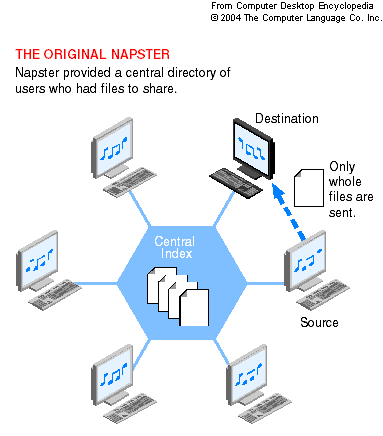
The technology is called Peer to Peer or P2P. The Recording
Industry of America (RIIA) goes crazy and sues Napster for copyright
infringement. This will not become Napster and the company will go
broke a few years later, only to resurface as a pay / subscription
service in 2003.
|
|
Microsoft
recognizing the potential of the the game world enters the arena with
Xbox; running on it is Halo2.

introduction
of Xbox with Halo2
|
|
We
now enter the 21st century. A new millennium. What will it bring?
|


