|
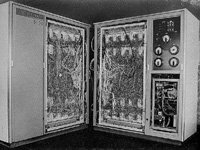
The Industrial Era 1963 - 1964 Important events: the first computer game is designed, Moore's law is defined, ASCII becomes a standard, the first general purpose computer language. |
pre history | antiquity | pre industrial era | industrial era
| 1947 | 1949 | 1950 | 1952 | 1955 | 1958 | 1961 | 1963 | 1965 | 1969 | 1970 | 1972 | 1974 |
| 1976 | 1978 | 1980 | 1981 | 1982 | 1984 | 1986 | 1989 | 1991 | 1993 | 1994 | 1996 | 2000 |
| 2002 | 2005 |
| Related Articles |
| Related Resources |
|
pre history |
 In this year ASCII
is introduced: American Standard Code for Information Interchange. This code
is developed by both the USA government and the computer industry. It is Bob
Bemer who is the chief designer for the ASCII code.
In this year ASCII
is introduced: American Standard Code for Information Interchange. This code
is developed by both the USA government and the computer industry. It is Bob
Bemer who is the chief designer for the ASCII code.

The ASCII code will be the standard character coding for years to be.
The importance of the universal code is that hitherto every computer manufacturer
had his own coding. So only via a translation table computers could exchange
data. By using the ASCII code no such tables of programs were needed anymore
and computers of all brands could exchange their data. This was a first in standardization.

The ASCII alphabet
On
the basis of an idea of Alan Turing's, Joseph Weizenbaum at MIT develops a "mechanical
psychiatrist" called Eliza that appears to possess intelligence.
The audio
compact cassette is invented by Philips a consumer
electronic manufacturer in the Netherlands. The compact cassette is the spin
off from a product made by Philips for a dictaphone where engineers have put
a tape into a cassette.

This tape will become the storage medium for many home computers to come in the next two decades.
The first graphic
consoles DAC-1 by General Motors and Sketchpad by MIT Lincoln laboratories are
developed. Sketchpad uses the first lightpen developed by Ivan Sutherland.
Douglas Engelbart
starts research on the computer mouse at the Stanford Research Institute. (see
more at 1967)

In the spring, Kemeny and Kurtz select the General Electric 225 computer and the DATANET 30 as the hardware for the development of the time-sharing system. Kemeny uses a GE-225 in the Boston area to develop the prototype BASIC compiler. In the fall, Kurtz and Mike Busch '66 go to Phoenix, Arizona, to learn how to program the equipment.

CDC
(Control Data Computer) develops one of the first commercial SUPER COMPUTERS:
CDC 6600 and STAR100 (later re-baptized in CYBER).
This computer has ten peripheral processors known as a pre
processing unit. This unit sends the data to a central processor: CPU. This
processor runs at 3.000.000 instructions per second. (3 MIPS)
 Intel's
chairman Gordon Moore suggests that integrated
circuits would double in complexity every year while prices will stay the same.
This suggestion will be known as Moore's Law. This statement is printed by a
magazine in an article written by Moore. He will only have to change this law
in 2001!
Intel's
chairman Gordon Moore suggests that integrated
circuits would double in complexity every year while prices will stay the same.
This suggestion will be known as Moore's Law. This statement is printed by a
magazine in an article written by Moore. He will only have to change this law
in 2001!
McLuhan writes
"Understanding Media", predicts global electronic village.(1)
Hursley(22)
plays a major part in the development of the high-level programming language
PL/I. Two years later the Laboratory is assigned worldwide responsibility for
it, having also produced the first PL/I compiler.
SCAMP leads
to Hursley's involvement in the development of the System/360 from its beginnings.
The Model 40 establishes a solid reputation for the Laboratory.
 April
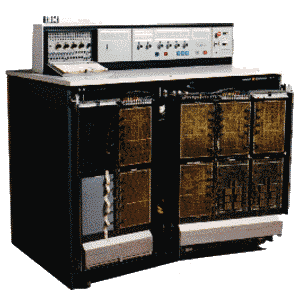
7, IBM announces the first 'Family' of computers: the IBM
/360, after 5 years of development. The machine will start shipping in 1965
April
7, IBM announces the first 'Family' of computers: the IBM
/360, after 5 years of development. The machine will start shipping in 1965
It is the first in the 3-rd generation of computers. This series consists of six with each other compatible computers and peripherals. Their controlling circuitry is stored on chips. This is a new strategy to make computers compatible with each other.
In the same time computers from different manufacturers still could not "talk" to each other. Even at the level of plugs. Later the term "plug compatibility" will be used when manufacturers want to sell a machine to a client that has a computer from another manufacturer.
Knowing that it will be no surprise that this new IBM "computer family" is a runner. Up to a 1000 machines are sold every month!(20)
IBM also introduces the 1403 printer for System/360. It uses a revolving metal chain (hence chain printer), and can print 1100 lines of text per minute.(25)
However the operating system to run on this machines is riddled with bugs, it hangs up machines without apparent cause. This threatens the existence of IBM.
Buchanan, Feigenbaum
& Lederberg begin DENDRAL expert system project.
Online transaction
processing made its debut in IBM´s SABRE reservation system, set up for
American Airlines. Using telephone lines, SABRE linked 2,000 terminals in 65
cities to a pair of IBM 7090 computers, delivering data on any flight in less
than three seconds.
 BASIC
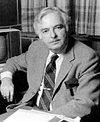
- Beginners All Purpose Instruction Code - is introduced as a computer language
by professors Thomas Kurtz en John Kemeny (picture left).
BASIC
- Beginners All Purpose Instruction Code - is introduced as a computer language
by professors Thomas Kurtz en John Kemeny (picture left).
They got lots of help from undergraduates. And BASIC would become the "lingua franca" of the young computer community. (20) One of the main goals of this language is to train students in programming computers with a relatively simple language. In the Fall of 1964, the Dartmouth Time Sharing System became operational with BASIC as primary language for student program development. The first BASIC was a slow, unstructured, interpreted language.(25)
At a meeting
of structural research managers from the NASA centers Tom Butles proposed that
NASA develop a general purpose computer program using the new Finite Element
method.(25)
 Epson
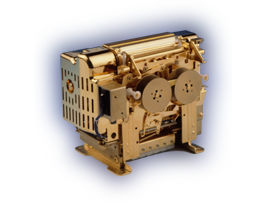
invents the dot matrix printer: EP-101(27). The machine is
developed because the mother company Seiko needed a small device to be used
with the time keeping instruments at the Olympics in Tokyo. It will take another
four years before this printer will go into serial production.
Epson
invents the dot matrix printer: EP-101(27). The machine is
developed because the mother company Seiko needed a small device to be used
with the time keeping instruments at the Olympics in Tokyo. It will take another
four years before this printer will go into serial production.
Computer Aided
Design (CAD) is developed through a mutual project by IBM
and General Motors.
First Local
Area Network is developed at Rank Xerox's Palo Alto Research Center
With a speed
of 9 megaflops, Control Data Corp.'s CDC 6600, designed by Seymour Cray, claims
the title of first commercially successful supercomputer.

|
Last Updated on January 14, 2006 | For suggestions please mail the editors |
Footnotes & References