


click on the home button to go to the home page
|
The Industrial Era 1976 - 1977 The Third Generation of computers started approximately in this era. Computers are characterized by mainly electronic models and were fully programmable. |
pre history | antiquity | pre industrial era | industrial era
| 1947 | 1949 | 1950 | 1952 | 1955 | 1958 | 1961 | 1963 | 1965 | 1969 | 1970 | 1972 | 1974 |
| 1976 | 1978 | 1980 | 1981 | 1982 | 1984 | 1986 | 1989 | 1991 | 1993 | 1994 | 1996 | 2000 |
| 2002 | 2005 |
| Related Articles |
|
| Related Resources |
history of videogames |
 Z80 microprocessor
from Zilog was available in February. The first computer that used this CPU
was the Z-1 from Cramenco.
Z80 microprocessor
from Zilog was available in February. The first computer that used this CPU
was the Z-1 from Cramenco.
The 6501 and 6502 micro processor
was developed by MOS Technology Corporation.
Its relative low price (25US$) was the reason why Steve Wozniak selected this processor for his first computer the Apple I (the predecessor of the Apple II). The 6502 processor was soon to be used in Commodore computers. At this point the Intel 8080 cost about US$150.
|
That summer in 1975 at the Homebrew Club the Intel 8080 formed the center of the universe. The Altair was built around the 8080 and its early popularity spawned a cottage industry of small companies that either made machines that would run programs written for the Altair or made attachments that would plug into the various kinds of micro computers.
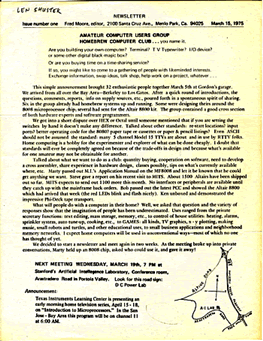
First Homebrew Computerclub news letter.
For the complete newsletter
collection the Homebrew Computerclub go here.
|
It is on the Homebrew Computer
club in Palo Alto, California (Silicon Valley), that Steve Wozniak, 26 years
old, working at Hewlett-Packard and a long time hacker, wished to have his
own computer.
He already designed several computers on paper and even wrote FORTRAN and Basic interpreters for these theoretical machines, but lack of money left these machines in the theoretical phase. He was interested in the Intel 8080 chip (the heart of the Altair), but decided that $179 was too much money. This decision not to use the 8080 was regarded as a stupid move by the other members of the club.
The thing with microprocessors was that a program or device designed for it would not work on any other processor. The "connection" for devices for the Altair was known as the S-100 bus because it used one hundred signal lines. Disciples of the 8080 made attachments to the 8080 and S-100 even though they readily admitted that the s-100 bus was poorly designed. The people who wrote programs or built peripherals for 8080 computers thought that later competing microprocessors were doomed. The sheer weight of the programs and the choice of peripherals, so the argument went, would make it more useful to more users and more profitable for more companies. The 8080, they liked to say, had critical mass which was sufficient to consign anything else to oblivion."
 (4)
(4)
Casio CQ 1
In Japan the
worlds first calculator was sold that had combined functions: clock and calculator
the Casio CQ 1
CP/M
is created by Gary Kildall.

CP/M
command structure
Intended as an operating system for personal computers. It allowed one version of a program to run on a variety of computers. This is the would have been OS for all personal computers. Were it not that Kildall somehow will skip the deal with IBM by taking the wrong turn in negatiations.
The market
demanded floppy disks with a larger capacity.
As a reaction on this IBM launched a floppy disk that could use both sides what brought the capacity to a whopping 360 Kb.
More than 50 different microprocessors
were on the market at this time.
Examples: AMI, Mostek, Motorola, National Semiconductor, RCA, Rockwell, Signetics, Teledyne Systems and Toshiba.
|
 |
lOptical diodes Inc. (Frontier Inc) and MOs Technology Corp. produced the 6502 micro processor and the KIM a 6502 evaluation kit that could, with a lot of effort and creativity, be turned into a computer.
|
Digital shipped
WPS-8 a word-processor program.
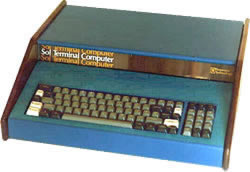
Lee Felstein
build the SOL-20 computer (10K RAM), named
after a Popular Electronics editor Les Solomon.
The typewriter machine keyboard-cum-computer used a TV as monitor. It sold for $1649 as a kit, but if you wanted to avoid the soldering you had to pay $2129 for a complete assembled kit.
The first software
written for the Sol-20 machine was 'Electric Pencil, a word processor written
by Michael Schrayer (December). It seemed that the program is still available
in 2000!
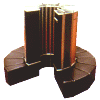 The
first supercomputer
was created by Seymour Cray the
Cray 1, to be superseded quickly by the supers of Control Data (CYBER) and
Japanese firms like NEC (SX), FUJITSU, and HITACHI.
The
first supercomputer
was created by Seymour Cray the
Cray 1, to be superseded quickly by the supers of Control Data (CYBER) and
Japanese firms like NEC (SX), FUJITSU, and HITACHI.
The CRAY-1 was however the first commercial available machine that broke the barrier of the magical 1 MIPS. If you went the conventional route and tried to build one yourself using PC's it would take 200.00 of them all cross connected (5), or you could just purchase 33.33 Sun4s. CRAY Research INC made at least 16 of their fabulous CRAY 1's A typical CRAY 1 would cost about 700,000 dollars. You could order the machine in any color you wished and that still holds true today.
RCA introduce
the 1802 microprocessor.
Later it is used in a RCA COSMAC VIP system developed by Joseph Weisbecker. It included 2 Kb RAM, 512 bytes of ROM, and an interface for Video, Cassette and Audio.
Ethernet, which
allows coaxial cable to move data extremely fast, is described by Robert M.
Metcalfe.
This is a crucial component in development of LANs. (local area network)
First issue of
Dr. Dobb's Journal in January 1976, a magazine primarely devoted to system programmers.
Digital Equipment
Corporation introduces its popular minicomputer, the DEC VAX 11/780.
Honeywell ships
Multics Relational Data Store, the first commercial relational database

Dennis
C. Hayes invents the PC modem, establishing the critical
technology that will allow online and Internet industries to emerge and grow.(9)
|
|
|
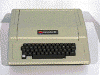 In April Apple introduces the Apple II on the West Coast Computer Fair in San Francisco.
|
In a fast pace
8 bit microprocessors (such as: Intel 8080/6/8, Motorola 6800, Zilog Z80 and
MO's 6502) were integrated into Personal Computers.
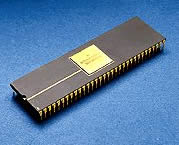 ~~~
~~~
motorola 68000
pictures: motorola.com
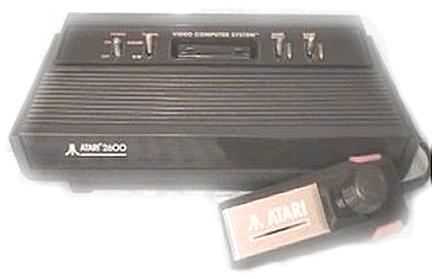
Atari
releases the Atari 2600 home video
game console, another but very succesfull one based on the 8 bit 6502 chip.(6)
Interactive
System Corp. starts selling Unix commercially.
UNIX is introduced into the IBM 360 System. Up to this time UNIX could only run on DEC PDP minicomputers. The University of California at Berkeley released its own version of the UNIX operating system called version 4xBSD. The package included a Pascal interpreter, a Pascal shell and a selection of hardware drivers.
The first implementation
of TCP (Transaction Control Program) was a fact.
TCP is a protocol or tool that allows computers to be connected via different networks to communicate with each other.
In this year
100 hosts are connected to the ARPAnet .
Digital introduced
the VAX-11/780 the first member of the succesfull VAX series of computers.
|
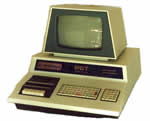 Although the KIM set sold well for evaluation boards, Chuck Peddle of Commodore was not pleased with the product.
|
|
|
The idea of
Open Systems Initiative (OSI) is born.
Open Systems Interconnection started to research possibilities how to let different types of computers to communicate with each other.
 Under the management
of Allen Shugart the IBM research team reduced the 8inch floppy to a 5.25inch
size.
Under the management
of Allen Shugart the IBM research team reduced the 8inch floppy to a 5.25inch
size.
These smaller floppy’s are more stable and easier to carry and handle. This size becomes a defacto standard for many brands of micro computers. The initial prize for the diskdrives is 390U$
Intel introduced
the 16bit 8086 chip and the 8087 co-processor.
These chips cause a lot of excitement but were not quickly adapted because they were ahead of their time (2). Only years later descendants of these chips would dominate the market.
First 64Kb RAM
chip is mass produced by IBM.
Paul
Allen and Bill gates sign an agreement to officially found the Microsoft
company(3)

first logo of Microsoft
First computerized
word processor introduced by Wang Laboratories. Price: $30,000.(8)
|
Another of those: "he could not be wrong more" Ken Olsen, founder of Digital Equipment Corporation, states: "There is no reason anyone would want a computer in their home." "There is no reason for anyone to have a computer in their home." |
First
issue of Personal Computing Magazine in January 1977.
IBM's develops
with the support of the NSA data encryption standard, DES.
It requires an eight-number password for scrambling and unscrambling data, allowing for 70 quadrillion possible combinations. This encryption scheme will be used by financial institutions and governmental bodies throughout the world.
recommended reading: Crypto from Steven Levy


|
Last Updated on August 10, 2006 | For suggestions please mail the editors |
Footnotes & References


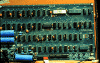
 On 1 April Apple Corporation is
founded by Steve Wozniak and Steve Jobs.
On 1 April Apple Corporation is
founded by Steve Wozniak and Steve Jobs.  Tandy (Radio
Shack) introduced their version of a Personal Computer the TRS-80-1.
Tandy (Radio
Shack) introduced their version of a Personal Computer the TRS-80-1.