| inventors
no picture: papers
& manuals hardware software |
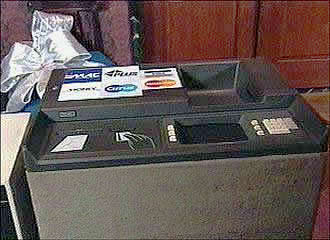
An automatic teller machine or ATM allows a bank customer to conduct
their banking transactions from almost every other ATM machine in the
world. Don Wetzel was the co-patentee and chief conceptualist of the
automated teller machine, an idea he thought of while waiting in line
at a Dallas bank. At the time (1968) Wetzel was the Vice President
of Product Planning at Docutel, the company that developed automated
baggage-handling equipment. The other two inventors listed on the patent
were Tom Barnes, the chief mechanical engineer and George Chastain,
the electrical engineer. It took five million dollars to develop the
ATM. The concept of the ATM first began in 1968, a working prototype
came about in 1969 and Docutel was issued a patent in 1973. The first
working ATM was installed in a New York based Chemical Bank. (note(1):
There are different claims to which bank had the first ATM, here is
Don Wetzel's reference:
"No, it wasn't in a lobby, it was actually in the wall of the bank, out on the street. They put a canopy over it to protect it from the rain and the weather of all sorts. Unfortunately they put the canopy too high and the rain came under it. (laughing) One time we had water in the machine and we had to do some extensive repairs. It was a walkup on the outside of the bank. That was the first one. And it was a cash dispenser only, not a full ATM... We had a cash dispenser, and then the next version was going to be the total teller (created in 1971), which is the ATM we all know today -- takes deposits, transfers money from checking to savings, savings to checking, cash advances to your credit card, takes payments; things like that. So they didn't want just a cash dispenser alone." - Don Wetzel on the first ATM installed at the Rockville Center, New York Chemical Bank from a NMAH interview.
Jack Gebhart had the idea to put the magnetic stripe on the bankcard to carry the customer information. This information could then be read by a reader, also from Jack Gerbhart, which in its turn is connected to a computer. (4) There is as usual a controversy. Who invented the idea of an ATM? (6)
|
 Bank automation started as early as 1939 with the invention of the ATM by
Luther George Simjian (1905-1997) from Turkish origin.
Bank automation started as early as 1939 with the invention of the ATM by
Luther George Simjian (1905-1997) from Turkish origin.
Simjian came up with the idea of creating a hole-in-the-wall machine that would allow customers to make financial transactions. The idea met skepticism but he persuaded what is now Citicorp to give it a trial. After six months, the bank reported that there was little demand. "It seems the only people using the machines were a small number of prostitutes and gamblers who didn't want to deal with tellers face to face," wrote Simjian. (4)
ATM predecessor installed: New York's First National City Bank (now CitiBank)
installs a Bankograph in several branch lobbies. The idea is for customers
to pay utility bills and get receipts without having to see a teller.
Cash
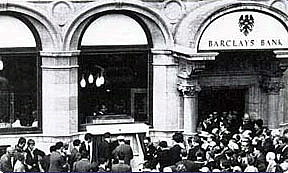
dispensing machine at Barclay's Bank in London.
June 27
On June 27 1967 De La Rue wins the race to unveil the first machine, drawing crowds to the unveiling.
picture courtesy De La Rue Ltd.The concept is developed by John Shepherd- Barron. He came up with a self-service machine which dispenses paper currency on a 24/7 basis. The first of this type of machines will be installed outside a north London branch of Barclays Bank in 1967.
It uses paper vouchers bought from tellers. The machine is called the De La Rue Automatic Cash System, or DACS.(7)
The concept of the ATM
established by Wenzel.
Card-eating:
Barclays and a few other banks introduce a machine that encodes cash on plastic
cards purchased from a teller. The problem is that the machine always eats
the cards, and customers have to buy new cards if they want to make more transactions.
(8)
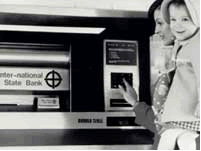
First use of ATM magstripe cards: Docutel installs
its Docuteller machine at New York's Chemical Bank. The installation marks
the first use of magnetically encoded plastic.
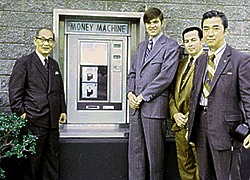
picture courtesy Omron
Chemical Bank's ad campaign announces: "On Sept. 2, our bank will open at 9:00 and never close again!"
Other manufacturers get into the game, but Docutel is the first to apply for a patent. Docutel is later credited by the Smithsonian’s National Museum of American History as being the ATM’s inventor. But most people in the industry recognize Docutel’s first machine as the first modern magstripe machine.
Donald C. Wetzel is given credit for developing the Docutel machine, which is initially met with resistance from bankers. Bankers say they’re concerned about the machine’s cost, which is about $8,000 more annually than a human teller. The bankers also fear that customers won’t like having a machine handling their money. (8)
First true bank ATMs: Docutel introduces its
Total Teller, the first true fully functioning bank ATM.
Omron
(Japan) installs the first On-line cash dispenser.
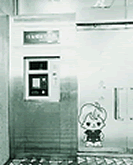
picture courtesy Omron Corp
Docutel
rewarded a patent for the ATM.
Proliferation begins: By 1973,
2,000 ATMs — mostly from Docutel- are operating in the United States.
They sell for about $30,000 each.(8)
Diebold
begins work on the development of its TABS 600 with plans for an off-line prototype.
(8)
Diebold TABS 500 picture courtesey: atmmarketplace.com
Diebold’s first TABS 500 machine, an off-line
version, is installed at a bank in Atlanta.
Diebold develops the TABS 550, an on-line and off-line version. The flexibility of the machine makes it unique and more marketable to banks.
The TABS 600 also is developed.(8)
Chungho
ComNet Co., Ltd. begins developing Teller Machines for banks.
The
first IBM-compatible Diebold machine is installed at a bank in Indianapolis. (8)
Chungho ComNet Co (Korea) begins selling Cash Dispensers
Chungho
ComNet Co (Korea) begins selling On-line Teller
Machines. Machines like this now have a direct connection via telephone lines
with the bank's mainframe computers. In later years this connection is regarded
as too high risk open for fraud and the machines' records will only
be updated once to several times a day.
ICL, the IT services company, has designed the first cash
dispenser (CD) with
a bill paying facility.
The new CD incorporates a barcode scanner, which allows customers to pay bills automatically from their bank accounts, as well for traditional cash withdrawals and to check account balances.
Banque du Caire, Egypt’s third largest bank, is the first organisation to adopt the new technology in a bid to reduce queues in branches and offer customers a more convenient service. ICL will design and integrate 100 new cash dispensers for the bank in a deal worth £2.4million.
The first people to be able to use the service will be customers of an Egyptian national mobile phone network. Their phone bills will incorporate a barcode holding details of the amount due, as well as their bank account number at the Banque du Caire. The customer simply sweeps the barcode over the scanner at the cashpoint, keys in their PIN number and the bill is paid.

|
Last Updated on 17 April, 2006 | For suggestions please mail the editors |
Footnotes & References