


click on the home button to go to the home page
|
The Industrial Era 2005 - 2006 From this chapter on we will observe game technology more closely which is hand over hand taking the lead in computer developments Since you honestly can not speak of historic events for this period and like the previous period (2002-2004) the editors continue the idea to display the trends in computing that drew attention in previous five or ten years. As well as promising inventions and other developments that might be of future value. Also this page will display some less serious subjects, just to get a smile on your face. If you have an idea of what should be displayed on this and the next pages please mail us. |
pre history | antiquity | pre industrial era | industrial era
| 1947 | 1949 | 1950 | 1952 | 1955 | 1958 | 1961 | 1963 | 1965 | 1969 | 1970 | 1972 | 1974 |
| 1976 | 1978 | 1980 | 1981 | 1982 | 1984 | 1986 | 1989 | 1991 | 1993 | 1994 | 1996 | 2000 |
| 2002 | 2005 |
| Related Articles | |
| Supercomputing | |
| Related Resources | |
 |
 On
February 23, Christie's holds an auction of rare documents and artifacts
related to the growth of technology called "The Origins of Cyberspace:
A Library on the History of Computing, Networking & Telecommunications".
The auction brings in more than $700,000 (initially valued at over 1.2 million).
The auction—the first of its kind—is a signal that there's a
growing interest in collecting technology, just as one might collect art. On
February 23, Christie's holds an auction of rare documents and artifacts
related to the growth of technology called "The Origins of Cyberspace:
A Library on the History of Computing, Networking & Telecommunications".
The auction brings in more than $700,000 (initially valued at over 1.2 million).
The auction—the first of its kind—is a signal that there's a
growing interest in collecting technology, just as one might collect art.
The Computer History Museum(2)(*) is able to purchase some of the artifacts available at the auction, as some are purchased by others and then donated to the museum.(1) |
| May
- Google now indexes over 8 billion pages |
 |
|
|
 |
|
State
of the art prediction by Ian Pearson, head of the futurology unit at British
Telecom:
'If you draw the timelines, realistically by 2050 we would expect to be able to download your mind into a machine, so when you die it's not a major career problem,' Pearson told The Observer. 'If you're rich enough then by 2050 it's feasible. If you're poor you'll probably have to wait until 2075 or 2080 when it's routine. We are very serious about it. That's how fast this technology is moving: 45 years is a hell of a long time in IT.' (3)
We'll just wait and see if your editor is still talking to you by then ;=)
This
entry is just for fun: students of the University of Informatics of Kopenhavn
Denmark receive the idea of brewing an open source beer during a workshop
on intellectual rights given by Rasmus Nielsen.
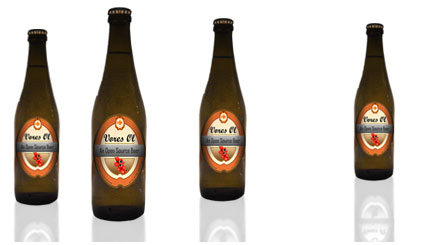
picture courtesy http://www.voresoel.dk; accessed 20050728
An expert on brewing beer also got invited and the students develop a recipe. The result is "Vores Oel", meaning: Our Beer. Students have designed a bottle label and build a web site on which the recipe is published. As is usual with open source anyone can use the recipe as long as the source is mentioned. Just like the web browser Firefox, anyone is invited to improve on the beer as long it says that the original comes from Vores Oel.
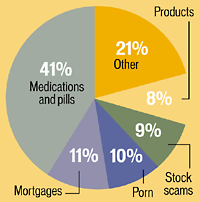
Spam
still rules the waves. Here is an illustration from Sophos,
an anti spam software manufacturer, reporting on the first half of 2005.
Nine
months (September 30) after Google started its "print" project Yahoo
is following suite and forms the Open Content Alliance with Adobe and Hewlett-Packard.

The universities of California and Toronto, as well as the British National Archives are also part of the Alliance. California will offer 18,000 books to go on line. Books free from copyrights are freely available.
In January the MIT Media Lab launched a new research initiative
to develop a $100 laptop—a technology that could revolutionize how we
educate the world's children.
See the handle at the right side? With this you can crank the battery, turning it for 4 minutes will give you battery power for 15. The one megapixel low cost screen should do just fine.

MIT's 100 dollar PC
A non-profit association, One Laptop per Child (OLPC), has been created to fund this initiative, announced by Nicholas Negroponte, Lab chairman and co-founder, at the World Economic Forum at Davos, Switzerland. The $100 laptops will not be available for sale through the commercial channels and will only be distributed to schools directly through large government initiatives. (5) In November the association showed the first prototype to Koffi Anan in Tunisia.
simputer, picture courtesy simputer.orgThis is not a unique project though, in 2001 in India a group of scientists also constructed a comparable machine in the form of a PDA. This product was called: Simputer. But this one costs between $130 and $260, depending on screen size and type (monochrome or color)(6) For most farmers in India a steep price with a yearly income below $750 (7)
2006
Spam
intensifies to 96% of all email, the number of contagious viruses increases
per day.
Mobile phones and PDA's are increasingly infected with viruses targeted at mobile devices running on Debian linux or Palm OS.
Yahoo
and AOL introduce the email stamp. An idea previously proposed by Microsoft
to dam the flooding of spam.
Here is our stamp ;=)
thocp mail stamp designed by thocp
higher resolution upon requestThey propose a levy of 0.25 to 1 U$ cent for companies. Yahoo and AOL will guarantee that mails provided with a stamp will pass filters as "friendly" spam, contrary to mail infected with viruses, or mail intended to PHish, or just plain spam.
On
2 march 2006 Wikipedia
the
free internet encyclopedia made by thousands of volunteer contributors
worldwide passes the 1.000.000 English language articles. Wikipedia started
on 15 January 2001.

image courtesy of wikipedea.org
On December 15 2005, the science journal Nature conducted a study to find out the quality of encyclopedia's in general. It appears that Wikipedia's quality is not less than the traditional encyclopedias like Encyclopedia Britannica.
How reliable is Wikipedia?In order to test its reliability, the science journal Nature conducted a peer review of scientific entries on Wikipedia and the well-established Encyclopedia Britannica.
The reviewers were asked to check for errors, but were not told about the source of the information.
"Only eight serious errors, such as misinterpretations of important concepts, were detected in the pairs of articles reviewed, four from each encyclopedia," reported Nature.
"But reviewers also found many factual errors, omissions or misleading statements: 162 and 123 in Wikipedia and Britannica, respectively." (8)
Read on how the research was conducted here.
News at Seven is developed at North Western University in Illinois. News@7 will be available at the end of this year says Kristian Hammond, one of the developers.
It works like this, you start with adding your preferences and the news avatar compiles your daily news show. The program looks for RSS feeds, video clips, blogs and other information related to your preferences on the internet and sets up your personal news show.
(this expands the idea of Google Alerts enormously eds.)
The above picture is from a demo that is now offered via WUI's site. The avatar is still somewhat slowish and moves rather irkish but it clearly shows where this type of services is headed. It has in other words enormous potential.
There are now more than 100 million web sites on the Internet.
picture courtesey Netcraft.com (10)
The Internet has doubled in size since May 2004, when the survey hit 50 million. Blogs and small business web sites have driven the explosive growth this year, with huge increases at free blogging services at Google and Microsoft. From the picture above one can see that only half of the sites are active. Most of the latter only serve as mail box or billboard and no activity is detected therefor.
August 1995 18,957 hosts April 1997 1 million sites February 2000 10 million September 2000 20 million July 2001 30 million April 2003 40 million May 2004 50 million March 2005 60 million August 2005 70 million April 2006 80 million August 2006 90 million November 2006 100 million Data based on Netcraft.com

|
|
Last Updated on March 1, 2007 | For suggestions please mail the editors |


