click on the home button to go to the home page

 |
 |
 |
 |
 |
| The Pre Industrial Era 1886-1899 Calculators are constructed that begin to have some of the characteristics of computers as defined by Babbage. This era produces mainly calculators that have single predefined purposes. The Zero-th computer generation start in this period too. In this era, various companies will electrify the mechanical calculators and begin to add storage features, the ability to manipulate stored results, and the capability of printing the results to paper. The industrial revolution is in full gear during this period and its great achievements are built on the use of numbers. Advances in practically all areas are bringing progress to commerce, transportation, manufacturing, and construction. These advances also brought complex new engineering
challenges. |
pre history | antiquity | pre
industrial era | industrial era
1886 -
1900 - 1927
- 1938 - 1940 - 1944
|
In general one might say that a "computer" is a mechanical
or Electromechanical contraption. The calculations are performed
in strict sequential order. Calculations will perform in predefined
steps in a predefined order and there is no branching to other calculations,
memory functions or such. In the years that will follow more and more mechanical parts will
be replaced by electrical circuits. Just as an example: remember what happened with the infinitesimal
calculus between Newton
and Leibnitz
in 1687? It shall be some 100 years before computer science is recognized as a science at all. Until then it will be regarded as: "Wise men playing with their toys" and persons toying with these machines as "extravagant". |
|

 |
In later years this invention promoted the creation of tape recorders "to record sound" and later data recorders "to record data". |
 The Westinghouse
Manufacturing Company, founded by George Westinghouse, installs the first alternating-current
(AC) electrical power system in 1886 and fights to establish it as the standard
in lieu of the early direct current (DC) system established by General Electric
(GE). Both companies finally pool their patents and agree on the AC standard
in America. (11)
The Westinghouse
Manufacturing Company, founded by George Westinghouse, installs the first alternating-current
(AC) electrical power system in 1886 and fights to establish it as the standard
in lieu of the early direct current (DC) system established by General Electric
(GE). Both companies finally pool their patents and agree on the AC standard
in America. (11)
American Arithmometer
Company founded William Burroughs.
The connection
between Boolean algebra and circuits based on switches is recognized by an educator
called Charles Pierce, but nothing substantial happened in this area until Claude
E. Shannon will publish his 1938 paper.
(17)
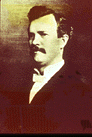
 (9)By
1887 Dorr E. Felt had built eight machines and decided
to try to sell them.
(9)By
1887 Dorr E. Felt had built eight machines and decided
to try to sell them.
He encountered several problems. It was as much a struggle to get the machines on the market as it was to invent them. Also, he would have to train the operators. (Such training, incidentally, turned into a highly profitable sideline in later years.) According to Felt, college professors as a rule ignored this step forward into mechanical mathematics, and bookkeepers seemed to think that it was an interference with their chosen vocation.
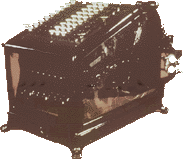
However, in a few years the Comptometer, advertised as "The Machine Gun of the Office," and the Burroughs key driven adding and listing machines became the most popular accounting machines. (9) The picture shows the punch keyboard of such a Comptometer.
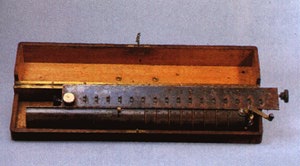
Otto Büttner
a mechanical engineer from Dresden Germany, develops a calculator
that performed the four basic calculations.
This machine combined the stepping and gear wheel technology. And that makes this one a historical unique case in the development of calculators.
 |
|
 |
|
 |
|
 |
|
Heinrich
Herz experiments with electromagnetic waves that will become known as radio
waves.
This discovery was the seedbed for the new technology of recording, CRT's, and sound.
Nikola Tesla patents the rotating field motor May 1, he later sells the
rights to George Westinghouse.
This invention helps create and transmit AC power and today is still a method for generating and distributing AC power.
 |
Hollerith's original patent (download apr. 1Mb) |
A 19-year-old
Frenchman, Leon Bollee of Le Mans, unaware of Verea's patent, built his own
machine: "machine a calculer".
The machine was a direct multiplier, using the principle of a built-in multiplication table.

picture digitally enhanced by thocp, courtesy musee des arts
et metiers
(18)
It was huge, unhandsome and impractical. Bollee built several of these machines as well as other smaller types, but in later years he became more interested in designing, building and racing light automobiles.(9) One of his machines can be seen at the "Musee des Arts et Techniques" in Paris, France.
First
printing desk calculator is invented by Dorr E Felt.
US
Census results are tabulated for the first time with significant mechanical
aid by the punch card tabulators of Herman Hollerith (1860-1929) of MIT, Cambridge,
Mass.
This is the start of the punch card industry. The cost of the census tabulation is 98% *higher* than the previous one, in part because of the temptation to use the machines to the fullest and tabulate more data than formerly possible, but the tabulation is completed in a much shorter time. Another precedent is that the cards are read electrically.(14)
Jun 1, The U.S. census stands at 62,622,250. The US government uses the Jean Baptiste Pacard card punch to tabulate the results of the census. Herman Hollerith designs a system that uses a machine with a sorter.(15)
Mar
11, Vannevar Bush is born. He developed the 1st electronic analogue computer.
Philips
& Co. is founded by Gerard Philips in Eindhoven (the Netherlands), Philips
first products will be light bulbs
The
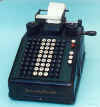
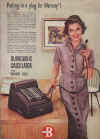
first commercially successful desk calculator is sold by William Burroughs.
Burroughs started construction in 1888. His machine is similar to Felt's but more robust, and this is the one that really starts the office calculator industry.(14) Earlier attempts were made but were unsuccessful
 Four
years after Bollee's invention a machine is introduced by a Swiss :Otto Steiger.
His machine is using the multiplication table block from Bollee's machine in
a commercially marketable form.(9)
Four
years after Bollee's invention a machine is introduced by a Swiss :Otto Steiger.
His machine is using the multiplication table block from Bollee's machine in
a commercially marketable form.(9)
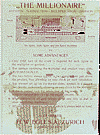 The
machine, called the Millionaire, was developed primarily for big business.(9)
The
machine, called the Millionaire, was developed primarily for big business.(9)
 and
was immediately used by scientists.(9)
and
was immediately used by scientists.(9)
Guglielmo
Marconi builds the first radio transmitter.
A bell could be sounded at a distance of 10 meters with this technology.
27. November.
In Wakayamy in Japan Konosuke Matsushita (Mat-Sosch-ta) is born.
He will found Matsushita Electric Corp. MEC will merge with amongst others: JVC, Panasonic, Loewe Optra Technics, Panasonic and National. And thus become the worlds largest (consumer) electronics company well into the 21st century.
 (9)
(9)
In the past
few years the development of calculating devices mushroomed.
And inventions were daily news. It is therefore remarkable that no radically new concepts evolved from the data processing industry from 1890 to the late 1930's.
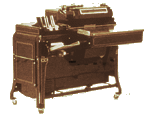
But still some very significant technological discoveries were made in the communications and electronics industries which ultimately had a huge effect upon the course of data processing. Shown here is the collator and the tabulator.
In
1888 Obeline Smith made the basic suggestion for magnetic storage of data. In
1895, Poulsen invented the magnetic recorder.
Ludwig Boltzmann
(1844--1906) Austrian physicist and philosopher, held the chair of Mach from
1902--1905. He introduced the H-Theorem in his lectures on Gas Theory, which
formed the basis for Shannon's
Information Theory.
Entropy Formula (Boltzmann) S = k.logW
One of these famous "he couldn't be wrong more" 1895/1899 "Everything that needed to be invented is now invented." Lord Kelvin, president of the Royal Society of the UK |

Hollerith
founds the first company that will later become part of IBM: Computing Tabulating
Recording (CTR)
Sir Joseph
John Tompson 1856-1940 (USA) discovers the electron.(12) The
first smaller than an atom part. He uses the improved hydrogen vacuum pumps
to get this results.
German scientist
Karl Ferdinand Braun invents the Cathode-Ray Oscilloscope.
Valdemar
Poulsen invents a magnetic wire on which data can be recorded.
This is a very important invention because later this principle will be used for magnetic tapes and consequently magnetic drums and platters. The latter will be called hard disks.
Sir Joseph
John Thomson (1856-1940) discovers the electron

The 17th of
July, NEC Corporation is founded
|
Last Updated on 8 October, 2006 | For suggestions please mail the editors |
Footnotes & References