click on the home button to go to the home page
|
The Industrial Era 1949 The First Generation of computers start approximately in this era and computers were characterized by electromechanical mechanisms and partly programmable. In this chapter the transistor will be developed and the first stored program computers come on line |
pre history | antiquity | pre industrial era | industrial era
| 1947 | 1949 | 1950 | 1952 | 1955 | 1958 | 1961 | 1963 | 1965 | 1969 | 1970 | 1972 | 1974 |
| 1976 | 1978 | 1980 | 1981 | 1982 | 1984 | 1986 | 1989 | 1991 | 1993 | 1994 | 1996 | 2000 |
| 2002 | 2005 |
| Related Articles |
 buy our CD for easier off line browsing |
| Related Resources |

BINAC 1949
 BINAC
Binary Automatic Computer is built for Northrop.
BINAC
Binary Automatic Computer is built for Northrop.
This computer is made by the company of Eckert en Mauchly Electronic Control Co., Philadelphia, and one of the first computers that made use of magnetic tape. It is the first computer to operate in real time. During the development of the BINAC Mauchly developed the so called Short Order Code and is thought to be the first high-level programming language (opinions differ over whether BINAC ever actually worked) The BINAC consists actually of two computers which carried out operations simultaneously and compared the results. It is the first computer to work in real time. The BINAC will be delivered in September to Northrop.

The Whirlwind
computer, constructed under the leadership of Jay
Forrester at MIT's Digital Computer Laboratory, to be the first real-time
computer, is placed in service during the third quarter. It contains 5,000 vacuum
tubes.

EDSAC 1949
EDSAC
(Electronic Delayed Storage Automatic Computer), a stored-program (program
and data both modifiable in storage) computer built by Maurice Wilkes and
Renwick at Cambridge University, England.
It performs its first calculation on May 6. It uses paper tape I/O, and is the first stored-program computer to operate a regular computing service. In August the relocation loader is added to the "initial orders" of the EDSAC.
|
 |
Alan Turing sends a letter to the London Times on artificial intelligence. |
|
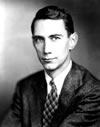 |
Claude Shannon of MIT builds the first chess playing machine but will never exploit it. |
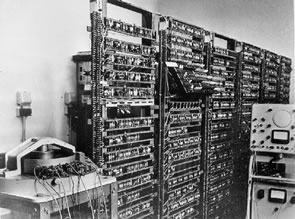

Manchester Mark I
From the Small-Scale
Experimental Machine (also called the "Baby") a full-sized machine
was designed and built, the Manchester MARK-1
By April 1949 the MARK I will be generally available for computation in scientific research in the University. With the integration of a high speed magnetic drum by the Autumn (the ancestor of today's hard disk) this is the first machine with a fast electronic and magnetic two-level store. It in turn is the basis of the first commercially available computer, the Ferranti Mark 1, the first machine off the production line being delivered in February 1951.(1)
First Germanium
transistors are available.
Computers in
the future may weigh no more than 1.5 tons., Popular Mechanics, forecasting
the relentless march of science.
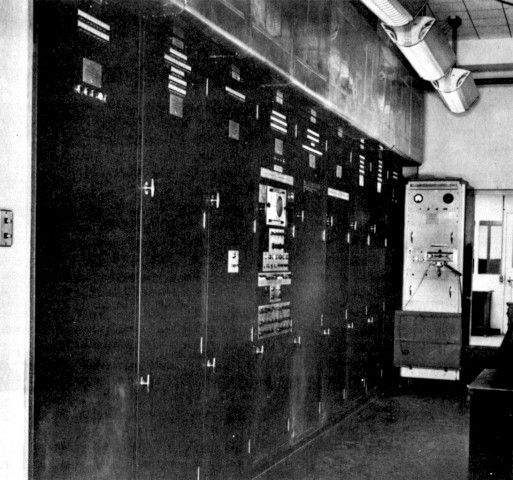
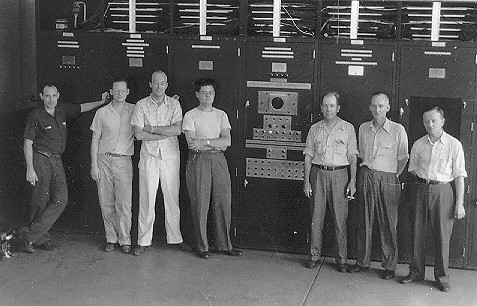
The EDVAC 1949 and the team who build it
EDVAC (electronic
discrete variable computer) First computer to use Magnetic Tape.
This is a breakthrough as previous computers had to be re-programmed by re-wiring them whereas EDVAC could have new programs loaded off of the tape. Proposed by John von Neumann, it was completed in 1952 at the Institute for Advance Study, Princeton, USA.
Bell Computer,
Model VI .
Burroughs Adding
Machine Company establishes an electronics research laboratory in Philadelphia,
Pennsylvania.
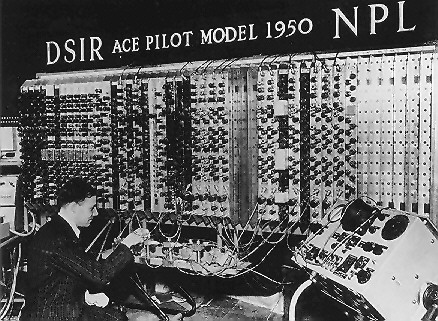
Pilot ACE 1949
Early this
year construction is started on Pilot ACE at the National Physical Institute.
CSIR Mk I
(later known as CSIRAC), Australia's first computer, ran its first test program.
It is a vacuum tube based electronic general purpose computer. Its main memory stored data as a series of acoustic pulses in 5 foot long tubes filled with mercury.
Grace Murray
Hopper joins the Eckert-Mauchly Corporation as senior mathematician.

IBM CP(e)C
IBM CPC -
Card Programmed (electronic) Calculator is introduced
Jay Forrester
uses iron core memory for main computer memory storage.
Iron core storage will be used for more than two decades and is replaced by semiconductor memory in 1964.
Konrad Zuse
founds the computer company Zuse KG at Neukirchen building a line of Z computers
using valves vacuum tubes, and later transistors.
|
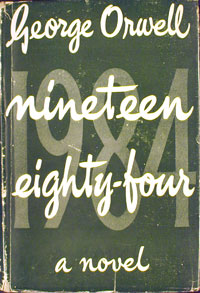
George Orwell (ps of Eric Arthur Blair 1903 - 1950) publishes "1984", in which computers are used to enslave the population.
|
picture courtesy Brown University Library |
The Harvard-MARK
III, the first of the MARK machines to use an internally stored program and
indirect addressing, goes into operations again under the direction of Howard
Aiken.
Siemens AG
purchases the Zuse KG company.
Work on the
SWAC Standards Western Automatic Computer was begun at the National Bureau of
Standards under the name "ZEPHYR."
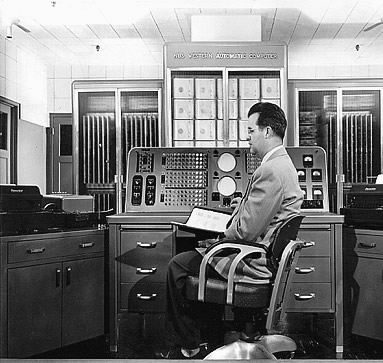
SWAC 1949
January, The
SWAC is started at the National Bureau of Standards' Institute for Numerical
Analysis.
 |
|
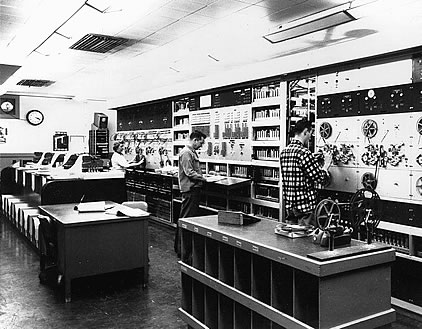
Mark III 1949
September,
The Harvard Mark III becomes operational.
October, The
Manchester Mark I final specification is completed.
This machine notably being the first computer to use the equivalent of base/index registers, a feature not entering common computer architecture until the second generation around 1955.
October, The
Manchester University computer, the Manchester Baby, or officially known as
the small-scale electronic machine (SSEM) is fully operational at Manchester
University.
One of these famous citations of "They couldn't be wrong more" 1949 "Computers in the future will contain 1,000 vacuum tubes and probably weigh more than 1,5 tons" Popular Mechanics Magazine. |

|
Last Updated on June 17, 2006 | For suggestions please mail the editors |
Footnotes & References
| 1 | ref: http://www.computer50.org/; "the Birth of the Modern Computer" |