you are here: main page > reference > robotics
|
Note from the editor: Robots have been fascinating to the human race as soon as they started to think about machines or simulacrums. This narrative will display a timeline on robotics. Future attachments will explain more in depth the workings of robots and developments in robotics: hardware, software and artificial intelligence. The status of this page is to give you a first impression of the history of robotics and will be extended regularly. If you feel developments or events have been skipped or wrongly interpreted or need additional information or you want to become co-editor of this Robotics section, or contribute in any other way, please contact the editor |
Keynotes
|
~3500 BC
 Greek
myths of Hephaestus and Pygmalion incorporate the idea of intelligent robots.
Greek
myths of Hephaestus and Pygmalion incorporate the idea of intelligent robots.
Egyptians
invent the idea of thinking machines: citizens turn for advice to oracles,
which are statues with priests hidden inside.
Babylonians
develop a water clock named the "clepsydra."
This water clock is considered one of the first "robotic" devices in the history of man kind. The water is recycled through a kind of siphoning system.
~700 - 800 BC
First
symbolic mention of robots - automatae - appears in Homer's Iliad(7) -
or simulacra as they will be called.

Here they are called "Golden Servants" made by the Greek mythological god Hephaestus: the binding god. His particular power's are to mold metals into living beings made of precious metals. In Greek mythology, heavens are made of metal (bronze or gold) and Hephaestus is known as the celestial smith.
Archeologists will find hollow statues in which were hidden substances, believed to be potions, that should give mythological powers to these statues. A conclusion can be made that in the believe of the early Greek culture these statues would come, or were, alive and guard the premises when needed. Just like the Golden Servants that serve the god Hephaestus in his celestial forge are alive, given a soul by Hephaestus.
427 BC
In the Phaedo and later works Plato expresses ideas, several millennia before
the advent off the computer that are relevant to modern dilemmas regarding
human thought and its relation to the mechanics of the machine.
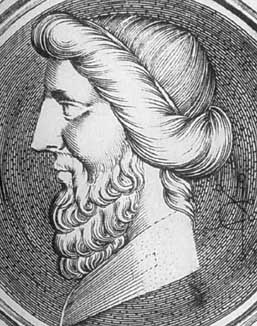
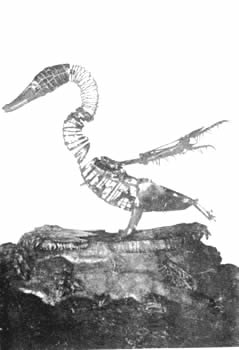
Archytas of Tarentum, a friend of Plato, constructs a wooden pigeon whose movements are controlled by a jet of steam or compressed air.

The
brilliant Greek mathematician, Archytas of Tarentum builds a mechanical
bird dubbed "the Pigeon", that is propelled by steam. It serves
as one of histories earliest studies of flight, not to mention probably
the first model airplane.
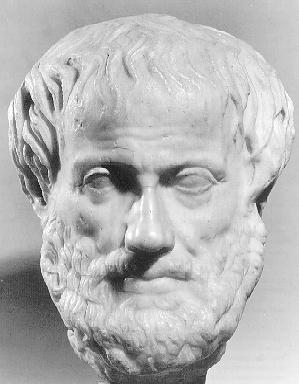
The Greek philosopher Aristotle writes...
“If every tool, when ordered, or even of its own accord, could do the work that befits it... then there would be no need either of apprentices for the master workers or of slaves for the lords.” ...
hinting how nice it would be to have a few robots around.
The
Greek inventor and physicist Ctesibus ('ti sib ee uhs') of Alexandria
designs water clocks that have movable figures on them.
Water clocks are a big breakthrough for timepieces. Up until then the Greeks used hour glasses that had to be turned over, after all the sand ran through. Ctesibus' invention changes this because it measures time as a result of the force of water falling through it at a constant rate. In general, the Greeks of this epoch are fascinated with automata of all kinds often using them in theater productions and religious ceremonies.
In China artisans develop elaborate automata, including an entire mechanical
orchestra.
The
Greek tradition is revived by Marcus Vitruvius Pollio (90 -20 BC, who
describes several automata and developed the canon of proportions,
which will become the basis of classical anatomical and architectural
aesthetics.
(5) (3)
One
of the first stories of A.I.,
as a story is written of how a man falls in love with a statue he has
created that has come to life.
Hero
of Alexandria detailed several automata that were used in theater and
for religious purposes. He also designed automata that opened the gates
on hydraulic principles.
A Chinese engineer and a Buddhist monk build the first
true mechanical clock a water-driven device with an escapement that causes
the clock to tick.

Arab
authors also designed complex mechanical arrangements.
The most famous amongst them is Al-Jazari. He wrote Automata - which is considered the most important text for the study of the History of Technology. This book is richly illustrated and gives the state of the art of technology in the middle ages and shows how advanced technology in that time was compared with the western countries.(6)
Talking heads were said to have been
created, Roger Bacon and Albert the Great reputedly among the owners.
Automated
carillons begin to appear in the Netherlands.


In
approximately 1495, before he began work on the Last Supper, Leonardo
designed and possibly built the first humanoid robot in Western civilization.(4)
The robot, an outgrowth of his earliest anatomy and kinesiology studies recorded in the Codex Huygens, was designed according to the Vitruvian canon. This armored robot knight was designed to sit up, wave its arms, and move its head via a flexible neck while opening and closing its anatomically correct jaw. It may have made sounds to the accompaniment of automated drums. On the outside, the robot is dressed in a typical German-Italian suit of armor of the late fifteenth century. This robot would influence his later anatomical studies in which he modeled the human limbs with cords to simulate the tendons and muscles.(3)
In the 16th century Clockmakers extended their craft to
creating mechanical animals and other novelties.
The technology of clockmaking has contributed considerably to the contruction of Atomata and calculators alike.
The
first real android in human form that has been recorded is thought to
have been built, approximately in this year, by Hans Bullmann at Nuernberg
Germany.
He is said to have created quite a few androids - simulated people of which some can even play musical instruments to the delight of paying customers. (16)
Contemporary with Bullmann was Gianello Torriano of Cremona (1515-1585). One of his figures, that of a woman lute player, survived and is now in the Kunsthistorisches Museum in Vienna.(20)

Torriano, a lady figurine playing the lute. (28)
In
his laboratory at Nuernberg, scholar Johann Müller, a.k.a. Regiomontanus,
is reputed to have created an iron fly and an artificial eagle, both of
which could take to the air. Supposedly with steam pressure.(16)
In
England, John Dee creates a wooden beetle that can fly for an undergraduate
production of Aristophanes' Pax.(16)
Here
is a fine example of the technology of automata in the sixteenth century.
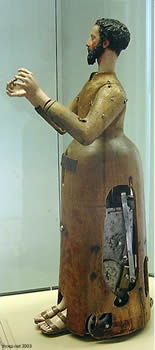
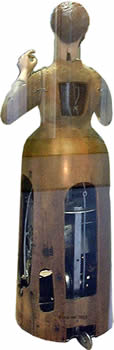
Shown here is a wooden monk, apr 30 centimeters in height, with a crude lever and joints mechanism. The purpose of this puppet will remain guesswork, and how long it took to create it too. But with our contemporary tooling it would certainly take a few months to get this intricate machinery working. A scientist in historic tooling would probably give it a year, but to our opinion at least 2 years of trying and retrying. This proves that making automata still went on during the dark ages. (the above pictures are taken at the Deutsches Museum at Munich in Germany, and the statuette stands behind very thick glass, that's why you see some reflection in the pictures)
 picture from: Dix livres de chirurgie (Paris 1564) |
In Dix livres de chirurgie (Paris 1564) Pare Ambroise publishes a design of a mechanical hand. Made from the real thing enforced with mechanical "muscles".
|
Rabbi
Loew of Prague is said to have invented the Golem, a clay man brought
to life.
It
is in the 18th century, halfway through the Edo period, that Japan sees
the debut of puppets, called "karakuri-ningyo," with mechanisms
fitted inside that makes them move by themselves.
At about the same time, similar mechanical dolls, called "auto-mata", appear in Europe. As for the Japanese puppets, their initial development dates back to the middle of the 16th century when "Nanban (foreign) culture" made its way to the country near the end of the Muromachi Era. A close examination of the puppet's mechanism points to the particular influence of the clock making technology of Europe brought to Japan by Francis Xavier and other Jesuit missionaries.
At
the Heilbrunn chateau in Germany, a mechanical theatre is created featuring
119 animated figures that perform a play about village life to the accompaniment
of a water-powered organ.(16)
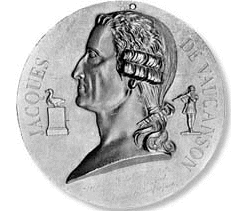
While
training as a Jesuit, Jacques Vaucanson creates flying angels which cause
him to be thrown out of the order. (16)
The
now famous word "android" is coined after German philosopher
and alchemist Albertus Magnus who attempts to create an artificial being.
French
inventor Jacques Vaucanson creates several robotic beings, including a
human-sized, flute-playing android.
Jacques
de Vaucanson begins building automata in Grenoble, France.
He builds three in all. His first was the flute player that could play twelve songs. This was closely followed by his second automaton that played a flute and a drum or tambourine, but by far his third was the most famous of them all. The duck was an example of Vaucanson's attempt at what he called "moving anatomy", or modeling human or animal anatomy with mechanics." The duck moved, quacked, flapped it's wings and even ate and digested food.
Actually
the very first writing automata, in the western world, was developed by
Knaus in 1753.
If you look closely to the top of this contraption you will observe some writing on a white rectangular piece of paper. And as was usual in these centuries, the ornaments were almost as important as the functionality of the machine itself.
German
Inventor Friedrich von Knauss creates an android able to hold a pen and
write a segment of up to 107 words.
Pierre
Jacquet-Droz starts to create life-like androids modeled after writers,
artists and musicians.
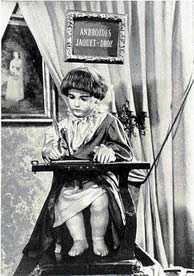
Pierre
and Henry Louis Jaquet-Droz (Swiss) invented the first automaton that
could write.
Soon after that they build another automaton that draws a portrait of King Louis XV. Taking the word 'robot' in a broad sense, we might say that their machines are some of the first working robots. They create three dolls, each with a unique function. One can write, another plays music, and the third draws pictures as the one shown here.
At the museum d'Arts et d'Histore at Neuchâtel, Switzerland, public demonstrations of the Jaquet-Droz automations can be attended. Demonstrations are held at the first sunday of each month at 14, 15, and 16 hours. Price is included in the admission of the museum.(24) The above automata draws 4 sketches, each sketch is drawn in about 3 minutes.
A nice book on this type of early automatons is written by Gaby Woods at least the fist few chapters, after that the book is less to the point.
Joseph
Jacquard builds an automated loom that is controlled with punched cards.
Punch cards are later used as an input method for some of the 20th centuries
earliest computers.
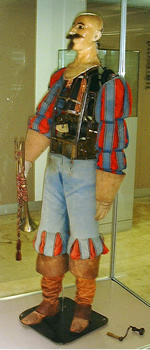
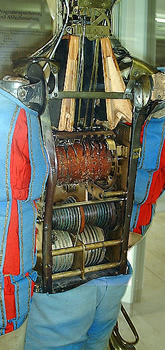
The
Mechanical Trumpeter constructed by Friedrich Kaufmann in 1810.
This is an example of a program (e.g. stepped drum) mounted into an automata to play a tune, like the European street organs. The notches mounted on the drum activated valves that let the air pass by 12 tongues. Which produced a kind of modulated sound. This sound will be modulated through a trumpet so it does sound like a trumpet The stepped drum and the bellows are powered by a spring mechanism that need to be wound up, observe the crank laying at the bottom. The height of this automata is apr. 180 cm.
Mary
Shelley writes the famous novel "Frankenstein." which is about
a frightening artificial life form created by Dr. Frankenstein.
The Frankenstein complex still resides in the mind of the general public. Pointing towards the possible mishap that will undoubtedly be caused by malfunction of robots and alike and that all machines will eventually turn against human kind. Later fears, misshapen, accidents and even novels concerning artificial life forms will deal with this so called "Frankenstein complex". In the mind of mankind robots are bound to cause accidents or other imaginary mischief.
Charles
Babbage demonstrates a prototype of his "Difference Engine"
to the Royal Astronomical Society.
He continues his work by designing an even more ambitious project "the Analytical Engine" that reportedly was to use punch cards inspired by Joseph Jacquard's invention. During his lifetime he never produces a functional version of any of the machines. Despite this shortcoming he is often heralded as the "Father of the Computer" and his work lives on as the foundation for the binary numbering system that is the basis of modern computers. A computer will form the "brain" of future robots.
Edison's
"invention laboratorium" is producing a talking-doll.
Nikolai
Tesla creates the first remote-controlled vehicles.
Seward
Babbitt (USA) designs a motorized crane with gripper to remove ingots
from a furnace. (23)

Nikola
Tesla builds and demonstrates a remote controlled robot boat at Madison
Square Garden.

The
word ROBOT is used for the first time in the context of mechanical people
in a play called "R.U.R" (Rossum's Universal Robots) by Czech
dramatist Karel Capek.
These are intelligent machines meant to serve their human makers. But the play ends dramatic as robots took over the world and destroyed humanity. The Frankenstein syndrome invented before he was even there! Karel Capek (Czech) called these powerful beings "robota" meaning forced and slavishly work. He distinguishes the robot from man by the absence of emotion.(12)
Fritz
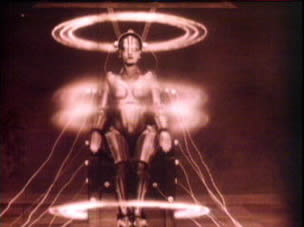
Lang's movie "Metropolis" is released.
"Maria" the female robot in the film is the first robot to be projected on the silver screen. The android is built in the form of its creator's wife. This movie is commonly known as the precursor to Star War's C-3PO.(19)
Alan
Turing introduces the concept of a theoretical computer called the
Turing Machine.
It is a fundamental advance in computer logic and also spawns new schools in Mathematics. He completes his seminal paper On Computable Numbers, which paves the way for modern computers.
The
first programmable paint-spraying mechanism is designed by Americans Willard
Pollard and Harold Roselund for the DeVilbiss Company.
1929-1938
Psychologists Clark Hull, Thomas Ross, develop the Hypothetico-Deductive
System, in an attempt to design learning robots.
|
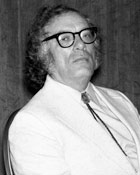 |
Asimov
is generally credited with the popularization of the term "Robotics"
which was first mentioned in his story "Runaround" in 1942.
Asimov later adds a "zeroth law" to the list:
|
continue

     |
Last Updated on 26-Feb-2006 | For suggestions please mail the editors |
Footnotes & References