


click on the home button to go to the thocp home page
|
the Pre Industrial Era 1927-1937 Between 1935 and 1940, the German scientist Konrad Zuse, worked in Berlin doing advanced research on using electric relays as ON/OFF controls that could act as a BINARY (0 and 1) counter mechanism. In 1941, he built the first computer that used the binary (DIGITAL) process using electrical relays, and also built the first vacuum tube digital computer system.
|
pre history | antiquity | pre
industrial era | industrial era
1886 - 1900 - 1927 - 1938 - 1940 - 1944
| Related Articles |
| Related Resources |

 H.J.
Zeeman (the Netherlands) discovered that silicon
acts like a metal. Later, in 1930, it will be discovered
that Silicon is a semi conductor. Silicon formed the basis of all chips (1954)
to come deep into the 21st century.
H.J.
Zeeman (the Netherlands) discovered that silicon
acts like a metal. Later, in 1930, it will be discovered
that Silicon is a semi conductor. Silicon formed the basis of all chips (1954)
to come deep into the 21st century.
Remington Typewriter
and Rand Kardex merged into Remington Rand.
On Sept.
7, 1927, Philo Farnsworth demonstrated the first working television.
He painted a square of glass black and scratched a straight line on the center. In another room, Pem's brother, Cliff Gardner, dropped the slide between the Image Dissector (the camera tube that Farnsworth had invented earlier that year) and a hot, bright, carbon arc lamp. Farnsworth, Pem and one of the investors, George Everson, watched the receiver. They saw the straight-line image and then, as Cliff turned the slide 90[degrees], they saw it move--which is to say they saw the first all-electronic television picture ever transmitted.
This by the way is a third instance of where different people claimed an invention that had to straitened out in court: Farnsworth vs RCA
Fritz
Pleumer (Germany) patented his magnetic tape. Data could be recorded and
read back. The invention was based on that of Valdemar
Poulsen who invented the magnetic wire in 1898.
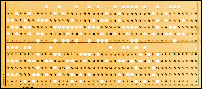 The
punched card with 45 holes was replaced by one with 80 holes.
The
punched card with 45 holes was replaced by one with 80 holes.
The 45 holes were regarded as limiting and changing it to 80 holes made the punched card one of the most important data carriers until the 1990's. Because IBM, as the most important manufacturer of computing devices and peripherals marked the 80 columns card as a standard it rapidly became the industry standard.
The
quartz crystal clock makes possible unprecedented time-keeping accuracy.
John
von Neumann's minimax theory is published; the theory is later used in game
playing programs.


 First
form of fax machine patented by Rudolf
Hell, a German engineer who pioneered in sending messages over long distances.
The machine was called the "Hell Schreiber"
First
form of fax machine patented by Rudolf
Hell, a German engineer who pioneered in sending messages over long distances.
The machine was called the "Hell Schreiber"
The Hellschreiber used the transmitted pulses to write images of characters directly on paper tape. Thus, Hell writing could be considered as a simple form of facsimile, covering seven image lines per character, with seven elements per line.
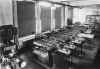 Vanevar
Bush, of MIT (USA) developed the Analytical Difference Engine. His machine was
based on the analogue movements of segmented parts of calculating and ordinary
gears. It was the most accurate calculating machine made in this time.
Vanevar
Bush, of MIT (USA) developed the Analytical Difference Engine. His machine was
based on the analogue movements of segmented parts of calculating and ordinary
gears. It was the most accurate calculating machine made in this time.
John Bernard Gudden discovered
that Silicon in pure form worked as an insulator, but the pure material behaved
as a metallic conductor.
That he discovered the principle of a transistor with this discovery he did not realize. But scientists of the Bell laboratories soon realized that one could create tracks of impurities in pure crystalline material. By doing that one created a kind of "corridor" for electrons to travel by.
The principle to introduce impurities was called "doping". And this was done by shooting with an electron canon on the silicon crystal or another carrier.Read
A Hungarian
scientist, Tihamer Nemes, filed a patent application in Germany for the principle
of making an optoelectrical system automatically transcribe speech.
His idea was to use the optical sound track on a movie film as a grating to produce diffraction patterns (corresponding to speech spectra), which then could be identified and typed out. The application was turned down as “unrealistic.” Since then the problem of automatic speech recognition has occupied the minds of scientists and engineers, both amateur and professional.(6)
E.
Wynn-Williams, at Cambridge, England, constructed a binary digital counter by
using thyratron tubes and used that principle in connection with a physics experiments.(14)
On
14 December 1931, Alan Blumlein applied for his famous patent, No.394,325, Binaural
Sound.
In which he described in great detail, an electronic method of reproducing sound from two microphones and two loudspeakers. He called this system 'Binaural' from the human factor of having two ears by which we hear sound. Because this patent was so far ahead of its time, it needed another 20 years before it was fully appreciated, long after Blumlein's tragic early death in 1942. Of course, today, we know Binaural as 'Stereo'. After 70 years his ideas for 'surround' sound were rediscovered and put to use in movies, theatres and computer gaming.
Reynold
B. Johnson a high school teacher in Michigan, devises a way to score mutiple-choice
tests by sensing conductive pencil marks an answer sheets. IBM later buys the
technology and will adapt it to read data mechanically.
|
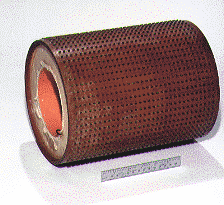 |
G. Taushek (Austria) invents on the basis of a principle discovered by Pleumer: the magnetic drum.
|
Quantum theory
of solids developed.
This theory provides insight into the mechanical theory of the structure, cohesion, and static and dynamic processes in solids, particularly crystalline solids such as Silicon. The basic material of the chip.
EMI engineers
W F Tedham and J D McGee turned Campbell Swinton's (see 1908)
dream into reality by producing the first electronic picture pick-up tube in
secret experiments, contrary to the orders of their bosses at EMI. They displayed
their images on a cathode ray tube.(21)
Canon
corp. is established.
Thomas
Flowers, working in London at the British Post Office Research Station at Dollis
Hill, designs electronic digital equipment for controlling the connections between
telephone exchanges. This is the proto technology for vacuum tubes switching
to be used by computers. Flower's first prototype will go on line in 1939.
On the Moore School of Electrical
Engineering of the University of Pennsylvania an electronic differential-analyzer
was constructed.
The first fax
transmission via a telephone line took place. The transmission of a photo
from California to New York (NY) took about 30 minutes!
International
Business Machines introduced the "IBM 601",
a punch card machine with an arithmetic unit based on relays. Capable of doing
a multiplication in 1 second. The machine became important both in scientific
and commercial computation, and about 1500 of them will eventually be made.(15)
While
not using the practical technology of the era, Alan Turing developed the idea
of a "Universal Machine" capable of executing any describable algorithm, and
forming the basis for the concept of "computability".
The Universal Turing Machine.
In 1935, at Cambridge University, Turing invented the principle of the modern computer. He described an abstract digital computing machine consisting of a limitless memory and a scanner that moves back and forth through the memory, symbol by symbol, reading what it finds and writing further symbols. The actions of the scanner are dictated by a program of instructions that is stored in the memory in the form of symbols. This is Turing's stored-program concept, and implicit in it is the possibility of the machine operating on and modifying its own program. (In London in 1947, in the course of what was, so far as is known, the earliest public lecture to mention computer intelligence, Turing said, "What we want is a machine that can learn from experience", adding that the "possibility of letting the machine alter its own instructions provides the mechanism for this" . Turing's computing machine of 1935 is now known simply as the universal Turing machine. (22)
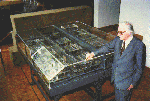 Konrad
Zuse (Germany) started to construct the Z1, world's first
programmable computer, in his bedroom.
Konrad
Zuse (Germany) started to construct the Z1, world's first
programmable computer, in his bedroom.
This machine became so large that it occupied his parent's living room as well. Shown here is a reconstruction and the inventor is standing next to it at the Deutsches Museum in Munich, Germany. Financing the project was not simple. Zuse's retired father went back to work at the postal services and friends donated money. At some time the machine worked. And thanks to a demonstration on an aviation show Zuse got support from the government and could establish a workshop to continue to develop more sophisticated models.
Alan
M. Turing (UK 1912-1954) published his article: 'On
Computable Numbers'.
Here Turing explained his ideas on the 'Universal Turing Machine', an electronic calculator. A machine that could make any calculation or logical operation. His model is theoretical and geared towards solving mathematical problems. A working model will not be made. But his ideas will determine the internal architecture of computers in the future.
IBM sells its
first electrical typewriter.
This earned them a market share of over 80% in the next few years.
The American
psychologist Benjamin Burack from Chicago (USA) develops what is probably the
first electrical Logic Machine: the Syllogism Machine. (7)
Burack's device uses light bulbs to display the logical relationships in a set of propositions, but for some reason he didn't publish anything about his work until 1949. (8) The machine belongs now to the national collections of the Smithsonian Institute in Washington, USA.
Claude
E. Shannon (USA 1916-? ) writes his master's thesis on machine logic.
It will take a separate article in 1938 to get his idea across, but then it becomes fully recognized as a giant step in computer science. Shannon realizes in his paper that an electric circuit used the same concept as Boolean Algebra. If an electric circuit is designed according to Boolean rules, it can be used to represent logic. Expressions can be validated and calculations be made. It became clear that information could be manipulated by a machine. Shannon’s publication had a tremendous effect and marked a turning point in the development of modern computer science.(16)
Howard
Aiken (USA) graduated at Harvard in physics and developed plans for a machine
that executed commands step by step.
He approached James W. Brice of IBM to discuss 'automatic calculators to calculate physic problems'.
Mid 1939 the discussions were finalized and the building and design subcontracted to Clair D. Lake and a group of engineers of the Endicott laboratories. That is how the Automatic Sequence Controlled Calculator (ASCC) a.k.a. Harvard MARKI came into existence.
Instructions are fed into the machine on a paper tape (see above), cards, or by setting switches. The numbers on which the instructions are to operate are stored in registers. The Mark I is an electromechanical machine. Its basic operations are performed by mechanical parts which are controlled electrically by about 3,000 relays. Although obsolete by the time it went into operation at Harvard in 1944, Mark I operates for more than 15 years and produces valuable mathematical tables. Aiken, who was familiar with the work of Babbage once remarked, "If Babbage had lived seventy-five years later, I would have been out of my job."
While Mark I is solving U. S. Navy math problems, plans are underway for a machine that is going to make the breakthrough from automatic to electronic processing of data.
George
Stibitz (c.1910-) of the Bell Telephone Laboratories (Bell Labs), New York City,
constructs a demonstration 1-bit binary adder using relays.


This is one of the first binary computers, although at this stage - see picture above - it is only a demonstration device. Improvements continue and are eventualy leading to the 'complex number calculator' of Jan. 1940.(15)
Dr. John V. Atanasoff and his
assistant Clifford Berry begin to build the first electronic digital computer.
In 1942 it will be finished and named ABC. It is not programmable but it provides the foundation for the next advances in computers.(17)

|
Last Updated on 4 October, 2006 | For suggestions please mail the editors |
Notes & References
