|
The Pre Industrial Era 1900-1926 The first logic built into calculating machines. Calculators got more and more business oriented and
were no longer for scientists only but business people as well. |
pre history | antiquity | pre
industrial era | industrial era
1886 - 1900 - 1927 - 1938 - 1940 - 1944
| Related Articles |
| Related Resources |
|
|
 Leonardo
Torres y Quevedo built two electro mechanical chess machines that could
play the endgame of king and tower against a tower. But he saw no future in
it because, like Babbage, he felt restricted by the mechanical constraints and
tolerances
that could not be met at the time.
Leonardo
Torres y Quevedo built two electro mechanical chess machines that could
play the endgame of king and tower against a tower. But he saw no future in
it because, like Babbage, he felt restricted by the mechanical constraints and
tolerances
that could not be met at the time.
Herman Hollerith
introduced an automatic punch card feeder that processed the census of 1900
a lot faster.

The
first calculator that solved a problem faster than it could be done by hand,
was Jevons' Logical Piano.
The elements for logical automata already existed - for example the self-regulating machines using "feedback". These machines could be programmed by punched cards and tape.
Writers were
venturing into the future. Samuel Butler began his
novel, Erewhon, with an essay entitled "Darwin Among
the Machines."
Allan Marquand,
a Princeton professor, developed a machine that solved very simple logic problems.
Below is the picture of its "output screen"
In his correspondence
the philosopher, Charles S. Pierce, showed a
deep insight into what machines could be.
In commenting on Marquand's machine, Pierce suggested that a system of batteries
and switches could be hooked up to solve very difficult problems in formal logic.
This would include most of the theorems of algebra and geometry. This was almost
like the basic idea to the modern computer: "All arithmetic operations
have electrical counterparts".
Max
Planck described the quantum effect. This theory will become very important
in later developments of micro processors. The development of quantum computers
would have been unthinkable without this theory.
Marconi
organized the first Trans Atlantic radio broadcast from Newfoundland
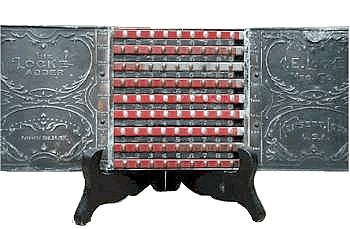
Locke's slide calculator (23)
Clarence
E. Locke of Kensett, Iowa, received a patent in 1901 for his multi-slide calculator,
the main features of which were that users would not have to change the machine's
position to find the results and that the slides were lockable and easily distinguished.
(24)
"The advertisement that appeared in McClure's in 1901 read as follows:
'Why don't you use the Locke Adder? It's the modern office appliance that is practically adapted to the needs of a growing business. The Locke Adder takes care of the computation of business details. No office systematically equipped without it. It's the fastest, simplest, handiest, most practical, durable, low priced calculating machine. Adds, Subtracts, Multiplies, Divides. Easily learned-lasts a lifetime. "It's more rapid
than you and always accurate." Quickly pays for itself. Ensures accuracy, releases from mental strain. Adds all columns simultaneously. Capacity 999,999,999. It is a valuable aid to the busy accountant, and as this useful machine, can be had for only $5.00, one should be in every business office.'
C.E. Locke Mfg. Company 21 Walnut Street, Kensett, Iowa." (23)
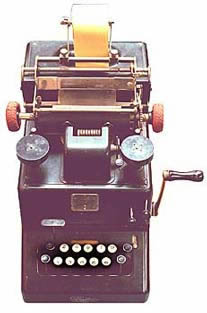
The
Dalton, introduced in 1902, was the first adding machine to use a ten-key keyboard.
The layout, however, differed somewhat from today's standard as the digits 2, 4, 5, 7, 9 were in the top row, and 1, 3, 0, 6, 8 in the bottom row. The same keyboard layout was used in the Facit calculators.(21)
A
young electrical engineer called Frank Pearne is approached by Mr. Joy Morton,
the president of the Morton Salt Company.
Pearne has been experimenting with printing telegraphs and needed a sponsor. Morton discuss the situation with his friend and mechanical engineer Charles L. Krum, and they decide in favor of this project.
After a year of unsuccessful experiments, Pearne looses interest and wanders off into the sunset to become a teacher. Krum will continue to investigate the telegraph mechanism and is joined by his son Howard in 1906. In 1910 they will deliver a working telegraph system.

Yazy Ryoichi "Arithmometer" 1902
The
first calculators starting to appear in Japan this one is from Yazu Ryoichi
(22)

Willbur
en Orvile Wright construct the first mechanical airplane. Man becomes
airborne.
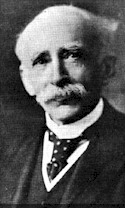

John
Ambrose Fleming files a patent for the first vacuum tube: a diode.(17)
A
very succesful handheld calculator the Golden Gem is manufactured.
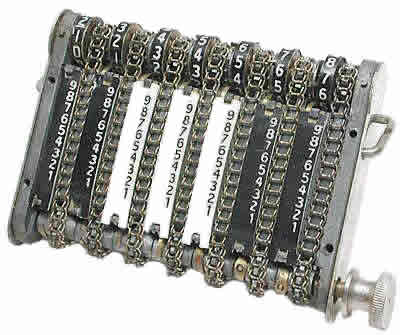
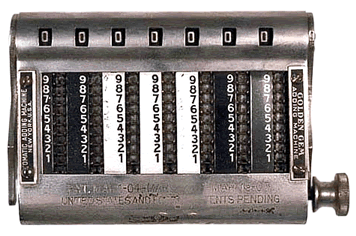
picture courtesy vintagecalculators & research.microsoft.com
This one is special since it is a chain adding machine. Not seen very often in this period. Can perform addition only, and made by the Automatic Adding Machine Co., New York, U.S.A.
Einstein
described his theory of relativity, a new way of thinking started in the scientific
community.
A turning point in thinking! Spurting scientists towards further development in mathematics, physics and astronomy. Following from this developments it leads to the atomic bomb, possibility of space flights is no longer a Jules Verne's phantasy, and the theory of probability further prospered. Just to name a few.

The
first use of aluminum in calculators was in the Adix company's "pocket"
calculator.
The bars inside the case were of aluminum that kept the weight down. The case is lined with blue velvet.
Lee
DeForest (USA) introduces a third electrode called "the grid"
into the vacuum tube and he calls it: "Triode".
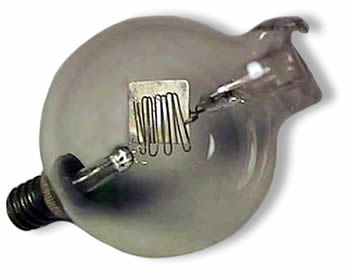
Lee de Forest's Triode or Audion (25)
This triode, also known unde the name of Audion Tube (from the words audio and ionize), is mainly used as a component for amplifiers in radio's but serves as an electronic switch as well and quickly replaces the electro mechanical relays which revolutionized computing. Lee deForest files for a patent the next year. (12) Without this invention it would be impossible to design digital electronic computers. (15)
The desk calculator
by Brunsviga (approximately 1906) is introduced.
The calculating mechanism is based on the principle of the stepped cylinder designed by Odhner. This device will be the father of all office desk calculators.

Henry Babbage,
Charles Babbage's son, with
support from R. W. Munro's firm, completed the mill of his father's Analytical
Engine, just to show that it would have worked, and it did!
The complete machine however will never be produced.(15) The London Science Museum will start to reconstruct this analytical engine in the late 20th century.
L.
Torres developed a formal language to describe machines.
This will be used later by Claude Shannon in his Information Theorem.
The Austrian
physicist Robert von Lieben filed patents for
an electronic tube in 1907 and 1910(11);
one of the original tubes can be seen at the Technisches Museum Wien
Lee
de Forest also filed a patent for vacuum tubes,(12) an
invention he made a year earlier.
Again a fine example for the need of something to be invented. And this invention happened in two separate places by two different inventors.
By the time the judicial system in the USA was in place to protect ones inventions many court cases were fought out over who invented what. An example of this is Atanasoff versus Mauchly on who invented the Electronic Binary computer, Atanasoff won after a legal battle of over 15 years.
First C-T-R
Tabulating Machine was produced(13)
Alan Archibald
Campbell Swinton proposes an electronic system of photography, it will take
about 25 years to make a practical system.(19)
In this way he describes an electronic scanning method and foreshadows the use of the cathode-ray tube for television.

Henry
Prevost, the youngest son of Charles Babbage, completed a calculator that
was based on his father's analytical engine.
He worked on this intermittently from his father's death in 1871. This manually operated machine could do the four basic calculations of adding, subtracting, division and multiplication and also print the results. He published after completion of his machine a table of multiples of the number pi with a 28 digit precision. A remarkable result in this time.
The mechanical
and electrical talents of Krum Senior and Junior complemented each other.
And after solving the problem of synchronizing the transmitter and receiver, they will see their first installation on postal lines between New York City and Boston in the summer of 1910.(14) The telegraph will be a fact and it will be one of the major developments that will speed up economic growth.
This technology will prove to be crucial in the development of the telephone and thus (remote) communication between computers.
Heinke
Kamerlingh Onnes (Leiden, the Netherlands), together with Mr. Dorsman
and Mr. Holst, reports to the Royal Academy of Sciences
(Koninklijke Academie van Wetenschappen) on the 27th of May, that they
have discovered the properties of Super
conductivity of Hydrogenium at a temperature of 4.3K (0 Kelvin = -273 Celsius).
No theoretical thesis is developed at that time, and no one knows what to do
with it yet.
Superconductivity, will be discovered later, is a phenomenon that occurs in certain metals when they are cooled down close to absolute zero (minus 273.7° C or 459.7° F.). In that state, they lose all resistance to the flow of electric current.
It will be explained by Bardeen, Cooper and Schrieffer with their "BCS theory" (their initials) in 1957. At extremely low temperatures, they will say, electrons are coupled with one another (in so-called Cooper pairs), cease their random collisions and flow unhindered. Superconductivity may lead to more efficient transmission of electrical power(26). Superconductivity will be adapted in the High Performance Computing industry.
Hollerith's
company - Tabulating Machine Company - merged with two other companies
to Computing Tabulating Recording
Company. Below the logo of that company.

Eventually this will become IBM - International Business Machine Corporation in 1924. De new firm produced not only calculators but also weighing machines and time clocks.
Bertrand
Russel and Alfred North Whitehead published their three-volume Principia Mathematica
an influential work on the foundations of mathematics that provided a new methodology
for all mathematics.(17)
Tokuji
Hayakawa founded a steel factory in Tokyo. From the mechanical pencil in 1915
- always sharp- the name of the Sharp company is derived
A.
Meisner invented the vacuum tube radio transmitter(17)
Charles
P. R. Macaulay constructs a logical machine to solve logical problems.(20)
|
  |
Albert
Einstein completed his theory of gravitation known as the general theory of
relativity
Physicist
Manson Benedicks discovers that AC can be converted to DC using the germanium
crystal, setting the stage for the later development of microchips.
The remaining series of faster and faster additional revolutions
should culminate in an "Omega point" (Teilhard de Chardin, 1916) expected
around 2030-2040.
|
 |
|
 |
|
 |
W. H. Eccles and F.W. Jordan discover that two triode valves could be connected to form a circuit possessing two stable states - the basis for the so-called flip-flop.
|
The proton
discovered, the proton makes up the atomic nucleus together with the neutron
and is the positive part of the nucleus.
Norton Hinckley
and Dave Tandy put their money, earned in a leather factory in Dallas, into
the founding of the Hinckley-Tandy Leather Company.
Later this will be the Tandy Corporation manufacturing affordable computers for consumers.
The Dutchman
Hugo Koch invented a machine capable of encrypting messages.
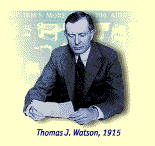
The input was done via a keyboard, the machine then produced encoded text at the output side. The difference between this and other coding machines was that the same letter would not necessarily encode into the same character every time. For example, suppose you typed the letter 'a', and 'g' came out at the other side. The next time you typed 'a', an 'u' might come out, rather than the 'g' that you expected. This made enciphered text very difficult to decrypt, since frequency analysis solved nothing. But Koch found little interest in his machine, and so he sold it to a German engineer named Dr. Arthur Scherbius. The latter improved the machine, and began to seek out interested parties. He renamed the machine to "Enigma", and was able to sell it to the German government. At first the German military were reluctant to put the Enigma into use(1) but soon the possibilities were recognized.
The first cash
register that prints numbers is introduced on the market by C-T-R (later IBM).
Leonardo Torres
y Quevedo built a calculator that used a type writer for the in- and output.(18)
Jan
Lukasiewicz develops the Reverse
Polish Notation (RPN) as a way to write a mathematical expression
without using parentheses and brackets.
By writing operators in front of their operands, instead of between them, brackets were made unnecessary. The RPN proved to be very practical in computerprogramming. The first "calculator" to use RPN was the HP9100A, which was introduced in 1968, although this machine is now regarded by many as the first desktop computer. The
In
Boston a radio station RadioShack was set-up. In 1940 this firm will publish
its first mail order catalog
Vladimir
Kosma Zworkin holds the first demonstration of an electronic television camera
tube.

Mar 5, International
Business Machines (IBM corporation) is formed after more mergers involving the
Computing - Tabulating - Recording Company - see 1911.
By 1990 IBM will have an income of around $69 Billion (and 373,816 employees). The 1992 recession will cause a cut in stock dividends (for the first time in the company's history) and the sacking of 40,000 employees. (15)
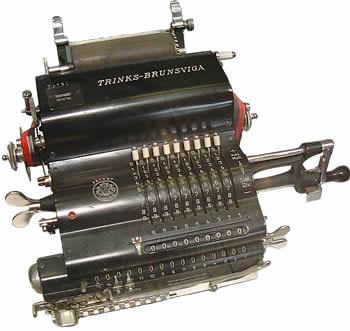
In
different countries and by different manufacturers simular calculators with
the four basic functions (+-/*) are manufactured.
One of these types is shown above: the Brunsviga. Other makes are a.o. Odhner, Giessler, and Gauss; all build on the same principle: stepped gear. The machines are much more sophisticated then the original Odhner from 1904
The
first television receiver based on the principle of the Braun's
tube was demonstrated in Germany.
Until the beginning of the 21st century this will be the main technology to view data directly from the computer. It will be called CRT (Cathode Ray Tube) or Computer Screen.
Mathematicians have been fascinated
by primes for centuries. Prime numbers are unusual numbers that can only be
divided by one or themselves. The numbers 1,3,5,7,11,13,17,19, ... etc. are
such prime numbers.
 Mathematicians in the future looking to solve complicated problems in number
theory just crank up a computer.
Mathematicians in the future looking to solve complicated problems in number
theory just crank up a computer.
But that wasn't an option during this period. At the University of California's Derek Lehmer did his computing on a mechanical computer designed by him from bicycle chains and sprockets. Derek Lehmer -- whose interest was finding prime numbers and solving equations -- built mechanical aids to help him do the number crunching.
Left the bicycle chains and electric motor helped Professor Lehmer to track down prime numbers.
The bicycle chain contraption used a concept called the "number sieve," which was first laid out by the Greek thinker Eratosthenes in 200 BC.
Lehmer went on to build other number sieves. One of them used 16 millimeter film strips, and another used metal gears. The machines were capable of performing 300,000 mathematical tests a minute. Today's computers do that in fractions of a second.
Before Lehmer put those chains to work, his father had painstakingly punched holes in sheets of paper -- using the patterns to search for prime numbers. It wasn't glamorous work. You would wonder what they were thinking while they were doing this because they had to wait so long to get the answer, and think about how easy it would be to make a mistake.
Derek Lehmer went on to deliver many lectures describing his low-tech number crunchers. The machines have now become museum pieces. And, today, people marvel at what they could do long before computers changed the world of mathematics.
There's been a close connection between the world of computers and prime numbers. Mathematicians still log countless hours on supercomputers searching for primes since prime numbers are the basis for super-secure codes that protect digital data.(7)
Lilienfeld patents the first
semiconductor as a device for amplification.(8)

|
Last Updated on February 23, 2007 | For suggestions please mail the editors |
Notes & References