click on the home button to go to the thocp home page
|
The Prehistoric Era 1310 - 1617 Europe just slipped out of the dark ages. In Asia
sciences had their top days.
The first mechanical calculators showed up in Europe.
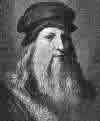
Leonardo Da Vinci did he really invent a mechanical
calculator?
|
pre history | antiquity | pre
industrial era | industrial era
0000 - 469
- 1310
 |
|
|
||||||||||||||
The earliest
reference to computers came from a writer called Trevisa.
He wrote about "Compotystes" meaning persons that occupied themselves with calculations of time.
Circa 1403-09
an encyclopedia of over 20,000 chapters, the Yongle Dadian(17),
is compiled in China.
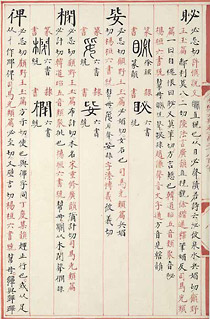
picture courtesy: Cornell University Library
An encyclopedia is a written compendium of human knowledge at the time of publishing.
A few centuries after the Dadian is published a few attempts by Ephraim Chambers in the UK 1728, and a project led by Denis Diderot in France 1771 (16)) will create similar encyclopedias but these will be just a shimmer of the Yongle Dadian. Another but this time more successful encyclopedia is created between 1768 and 1771, the Encyclopedia Britannica (EB). And thanks to improved printing techniques and facilities this one will be re-published several times, well into the 21st century.
Encyclopedia Britannica (18)In the 19th century in most countries works like the EB were published. Most active were North America (American Encyclopaedia), France (Encyclopédie), and Germany (Brockhaus). Though the methodology of the encyclopedists did not change much during the centuries (entries organized in hierarchical or alphabetical order) at the end of the 20th century a new technology of publishing is used: CDROM. Amongst the most known are MS-Encarta and EB. While since 2000 the World Wide Web offered online encyclopedias like Wikipedia.
Do you want to know more
?

These
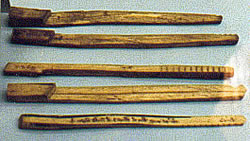
tally sticks were used by the exchequer in the UK to keep track of taxes. (see
also David
Birch's article on Tallies
and Technology)
Regiomontanus
is rumored to have made a mechanical eagle that flies
out from the city ramparts to greet the Holy Roman Emperor on one of his visits
to Nuremburg.
This seems to have happened sometime between 1471-1475, the time during which Regiomontanus lived there.(20)
|
 |
|
 |
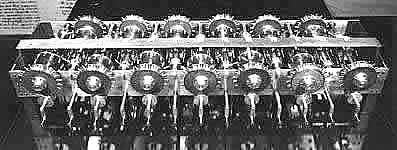
This is the reconstruction of his calculator, its present location is unknown to the editors |
 |
 Before
he began to work on the Last Supper, Leonardo designed and possibly built the
first humanoid robot in the
Western civilization.
Before
he began to work on the Last Supper, Leonardo designed and possibly built the
first humanoid robot in the
Western civilization.
The robot, an outgrowth of his earliest anatomy and kinesiology studies recorded in the Codex Huygens, was designed according to the Vitruvian canon. This armored robot knight was designed to sit up, wave its arms, and move its head via a flexible neck while opening and closing its anatomically correct jaw. It may have made sounds by the use of automated drums. On the outside, the robot is dressed in a typical German-Italian suit of armor of the late fifteenth century. This robot would influence Da Vinci's later anatomical studies in which he modeled the human limbs with cords to simulate tendons and muscles.(13)
|
 |
|
 |
Peter Henlein,
a craftsman from Nuremberg Germany, creates the first watch.
The first spinning-wheel
became in use in Europe.
This is a nice example of parallel inventions, since these kind of wheels were also developed in India and thereabouts but much earlier.
A Florentine
merchant named Francesco Lapi uses the '@' sign for the first time in recorded
history in a letter.(10)
The increasing
sophistication in technology of clocks and watches resulted in making more complicated
kinds of automata during the European Renaissance.
Gianello Toriano's mandolin playing lady is a famous example. This "clock" technology would become of crucial importance to the further development of computer technology.
Do you want to know
Nicolaus
Copernicus published the Revolutionibus,
in which he stated that the planets and earth were moving around the sun.
With this statement he recreated the contemporary human relationship to God as this was felt by the clergy. And as usual the authorities (i.e. the church) did not like his 'revolutionary' vision. He had a hard time surviving in the 16th century society, where all sciences and arts were subsidized by the clergy or nobility. Being supported as an artist or scientist by a maecenas (well doer) is not uncommon in this time. and the church effectively silenced Copernicus by withdrawing her support. A method still in use by modern-day politicians.
Joost
Buerghi (Switzerland) developed the Logarithm
table(6).
This marks a milestone in the development of mathematics. Much later it appeared that without the development of logarithms the computer would have taken much longer to develop.
|
|
Galileo Galilei
develops his geometric and military compass into a general purpose mechanical
analog calculator, to be known as the Sector.
William
Gilbert coins the term electricity from the Greek word elektra.
Around this
year the first clock showing minutes and seconds is built by Joseph
Burghi, Switzerland

In Padua, Italy,
Galileo Galilei (1564-1642) publishes "Le Operazioni del compasso geonerico
et militare" a manual for the sector he developed in 1597
John Napier
made the first printed use of the decimal point (after it had been invented
in the Netherlands) and invented logarithms, and several devices for multiplication.
The "bones" he invented were an aid to multiplication, though perhaps the chessboard calculator is the most ingenious and least known!
|
|
Lord John Napier published his findings on logarithms in his tractate "Mirifici Logarithmorum Canonus Descriptio" (Description of the admirable Canon of Logarithm) and influenced with this paper the entire development of mathematical science in the United Kingdom and beyond. |
|
Napier's book is published posthumously : "Rabdologiae, sue Numertionis per Virgulas Libri duo" in which he explained extensively the method for division and multiplication using his "Napier Bones".(7) |

|
Last Updated on 25 July, 2006 | For suggestions please mail the editors |
Footnotes & References
 The
The