|
The Prehistoric Era 469 BC - 1300 AD This era is regarded as the era that mechanical means of calculation were introduced though with very limited possibilities. In China a complete mechanical orchestra was built! The early western philosophers adapted the idea that mind and body were two separate things. The foundations of mathematics traveled slowly from the far east towards the west |
pre history | antiquity | pre
industrial era | industrial era
0000 - 469 - 1310
| Related Articles | |
| Tallies
and Technologies by David Birch |
|
| Related Resources | |
| pre history antiquity pre-industrial era Industrial era |
|

 Socrates,
mentat of Plato, was the first western thinker who said that mental activities
were taking place in ones sub consciousness.
Socrates,
mentat of Plato, was the first western thinker who said that mental activities
were taking place in ones sub consciousness.
Socrates,
Plato and Aristotle were the most
important philosophers that determined the, foremost rationalistic, philosophy
of the West.
Aristotle established the bases of mathematical logic. He introduced the concept of variable in the logic, using letters for the designation of concepts. After Aristotle's work, that was considered to be the perfection, science will, or seemed to, stagnate for almost two millenia. Being a scientist during this period meant knowing your classics, e.g. Plato, Aristotle and their contemporaries
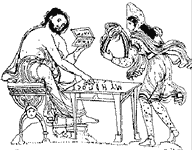
Stones, pebbles, were introduced
by the Greek as counting aids in the form of a counting board in Europe.
The Greek probably adapted the idea from the Sumerians since it looks very similar in method and form. From Greece this Abax or Abaq as it will be called spreaded through Europe. In Western Europe these counting boards staid in use for a pretty long time, but gradually people started to use the Indo-Arabic notation of numbers: "0123456789". (+/- 1200 AD)

In the Pheado
and later works Plato described various ideas relating to the human thinking.
He linked these ideas to machines. Imagine over a thousand of years before the invention of the computer!
Theaetetus,
member of Plato's academy, designed geometry.
Diophante
introduced the equal sign and was the first to use a form of symbolic language
of algebra.
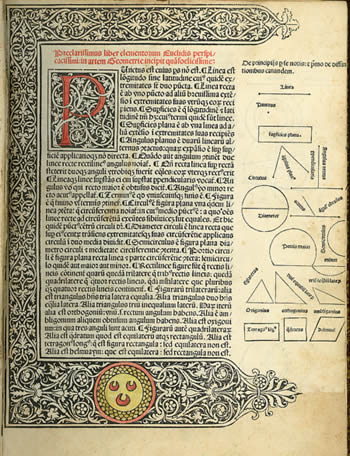
page from Elements, first issue in print Venice: Erhard Ratdolt,
1482 (20)
Euclid
(325-270BC) wrote the Elements, the world's most definitive text on geometry.
The book synthesized earlier knowledge about geometry, and was used for centuries in Western Europe as the geometry textbook.(19) Besides the Elements, there are the Data, On Divisions of Figures, the Phaenomena, and the Optics. And many more books that still are in use or were used deep into the 20th century(18)
The
counting board which later evolved to the abacus is believed to be first in
use by the Babylonians in this era.
The Sieve
of Eratosthenes (276BC-194BC) is used to calculate prime numbers. (23)(3).
Chi-Hwang-ti
orders all books in China to be burned and scholars to be put to death. (19)
In China artisans build a completely
mechanical orchestra.
An Egyptian engineer designs
a water clock that would be the most precise time
mechanism for the next 2000 years!
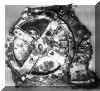
The first account of the Antikythera.
It is a disc-like instrument one can use to calculate the length of the months - at that time: 29 or 30 days. The mechanism must be set to the proper latitude and day of the week(4) in order to calculate the correct date.(27)
New research reveals the dating 150-100 BC:
The researchers, led by the mathematician and filmmaker Tony Freeth and the astronomer Mike G. Edmunds, both of the University of Cardiff, Wales, are reporting their results today [2006 11 30] in the journal Nature [Nature 444, 587-591].
They said their findings showed that the inscriptions related to lunar-solar motions, and the gears were a representation of the irregularities of the Moon’s orbital course, as theorized by the astronomer Hipparchos. They established the date of the mechanism at 150-100 B.C.(26)
|
The Year 1 In the 525 AD Dionysius Exeguüs estimated the year of Jesus of Nazareth's
birth, and proposed to use that as 'year 1', replacing the then used
Roman era. This Julian Calendar was replaced by the Gregorian Calendar
in 1582 AD, to compensate for accumulated leap-year days. Dionysius
slightly miscalculated Jesus' birthday, which is now estimated at
somewhere between 7 and 4 BC. It should be noted that there is no
such thing as a historical 'year 0'. (13)
There are other calendars like the Muslim, Chinese, and Buddhist.
They all have the year of their prophet's birth or date of dying as
a starting point. |

Zhang Heng (78-139) was a Chinese
mathematician who searched for the value of pi.
His use of the square root of 10 is one of the earliest approximations known. He also was the inventor of a primitive seismograph. (14)
Heron
of Alexandria (also written as Hieron of Alexandria) described the mechanism
or apparatus that made use of the so called "sequence
control" mechanism.
This mechanism used drums in which pins and gears were mounted to control events that 'laid ahead'.
| Definition:
Sequence control gives means to foretell the outcome of
a sequence of events in advance, without influencing the outcome directly. Sequence control is defined as a lower generation of computer programs. |
He also invented
a method for analog programming by means of strings or ropes and wrote papers
on hydraulics, mechanics, optics and geometry.
He designed a number of automata for sacral ceremonies, which were operated by weight-driven blocks and tackles. With some of them, control information could be programmed in analog form by positions and windings of the rope(11).
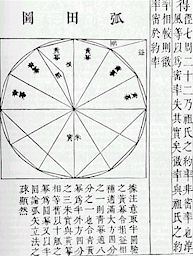
The first advanced
knowledge of the value of pi originated in China.
Above you see a diagram explaining Liu Hui's exhaustive method in 264 AD for finding the value of pi. By describing 3072 sides of a polygon in a circle, Liu Hui was able to overtake the Greeks and compute the value to a fifth decimal place at 3.14159. By the fifth century, the value was computed to ten decimal places. In the fourteenth century this knowledge however was lost in the mists of history.
By the year 1600 pi was only approximately calculated to seven places in Europe, a full twelve hundred years later.(1)When in the seventeenth century the Jesuits went to China the Chinese were impressed by the European knowledge of pi.
Eratosthenes proposed a method of finding prime numbers, named subsequently the Sieve of Eratosthenes.
In the future this 'sieve' will be used to determine either the speed of a computer or to detemine a new prime number
Decimal positional number system and arithmetics used by Aryabhata the Elder (India, 476-550)
 The
first reference to a chess game is published in India.
The
first reference to a chess game is published in India.
In the 18th century a smart businessman will hide a chessplayer in a small contraption to simulate a chess automate. It was so cleverly done that it never was discovered.
In the 20th century computer specialized companies will start building chess playing computers to prove that machines can beat humans. In 2000 IBM will build a successful combination of machine and computer program that can beat the world champion chess (Kasparov).
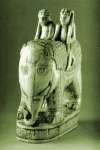
This statuette actually is from the 11th century, the piece shown has a remarkable likeliness to the chess pieces in the picture above.
Approximately
Brahmagupta (India, 598-670) calculates with the zero as a number and with fractions.
Block printing,
the first practical method of reproducing writing mechanically was developed
during the T'ang dynasty 618-907 in China.
A Chinese engineer
Liang Ling-Can builds the first fully mechanical
clock.
A water driven contraption with parts that made the clock to produce a ticking sound. The development of the mechanical clock is very important because early computers and other counting devices will directly inherit the technology from these contraptions of gears and springs. The early robots will never be constructed without the clock technology.(15)
|
The House of Wisdom in Bagdad functioned as the center of study and research in the Islamic world of the ninth century. Among its most prominent scholars were al-Khwarizmi and the Banu Musa, or Sons of Moses. The sons of a robber-turned-astrologer, these three brothers, Muhammad, Ahmad, and al-Hasan, showed a gift for learning at an early age. When their father died, the Caliph al-Mamun enrolled them in the House of Wisdom. There they excelled in the study of mathematics, astronomy and mechanics, leading research in those areas along with al-Khwarizmi. They organized and directed the work of translators of ancient Greek scientific texts. Their Book on the Measurement of Plane and Spherical Figures, which demonstrated the Greek methods for determining area and volume, became well-known in the Arab world and in Europe in the Middle Ages.(17) |
Arabic numerals (Indian, gubari format) used in Europe for the first time. The system becomes widely used in the 14th c. (15)
Also the concepts of zero and the positional system is taking hold in Europe. Gradually Arabic numerals replace the Roman', but it takes until the 17th century before the decimal system as we know it now will be universally in use.(16)
Peter Abelard (1079 -1142) composes an independent treatise on logic: conversion, opposition, quantity, quality, tense logic, ...
In short a critical philosophical treatise on the contemporary religious doctrine (21) That brought him in much distress. But thanks to his writing the phylosofy of the western world got an enormous stimulance to think beyond the "visible horizon". His logic laid the base for great thinkers.
The Indo-Arabic
figures are integrally accepted in Europe: 1 2 3 4 5 6 7 8 9 0
This did not come about easily, it took the clergy 200 years to decide that the use of these numbers from the "heretics" had its use.(10)
The work of Al-Khwarizmi (and
in particular the words and concepts of algorithm and algebra) is recognized
in Europe when Leonardo Fibonacci (of Pisa) writes Liber Abaci (Book
of Calculation). (24)
It will be one of the most influential books ever published in mathematics. He introduced the Hindu numerals 0, 1, 2, 3, 4, 5, 6, 7, 8, and 9 to Europe, along with the Latinized Arabic word, zephirum, which became zefiro in Italian, and in the Venetian dialect, zero, the name by which we know it in English today.(25)
In China, Yang Hui ( 1238-1298) uses decimal fractions in modern form.
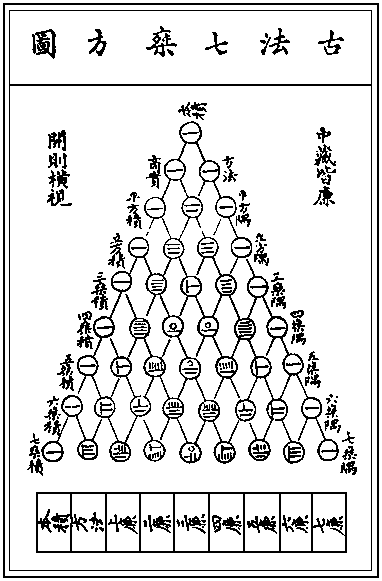
Yang also depicted the first Pascal Triangle, representing prime numbers, to depth 6. Below is an illustration from Chu Shikre to dept 8 created in 1303.(22)
Numeric presentation of pascal's triangle:
 |
|
 The
Abacus is in general use in China.
The
Abacus is in general use in China.
time
flash 15th century

|
Last Updated on April 2, 2007 | For suggestions please mail the editors |
Footnotes & References