|
The era of Antiquity 1830 - 1845 The era of Antiquity can be seen as the era of calculator
devices that had no memory, but features like output devices as well
as some kind of data storage becomes common.
Larger and more over general purpose machines analogous to that of Babbage will be constructed. The first idea of a computer is created by Babbage, be it only on paper. But the idea is there! What bothers scientists now are the limited mechanical possibilities of machinery |
pre history | antiquity
| pre industrial era | industrial
era
1620 -
1672 - 1773 - 1810
- 1830 - 1846 - 1874
|
Read on modern day transistors. |
|
 Georg en Edvard Scheutz (Sweden)
- father and son - after reading Babbage's article on his machine, start to
develop a Difference Engine themselves. They are the persons that created the
first machine that could print mechanically(!) calculated tables. The machine
will be finished in 1843.
Georg en Edvard Scheutz (Sweden)
- father and son - after reading Babbage's article on his machine, start to
develop a Difference Engine themselves. They are the persons that created the
first machine that could print mechanically(!) calculated tables. The machine
will be finished in 1843.

The design is less robust and the tolerances(14) larger than those strove for by Babbage. For us, this raises the question if Babbage's tight tolerances were really needed.
The problem of reproducing results without human errors as meant by Babbage is solved: the numbers are printed on paper maché or soft metal strips (tin of lead). These strips are used to make clichés for the reproduction of the tables.
At the same time Babbage shifts his attention to the Analytical
Engine. One that closely resembles the architecture of 21st century computers.
She translated an article on the Analytical Engine written in Italian by L. F. Menebrea, adding her own lengthy notes on the machine and its potential. This is the most important written work on the subject.
Babbage never completed his engines. But his son, Henry, spent some time later in his life working on the Analytical Engine. The assembled pieces of this machine along with the unfinished portion of the Difference Engine are at the Science Museum, London. Replicas are in the IBM collection.
Most of Babbage's contemporaries thought he was an eccentric dreamer obsessed with a slightly mad vision. Even those who tried to understand conceded only that his engine was an interesting theoretical possibility. However, looking back from this age of the computer, Babbage looks quite different.
He is seen as an unheralded prophet of the modern era, an impractical genius who could not reconcile the grandeur of his vision with the technological capabilities of his own age, and who therefore wasted most of his talents.
Joseph Henry invents the electrical
relay, a means to send electrical pulses over great distances. The foundation
for the telegraph is laid.
|
Bernoulli numbers were introduced in the 17th century and are forming a mathematical irregular sequence: B1 = -1/2, B2 = 1/6, B3 = 0, B4 = -1/30 ... Bernoulli numbers can be used to calculate the sum of squares of whole numbers. This technique will be used to crack codes in later centuries. |
The British physicist and inventor Sir Charles
Wheatstone and the British electrical engineer Sir William
Fothergill Cooke invent the first British
electric telegraph. (Sir Charles was a busy man. Amongst other things, he also
invented the accordion in 1829 and three-dimensional photographs in the form
of his stereoscope in 1838.)
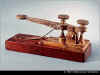
Samuel Finley Breese Morse
patents a more practical version of the telegraph.
 (23)
(23)
This one sends codes in combinations of short and long pulses: dots and strokes.

He demonstrates the construction together with Alfred Vall(15) . In 1844 the first connection between two cities (Washington and Baltimore) will be realized.(16)
|
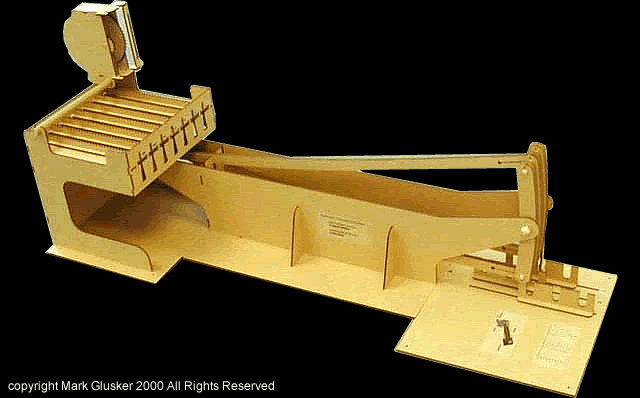
Thomas Fowler invents a calculating machine, built in wood, that was much admired by his contemporaries Augustus De Morgan, Charles Babbage, George Airey and many others. The machine used a tertiary calculating model.(24) At right is a reproduction made by Glusker and Vass
|
 |
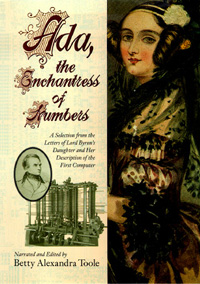
 Ada
Lovelace (1816 - 1852), after her translation of an article of the Italian
Luigi F. Menabrea (1809 - 1896) about the Analytical
Engine of Charles Babbage, designs some of the first examples of a computer
programs. It will take almost a century before her work is rediscovered and
the importance of it is realized.
Ada
Lovelace (1816 - 1852), after her translation of an article of the Italian
Luigi F. Menabrea (1809 - 1896) about the Analytical
Engine of Charles Babbage, designs some of the first examples of a computer
programs. It will take almost a century before her work is rediscovered and
the importance of it is realized.
In this age women were not supposed to do anything else than being well mannered and bear children. Some of the famous works from women are published under a pseudonym (George Sand) or under the personal name of their husband (e.g. Brahms) in order to have their work published.From a mathematical viewpoint, Lovelace was not satisfied with her translation. Nothing about the mathematical principles that laid the basis for the Analytical Engine was taught. Also about the possibilities of the Engine nothing was written. This prompted her to write the famous "Seven Notes" (A through G) in addition to the article. These notes were of importance because they describe the future possibilities of a computer.
To clarify her argumentation she writes a program to calculate the numbers of (Jakob) Bernoulli (Swiss).
It takes until 1953 before these notes are rediscovered and the importance is recognized. The Department of Defense (USA) commemorated her and named a programming language after her: ADA.(17)
In this year the principle of the Fax (Facsimile)
is invented, nicknamed the "recording telegraph". The Scottish physicist
Alexander Bain
will obtain a patent for his work. A marketable device however will not be sold
until 1861 by Giovanni Casselli.(18)
Fax is short for Facsimile and is a device that can transmit an image by electronic signals to another similar device. Other brands and flavors are at this time incompatible with one another.
Transmission via telephone lines will take another 92 years to happen. Graham Bell, in 1869, invents the telephone, and only in 1935 the first fax will transmit its signal via a telephone line.
 Babbage's Difference Engine did
contribute to a successful venture: it inspires a Swedish printer, George
Scheutz, to build his own engine to calculate differences and print tables.
He and his son Edward accomplish this in 1843. They built two machines. One
went to the Dudley Observatory at Albany, New York. The other to the Register
General at Somerset House in England. These two machines are at the Smithsonian
and the Science Museums. IBM has a replica in its collection.
Babbage's Difference Engine did
contribute to a successful venture: it inspires a Swedish printer, George
Scheutz, to build his own engine to calculate differences and print tables.
He and his son Edward accomplish this in 1843. They built two machines. One
went to the Dudley Observatory at Albany, New York. The other to the Register
General at Somerset House in England. These two machines are at the Smithsonian
and the Science Museums. IBM has a replica in its collection.
Returning to the path that led to commercial calculators: one of
the beginnings of commercial calculators coincides with the typewriter: the
keyboard, derived from musical instruments. Considerable ingenuity was required
to make this work effectively.(23)
Once Morse convinced Congress to sanction the first long-distance telegraph line, an iron wire was strung between posts from Baltimore, Maryland to Washington, D.C. -- a distance of 37 miles. On May 24, 1844, the first telegraph message, "What hath God wrought," was successfully sent and received along the first telegraph wire system.(1)

|
Last update 14 January, 2006 | For suggestions please mail the editors |
Footnotes & References