editor: J.F. van Hanswijk Pennink
retired from NCR
| Related Articles |
 buy our CD for easier off line browsing |
| Related Resources |
see also our partners site |
 |
Contact: 7 North Main Street, Dayton, Ohio 45402, USA |
 (5)
(5)
| Ascendant
Companies |
Descendent
Companies |
Assimilations
& Mergers |
||||
| Year | Company | Comments | Company | Comments | Company | Comments |
| 1884 | NCR | |||||
| 1976 | Data Pathing Inc., | An important producer of data / factory entry and processing systems. | ||||
| 1978 | Quantor Corporation | to gain computer output microfiche capabilities | ||||
| 1979 | Comten, Inc. | a leading force in data communications technology in communicating with IBM computers | ||||
| 1980 | Applied Digital Data Systems, Inc. (ADDS) | A leading supplier of high-quality video display computer terminals.
|
||||
| 1991 | AT&T | NCR is acquired by AT&T. |
||||
| 1992 | Teradata | merged with AT&T on February 28 | ||||
| 1995 | 1995 NCR |
split off, NCR is independant again | ||||
| 1997 | NCR | Dataworks inc. | A software firm that develops software for financial markets | |||
| 1998 | Stirling Douglas Group, Inc. (SDG) | A software firm and leading provider of merchandise management applications. | ||||
John H. Patterson founds the National Cash Register Company, maker of the first mechanical cash registers.
First company to commercialize cash registers
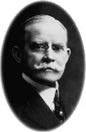 |
The first office, with 13 employees, is located in the Callahan Power
Building, in Dayton, Ohio.(6) |
 Englishman,
J. W. Allison observes the self-adding cash register at a Chicago exhibition.
Englishman,
J. W. Allison observes the self-adding cash register at a Chicago exhibition.
He learns that the machine can be adapted for English currency. He is so impressed, that he becomes NCR's first international agent, based in Liverpool, UK.
Innovative
sales techniques are instituted.
Guaranteed sales territories, quota and point systems, sales conventions, and conservative dress. Also, advertising, direct-mail, and publications for agents, customers and employees are instituted on a massive scale.
The
first company-owned factory is established on the Patterson farm land on the
south side of Dayton.
Sales
agents memorizes the NCR Primer, a book containing a sales presentation with
proven results.
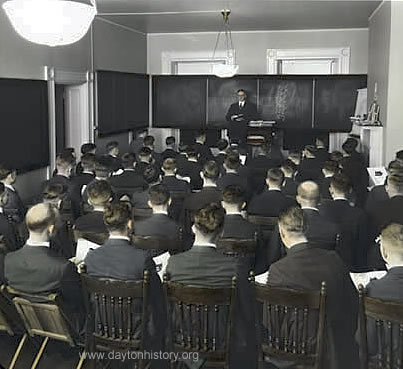
Formal sales classes are established.
Employee
benefit programs begin with hot lunches, a "glass" factory to improve
lighting and ventilation, baths, showers, exercise programs, social and professional
clubs, and many more.
NCR
suggestion system is established to encourage employee ideas for improving products
and operations.
Gold was awarded to suggestion winners.
"THINK!"
signs are erected in factory buildings, sales offices, and club rooms.
First
international convention for overseas sales agents is held.
| The
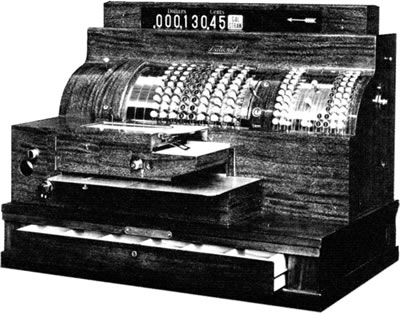
Class 35 is produced with a total register and printer. |
 |
A
tent camp is set up in Sugar Camp at Dayton, Ohio (seat of NCR) to train sales
persons, the so called“Canvas University”

Charles
F. Kettering designs the first cash register powered by an electric motor.
Within a few years, he will develop the Class 1000 register which will be in production for 40 years.
Charles
F. Kettering also develops the O. K. Telephone Credit Authorization system
for verifying credit in department stores.
The Class 500 was the most complex and ornate register manufactured by National
during this time period.(11)
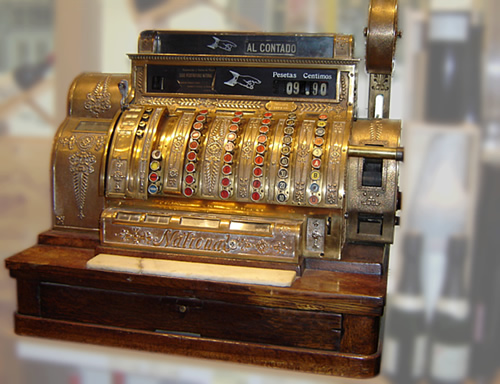
NCR Class 500
This
model was found in a wine shop near the covered market
in the Ramblas Barcelona 2006 (a shop worth visiting, very good wine selection)
It could keep track of up to nine separate totals, which meant that it could be used by nine different clerks or keep track of nine separate departments at the same time. The Class 500 is often found on stands that hold more than one cash drawer to take advantage of its power. It was also the most expensive machine produced at the time, with prices when new in 1909 ranging from $315 to $555, possibly much more if a floor stand or other options were added. The 1909 National Cash Register Catalog describes it as follows:
“Class 500 registers are furnished with five rows of keys; registering capacity, 1 cent to $99.99 and one row of special keys, and with six rows of keys, registering capacity, 1 cent to $999.99, and one row of special keys.
The
One millionth cash register is sold in NCR's 27th year of business.
NCR
saves many lives during the great flood in Dayton.
John Patterson orders flat-bottom boats made by company carpenters; a tent city is erected for the homeless; and food and medical care are dispensed. Patterson successfully heads a million-dollar relief fund.
Class
500 is a cash register with 9 cash drawers and electrically driven.
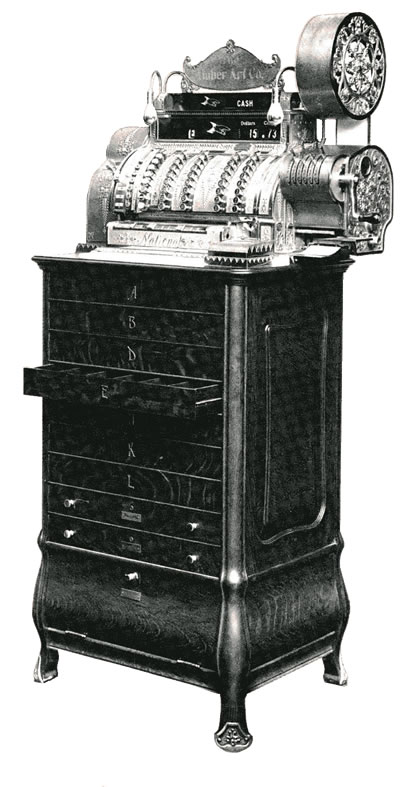
It has 10 totals and a printer. This machine can be used by 9 different employees. Thus curbing fraud, errors and possible misunderstandings.
|
|
Frederick
Beck Patterson, John Patterson's son, becomes president, and his father, chairman.
(a year before the founder's death in 1922)
The
Class 2000 bank machine is introduced, an electronic version called: "Postronic".
This machine is at once very successful since it gave perfect control over the savings account management of a bank. The machine has over 20,000 parts and is assembled by hand.
John
Patterson founder of NCR dies after have lead the company since 1884.
The
Class 2000 machine is modified for
accounting in hotels.
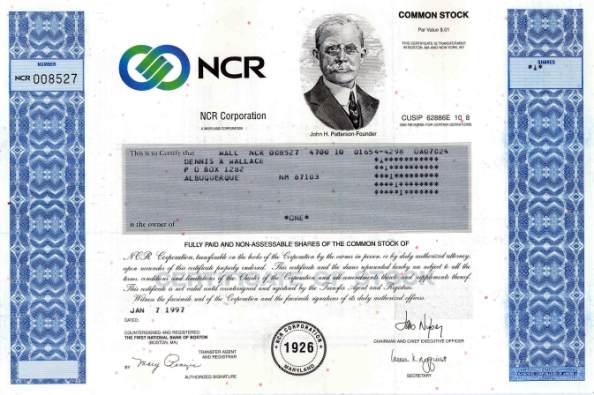
NCR
becomes publicly owned and is incorporated in the State of Maryland, USA.
NCR
buys the Ellis Adding Typewriter Company producer of the only machine that combined
a typewriter with a adding machine in one unit.
A detailed report on accounting is now possible. This concept will be improved upon by NCR making it the most flexible accounting machine in existence in the pre-electronic era (ref: NCR Class 31, 32, 33 )
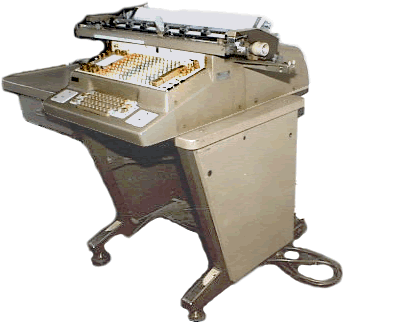
The
Class 3000 accounting machine is developed from the Ellis model having a keyboard
to input a narrative description of entries, as well as adding, subtracting
and printing features.
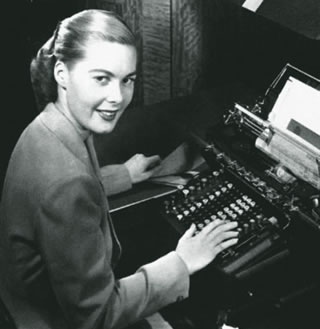
Colonel
Edward A. Deeds returns to NCR to become chairman of the board.
He left the company in 1915 to help manage Delco, a company founded by Charles Kettering. He also co-founds the Wright Airplane Company with Orville Wright and others.
NCR's
Golden Jubilee is celebrated with a "gold prospecting" sales contest
at worldwide offices.
Seven
NCR employees form a credit union with $70 capital.
The
Class 2000 is modified to process
and print pay checks in one single operation.
This will make it the most advanced electro-mechanical accounting machine ever.
The
first electronics research begin in the NCR Electrical Department. The research
team will produce a counting device using vacuum tubes by 1942.
Construction
on Old River recreational park, near the Dayton headquarters, begins.
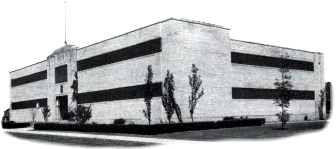
NCR building 26 ( courtesy daytoncodebreakers.org)
NCR
takes part in the war efforts during WWII and establishes a laboratory that
produces the American version of the Bombe.
A machine that will break the German Enigma Code. The research team in NCR building #26 is headed by Joseph R. Desch (1907 - 1987).
The project is seriously veiled with secrecy, classified only second after the Manhattan project - the atomic bombe, and even decades after the war engineers did not talk about this project. Engineers participating in this project have, on some level, exchange of information with the British - similar - project. Both projects are not on even "footage" but exchange of engineers between the projects happen occasionally. The Bombe is designed to break both the German (Enigma) and Japanese codes (Purple) and helped to shorten the War. It is the first electro mechanical machine to use vacuum tubes, the ENIAC is the second.
A detailed story can be found here:
and an entire website dedicated to this event is here: codebreakers
Adding
machines expand the product line with the purchase of the Allan-Wales Adding
Machine Corporation in Ithaca, New York.
The
first annual meeting of the NCR 25-year Club is held in Dayton.
NCR
engineers create magnetic memory drums attached to accounting machines, various
electronic digital displays and indicators, and signature verification systems
using video signals.
The
Class 31 accounting machine is introduced.
This machine is very versatile and can be put to service in all accounting fields. Other versions are the Class 32 en 33.
NCR
acquires Computer Research Corporation (CRC), of Hawthorne, California, which
produces a line of digital computers with applications in aviation. With this
acquisition NCR enters the computer era.
NCR
establishes the Electronics Division to continue to pursue electronic applications
for business machines.
NCR
Country Club opens in Dayton with two golf courses and a clubhouse.
NCR
carbonless paper is introduced.
NCR's
Post-Tronic, the first product with automated features, is unveiled to the banking
industry.
Stanley
C. Allyn becomes chairman of the board.
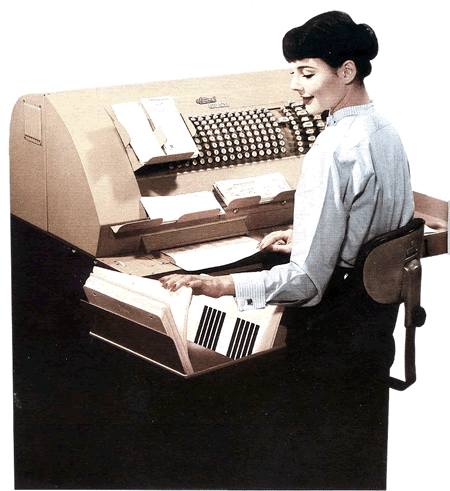
NCR
introduces the very successful Post
Tronic bookkeeping machine.
With the revenues it is possible for NCR to invest in the development of computers
Introduction of the NCR 304 business computer.
The first commercial available computer with a solid state processor.

The
NCR 304 system, the industry's first
all-transistorized, or solid-state computer for general business is marketed.
Introduction
of the NCR 315, a general purpose business computer.
It is the first computer with the ability to upgrade to a higher version in this series.
The
NCR 390 is the first low-cost, mass-marketed computer.
It uses punched tape recorders for original data entry.
The
420 optical scanner system is introduced.
It reads the entered data from cash register journals and accounting machine tapes.
The
NCR 315 computer with random-access memory, and later, all-thin-film rod memory,
is introduced.
Research
into silicon-chip technology begins.
Robert
S. Oelman becomes chairman of the board.
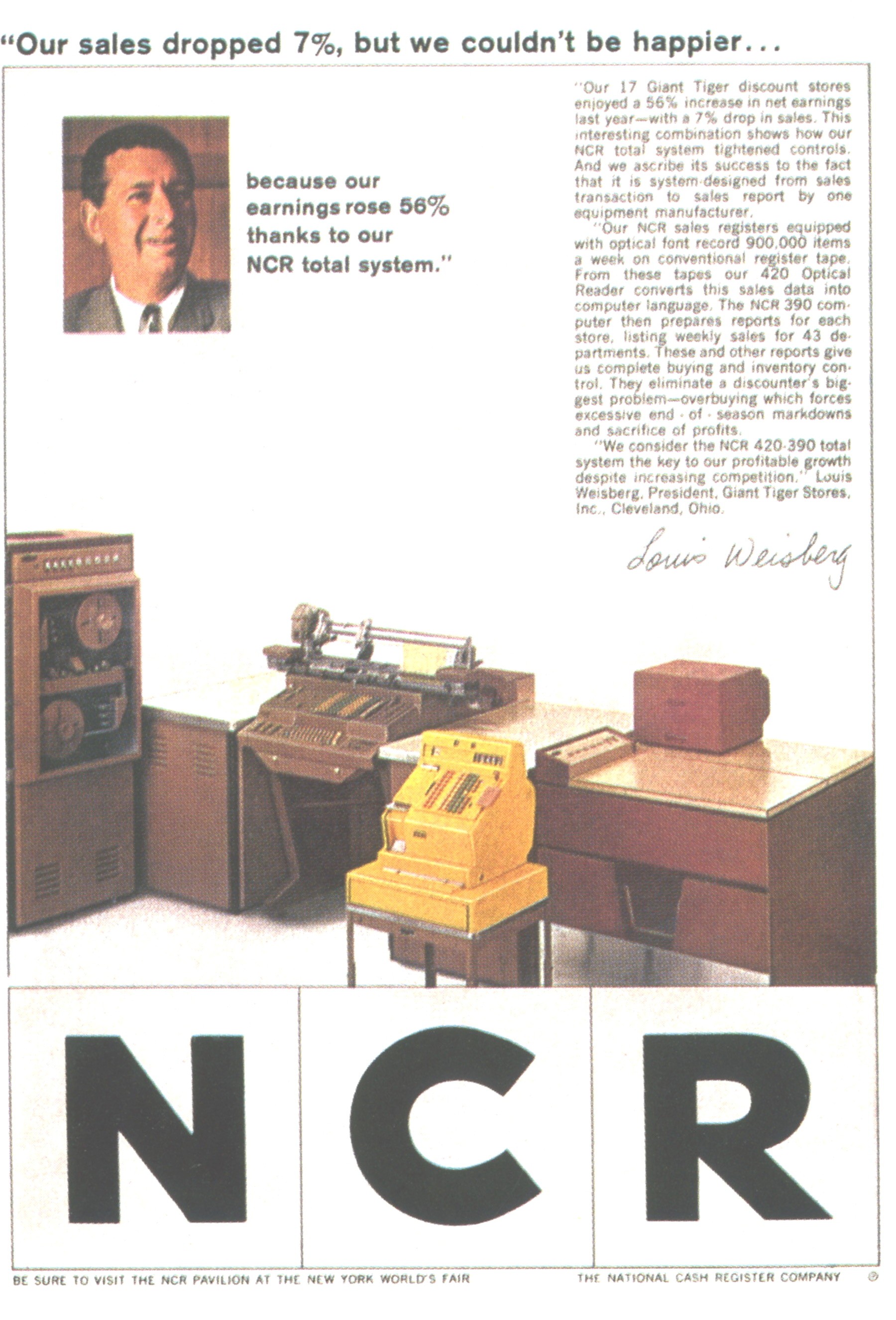
World exhibition in New York (USA)
click on picture for larger image
PCMI
Microform Systems is established.
The
NCR 615 Century series is introduced; the 5000th Century system was installed
in 1974.
It is the first low cost electronic data processing system to put programs, operating software and data on a hard disk.
MOS/LSI
circuitry for computer terminals is announced.
In
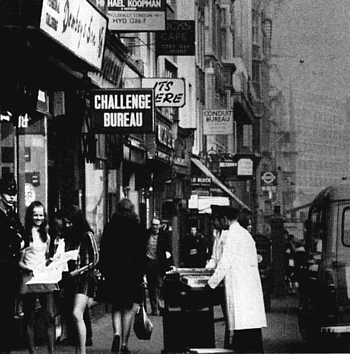
England NCR did a mega job by changing all cashiers from the 12 (duodecimal)
to the decimal monetary system.
The picture shows a converted accounting machine being delivered to a client. (see picture below the men in white coats)
Microelectronics
Division is established.
Encapsulation
technology is announced.
NCR
changes its logo
William
S. Anderson becomes president and will be named chief executive officer in 1973.
The
10-millionth machine, the NCR 280, is manufactured.
Anderson
becomes chairman of the board.
This
machine, NCR 299, is built in the NCR factories in Augsburg, Germany.
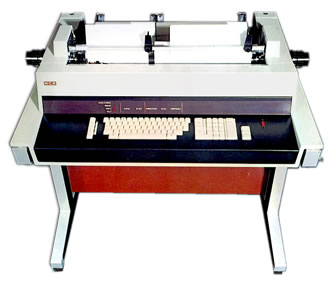
It has a selectric type of letter ball, a line width of 57 cm, a core memory of 8k for a stored program and 8k for data. A few machines in working order still exists, one at the computermuseum in the Hague Netherlands.
The
NCR company changes its name to NCR Corporation.
Charles
E. Exley, Jr., becomes president.
New
World Headquarters in Dayton is dedicated.
The
NCR Criterion series is announced.
NCR
acquires Data Pathing Inc. An important producer of data / factory entry and
processing systems.
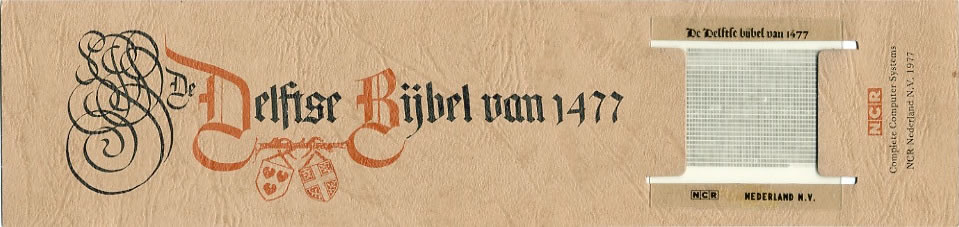
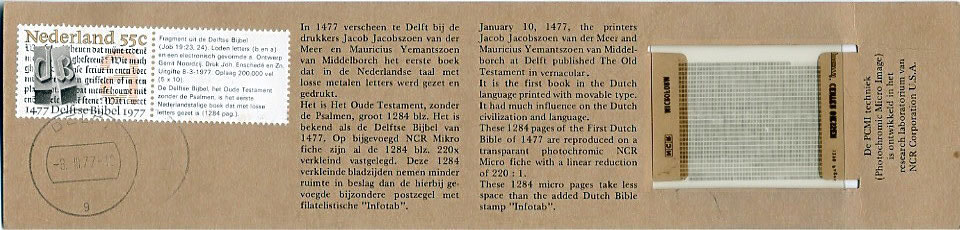
NCR
wanted to make a showcase example of their microfiche technology and put a
large part of the christian bible's old testament on one single microfiche.
This technology will play an important role in archiving and distribution of computer output on a low cost basis. The micro fiche technology will be in use until late in the 1990's, a long time for any technology.
NCR
acquires Quantor Corporation to gain computer output microfiche capabilities.
Quator is renamed to NCR Micrograhics System Division.
NCR
becomes the only computer system company with computer output to microfiches
NCR
acquires Comten, Inc., a leading force in data communications technology in
communicating with IBM computers.
This made NCR leading in data communication technology.
NCR
acquires Applied Digital Data Systems, Inc. (ADDS), a leading supplier of high-quality
video display computer terminals.
NCR
enters the word processing market with the WorkSaver product line.
An
OEM Systems Division is established and NCR's Microelectronics Division entered
the merchant market for semiconductors.
The
first NCR Tower super microcomputer system is launched.
This establishes NCR as a pioneer in bringing industry standards and open systems architecture to the computer market. The tower uses UNIX as the operating system
Charles
E. Exley, Jr. is named chief executive officer.
NCR's
first personal computer is released.
NCR
9300, the industry's first 32-bit VLSI mainframe, is released.
NCR
celebrates its 100th anniversary in the information processing systems industry.
Charles
E. Exley, Jr. becomes chairman and president when William S. Anderson retires.
A
Personal Computer Division is formed and several new, industry-compatible personal
computer models are introduced.
A
32-bit model is added to the UNIX®-based NCR TOWER family.
A
new generation of self-service automated teller machines is introduced.
Product
introductions include:
A
company-wide program make NCR people aware of the company's mission to "create
value for stakeholders."
Product
introductions include:
Gilbert
P. Williamson is named president and Charles E. Exley, Jr. assumes the title
of chairman and chief executive officer.
Product
introductions include:
NCR
announced its long-term product direction: Open, Cooperative Computing.
Product
introductions include:
American
Telephone & Telegraph Company announced plans to acquire NCR
NCR
is acquired by AT&T. Not without resistance by NCR itself.
AT&T and NCR sign a definitive merger agreement in May, and the merger completed on September 19.
Product
introductions include:
Charles
E. Exley retired and Gilbert P. Williamson assume the position of chairman and
chief executive officer. R. Elton White is named president.
Teradata
merge with AT&T on February 28 and is functionally integrated into NCR.
Groundbreaking
on a new development facility for massively parallel computing takes place in
San Diego.
NCR and AT&T recognize the one-year anniversary of a successful high-tech merger.
Democratic
National Convention delegates vote using NCR 7054 Integrated Touch Screen Systems.
Product
introductions include:
NCR Teradata becomes the world's most proven and powerful database for data
warehousing.
The
7054 ITS is discontinued.
The replacement is the Model 7450 terminal/workstation, which also accepts the Compris solution.
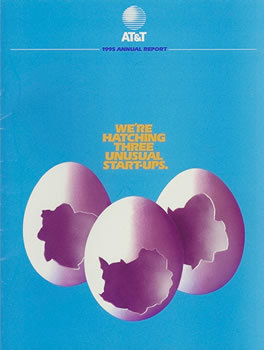
NCR
name changed to AT&T Global Information Solutions (GIS).
|
 |
December
31, AT&T GIS changed its name back to NCR Corporation in anticipation of
being spun-off to AT&T shareholders by January 1997, as an independent,
publicly-traded company.
NCR At A Glance
| Revenues: | $6.963 billion |
| Operating Income: | $75 million |
| Net Loss Per Share: | $1.07 |
| Research & Development Expenses: | $378 million |
| Weighted Average Shares Outstanding: | 101.4 million |
| Cash and Short-Term Investments: | $1.203 billion |
| Debt: | $76 million |
| U.S Revenues as % of Total Revenues: | 43.7 % |
| Stock Exchange Listing and Symbol: New York Stock Exchange, | 'NCR' |
| Number of Employees: | 38,600 |
| Number of Shareholders: | 2.5 million |
| Locations: | 1,100 offices |
| development and manufacturing | 30 development and manufacturing facilities in 130 countries throughout the Americas, Europe, Middle East, Africa, Asia and Pacific regions |
| Markets | Top International Markets: Japan, United Kingdom, Germany, France, and
Switzerland |
| Prime customers | Wal-Mart, JC Penney, Chase Manhattan Bank, NatWest, Canadian Imperial Bank of Commerce, USWest, AT&T, Southern New England Telephone, Reuters, BP Oil Europe, Qantas Airways |
| Revenues By Product Line: | Retail Products: $428 million Financial Products: $1.007 billion Computer Products: $1.398 billion PC/Entry Level Server Products: $503 million Systemedia Products: $551 million Customer Support Services: $2.238 billion Professional Services: $616 million Data Services: $123 million Other: $99 million Total Revenues: $6.963 billion |
Signaling
its evolution from a hardware-only company to a full solutions provider.
NCR purchases Compris Technologies, Inc., a leading provider of store automation and management software for the food-service industry, and purchases Dataworks, a company that develops check-processing software. (Dayton Business Journal - November 12, 1997)
NCR
buys Dataworks Inc. in a move to grow its global imaging and item processing
business.
Dataworks is a financial software developer. Dataworks, a privately held company in San Antonio - Texas, develops image, information storage, retrieval and archiving software for the financial industry. Dataworks' products are used by more than 1,000 customers throughout the United States and in 15 major international markets. It employs 60 persons in the United States.
NCR
finalized the transfer and sale of their computer hardware manufacturing assets
to Solectron, confirming NCR's commitment to concentrate on the market-differentiated
software and services components of their solutions portfolios.
NCR
sold its TOP END middle ware software to BEA Systems in a move to expand NCR's
application software offerings while moving away from horizontal general purpose
computer software. (4)
NCR
purchased 50 percent of Stirling Douglas Group, Inc. (SDG), a privately-held
software firm and leading provider of merchandise management applications.
Leading
e-businesses such as Travelocity.com, E*Trade and Microstrategy implemented
NCR's Teradata warehouse solutions as the foundation of their sophisticated
customer-focused offerings and marketing initiatives. (4)
Division's
main Scottish facility is in Dundee, where the company designs, develops, manufactures
and markets state-of-the-art self-service solutions.
NCR has a tradition of industry knowledge and expertise, and world-leading hardware technology. Self-service is no longer confined to the dispensing of cash, but ranges from cheque imaging to e-commerce and beyond into m-commerce. On the leading edge of technology, are our machines with personality, which can recognise customers from the unique pattern of the iris and respond to transaction requests by speech recognition and synthesis.NCR Corporation is a $7 billion global market leader active in 130 countries, and we're furthering our commitment in Scotland with a new R&D facility in Dundee, opening in 2001. (1)
International
NCR acquires CRM provider Ceres Integrated Solutions and services company 4Front Technologies, deepening NCR's solutions offerings in key markets for CRM.
Mark
Hurd appointed CEO of NCR.
|

|
Last Updated on July 16, 2006 | For suggestions please mail the editors |
Footnotes & References