|
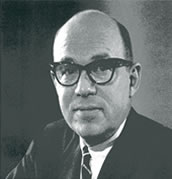
Robert S. Oelman
principal papers
hardware
software
see also
related subjects
keywords
NCR |
Achievement
The fifth president from 1962 till 1974
Biography
Robert Schantz succeeded Stanley C. Allyn and grew up
within the shadow of The National Cash Register Company. His grandfather,
Adam Schantz Jr was a major owner of land just south of the NCR Dayton
complex.
Both Schantz and John H. Patterson founding the suburban city of Oakwood
adjacent to Dayton.
A very young Bob Oelman participated in the NCR boy’s garden
project, and occasionally
caught sight of Patterson inspecting the plots southeast of Building
10.
Oelman also played violin in the Patterson School orchestra. When
the group performed at the NCR Schoolhouse, he recalled, “After
the performance Mr. Patterson came up and shook my hand, and sinds
I was leader, gave me two brand new dollar bills for each member of
the orchestra”
His family ties and boyhood contacts with NCR’s founder, however,
did not guarantee Oelman’s future success at NCR.
He graduated from Dartmouth College and studied economics and international
law at the University of Vienna before joining NCR’s overseas
department in 1933.
As Allyn recalled, “His (Oelman’s) work began to impress
Colonel Deeds and me in 1942”
At the time Oelman worked in Domestic Advertising. However, it was
discovered that one of his former Dartmouth professors was in charge
of office equipment production controls for the federal government.
Oelman therefore became Allyn’s assistant and NCR’s representative
to Washington through the war years.
He met with Allyn and Deeds on many Saturday and Sunday mornings to
report his progress and plan strategy. Allyn mentioned “He sorted
out the tangled mazes of wartime agencies with the pose of a veteran”
Oeleman was named assistant vice president in 1945, vice president
in 1946, and executive vice president in 1950.
Through those years, he understudied Allyn and became immersed in
all areas of the business, accompanying Allyn around the globe to
review NCR operations.
Allyn believed in training “a new management generation”
much as Colonel Deeds had trained his generation. Allyn proceeded
to introduce Oelman to world leaders and many others.
NCR’s worldwide stature and Allyn’s work with UNESCO and
the Economic Commission for Europe exposed the company’s executives
to the level of acquaintanship. Allyn praised Oelman’s distinctly
personality and political astuteness” as fitting him to lead
the company in the future.
Oelman became president in 1957 when Allyn was named to succeed Colonel
Deeds as chairman. NCR has introduced the previous year the first
electronic electronic accounting machine the Post-Tronic. And the
company was about to introduce the industry’s first all-solid
–state business computer.
In addition to approving NCR’s extensive data processing developments
in the late 1950’s and trough the 1960’s, from the NCR
304 to the Century Series Computers.
Oelman launched what would become the highly successful research microelectronics
at NCR in the early 1960’s Under his leadership NCR also established
data processing centers around the world. By the time he retired in
1974 at age 65 NCR’s worldwide sales had reached the $2-billion
level, compared with $383 million the year he became president.
Oelman devoted 41 years to the NCR also gained international recognition
for his work as officer and / or director on many civic and company
boards. Among many honors he was chosen; along with 20 other corporate
leaders, to meet European head of state in tour sponsored by Time
Live Inc.
Chronology
Honors and awards
Bibliography
|


