Achievement
Headed World War I aviation program.
3rd President of NCR 1931 till 1957
Co-inventor of the automobile self-starter with Charles F. Kettering.
Biography
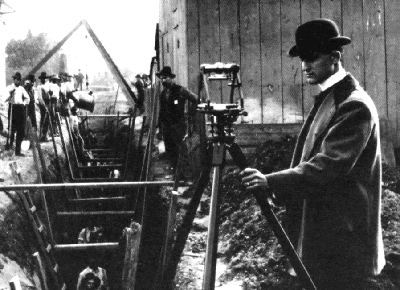
Deeds during a survey at NCR construction site at
Stewart St. ca. 1900
Edwards A. Deeds graduated in 1897 from the Denison University in
Grandville Ohio. He came to Dayton as draftsman for the Thresher Company.
This company was based in the Callahan Power Building where NCR in
1884 started their activities. Deeds occupies himself with designing
and installing motors in Dayton, Washington, Waterbury (Connecticut)
and in Cincinnati at a salary of $12 monthly.
In 1899 Frank Patterson, John Henry Patterson brother offered him
a salary of $30 a month to strengthen the NCR team. He accepted the
offer, and started to complete the electrification for the NCR factories
and builds the first electrical power plant. At the age of 24 he drew
the attention of John Patterson through an incident that almost got
him fired. Deeds discovered a dangerously weak construction in one
of the chimneys and convinced Frank to let him repair it. But he did
not wait for permission and started to break down the chimney. The
same night a storm damaged the pipe and it fell down on the power
plant's kettle house causing a lot of damage. But Deeds was not defeated
and worked the entire night and production continued the next day
as if nothing happened.
John Patterson was so impressed that he did not fire Deeds for this
one man action. Deeds also impressed Henry Perky, the developer of
health food, who was visiting NCR. Perky proposed Deeds to help him
to set up the Shredded Wheat Factory in Niagra Fall close to New York.
Deeds accepted this new challenge and became chief constructor. He
saved this company also by getting a re-finance from New York bankers
when Perky almost went bankrupt.
This was his first success in developing and financing such projects.
John Patterson recalled Deeds to NCR in 1903 and appointed him as
general assistant manager responsible for development and construction.
Deeds stayed 12 years at NCR. During this time he engaged Charles
F. Kettering a graduate from Ohio State University to use his expertise
to power the cashiers by an electric motor. Deeds himself had already
done some prototyping to prove that it could be done. In three years
time Kettering came up with a working production ripe model.
Deeds and Kettering worked day and night when working on something
that kept great promises for the future. Kettering left NCR in 1908
and went to work with William S. Chryst, a NCR colleague, in a workshop
of Deeds to make electric starters for cars. When Harry Leland of
the Cadillac Company ordered 5000 ignition sets Dayton Engineering
Laboratories Company ”Delco” was founded.
Colonel Deeds left NCR in 1915 to devote himself fully to the success
of this new company, but still was committed to NCR's expansion.
In 1910 Deeds was appointed vice president and executed many new projects.
He also made plans to found another Dayton type factory in Berlin
and kept his role as mentor for the company.
After the flooding in 1913 Deeds became vice president of the Inundation
Prevention Committee and was responsible for the Miami Conservancy
Project which constructed a series of dams that should keep Dayton
free of flooding's. The project was successfully concluded in 1922.
Deeds got the title “colonel” because he served in WW
I in the American Army, and through his activities Dayton became the
center of aviation. He founded the Wright Airplane Company together
with Orvile Wright, Charles Kettering and H.E. Talbott ( who was the
son of designer Talbott whom designed the bridge on Daytons main street)
Deeds coordinated and supervised the delivery of military airplanes
to the government in 1917. He also was the first person to have a
private landing strip at his home in Moraine Farm.
Deeds returned to NCR in 1931 because he felt himself very much committed
to the company. His power to inspire people led NCR to great heights
the next 26 years. In 1957 he stepped down as president and was a
beloved figure in the company, as well as one of the greatest inventors
of the 20th century
Chronology
Honors and awards
Bibliography
|


