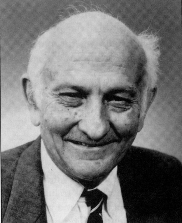
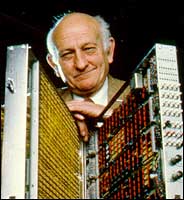
John Cocke
|
hardware
software
keywords
|
Achievement Chief designer for the RISC chip architecture at IBM
Biography Born on May 30, 1925, Mr. Cocke was raised in Charlotte, N.C. His father, Norman Cocke, was the president of the Duke Power Company and a trustee of Duke University. John Cocke's curiosity, which would prove so valuable later in his life, was evident early. As an adult, Mr. Cocke once recalled that when he was given his first bicycle at the age of 6, he dismantled it within a few hours, much to the chagrin of his mother, Mary. Mr. Cocke joined I.B.M.'s research labs in 1956 after he received a doctorate in mathematics from Duke, and he remained with the company until he retired. Mr. Cocke (rhymes with "sock") was the principal designer
of the type of microprocessor that serves as the engine of most of
today's large, powerful computers and the Apple Macintosh personal
computers. Machines using his chip design — a simplification
of the hardware, which opened the door to faster computation —
are reduced instruction-set computers, or RISC.
Throughout his long career as a researcher for I.B.M., Mr. Cocke was also responsible for a host of other innovations. He was a leader in the arcane but vital field of designing more efficient software compilers — the software that translates instructions written in a programming language understood by human programmers into the vernacular of all computers, the 1's and 0's of digital code. Mr. Cocke also came up with ideas that helped advance fields as diverse as speech-recognition technology and data storage. In computer science circles, Mr. Cocke was renowned for the breadth of his intellect, his energy, his insights and his unconventional working methods. A former colleague, Paul M. Horn, who had joined I.B.M.'s research labs after a career as a physics professor at the University of Chicago, recalled that when he worked on weekends, Mr. Cocke was invariably in the labs. The senior researcher, Mr. Horn recalled, would drop by and engage the newcomer in long discussions of the finer points of unification theory in physics. "John Cocke knew as much about high-energy physics as I did, and it wasn't even his field," said Mr. Horn, who is the director of I.B.M.'s research division. Even after he retired in 1992, Mr. Cocke always displayed "a wonderful childlike curiosity — he was interested in everything," recalled R. Andrew Heller, who collaborated with Mr. Cocke on the RISC technology, beginning in the late 1960's. The RISC chip design, experts say, was a striking example of Mr. Cocke's defining attribute. His deep understanding of both the computer hardware and software, and their interaction, often enabled Mr. Cocke to pierce through the complexity of computer problems with fresh insights.
The "Father" of RISC architecture Among his many achievements, he was named IBM Fellow, the company's highest technical honor, in 1972, he also won National Medal of Technology, the Turing award and was awarded the National Medal of Science in 1991 by President Bush. Over his lifetime as a scientist, he made unique and creative contributions to information technology through his innovative developments in high performance system design. His expertise in achieving high performance for a broad range of scientific applications led to remarkable advances in compiler design and machine architecture that culminated in his invention of the Reduced Instruction Set Computer (RISC) --- which profoundly affected the broad field of information technology. RISC is the basis for a Unix systems market that last year was $22.3 billion, according to industry analyst group, IDC. "His tenure at IBM spanned an amazing time, 1956 to 1992," said Peter Capek, John's colleague at IBM and close friend. "His career was unusual in its breadth. He was known for his work in computer architecture, but he was interested in everything -- circuits, storage, compilers -- any technology that could advance the state of the art." John is a founder and key innovator of the technology of compiler optimization, now used systematically throughout the computer industry to enable computers programmed in higher level languages such as FORTRAN, C, PASCAL and others to reach levels of efficiency comparable to -- and in some cases exceeding -- the levels of efficiency reachable by much more expensive and time-consuming programming techniques closer to the machine's instruction set.
Within I.B.M., Mr. Cocke's eccentric ways were legend, especially his periodic disregard for paychecks and stock certificates. His assistants, colleagues say, routinely combed through his trash to make sure he had not inadvertently discarded things of value. Before he was married in 1989 to Anne Holloway, Mr. Cocke, a longtime bachelor, would often wear the same clothes for a week or so, friends say. John Cocke, a leading computer scientist whose inventions spanned an uncommon range of computing technology from software to microprocessors, died on Tuesday at a hospital in Valhalla, N.Y. He was 77. The cause was a long illness, including a series of strokes, said his nephew Norman Cocke. Mr. Cocke is survived by his wife, three nephews and a niece. Mr. Cocke rarely published research papers, but that did little to
prevent him from gaining widespread recognition in the field. Chronology 1956 doctorate in mathematics from Duke 1956 - 1992 Researcher at IBM 1989 Married to Anne Holloway 1992 Retirement
Honors and awards 1994 National Medal of Science
|

|
Last Updated on July 7, 2004 | For suggestions please mail the editors |
Footnotes & References
| 1 | source:http://www.nytimes.com/2002/07/19/obituaries/19COCK.html By STEVE LOHR |
| 2 | http://www.research.ibm.com/resources/news/20020717_cocke.shtml |